
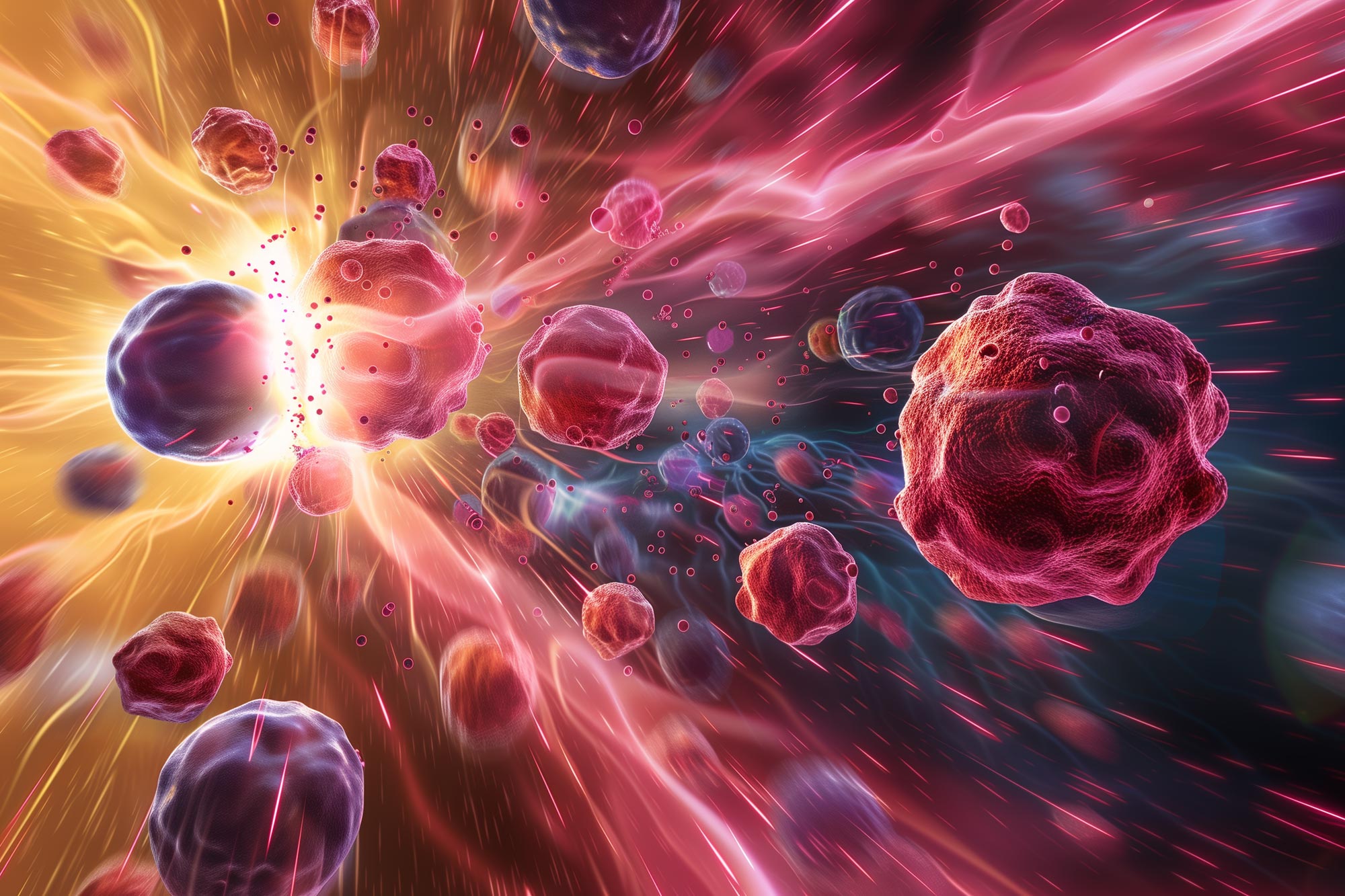
Innovative cancer treatment from Caltech utilizes ultrasound-activated drugs for targeted therapy, reducing side effects and improving effectiveness.
Chemotherapy as a treatment for cancer is one of the major medical success stories of the 20th century, but it’s far from perfect. Anyone who has been through chemotherapy or who has had a friend or loved one go through it will be familiar with its many side effects: hair loss, nausea, weakened immune system, and even infertility and nerve damage.
This is because chemotherapy drugs are toxic. They’re meant to kill cancer cells by poisoning them, but since cancer cells derive from healthy cells and are substantially similar to them, it is difficult to create a drug that kills them without also harming healthy tissue.
Breakthrough in Targeted Drug-Delivery
But now a pair of Caltech research teams have created an entirely new kind of drug-delivery system, one that they say may finally give doctors the ability to treat cancer in a more targeted way. The system employs drugs that are activated by ultrasound—and only right where they are needed in the body.
The system was developed in the labs of Maxwell Robb, assistant professor of chemistry, and Mikhail Shapiro, Max Delbrück Professor of Chemical Engineering and Medical Engineering and Howard Hughes Medical Institute investigator. In a paper published in the journal Proceedings of the National Academy of Sciences, the researchers show how they combined elements from each of their specialties to create the platform.
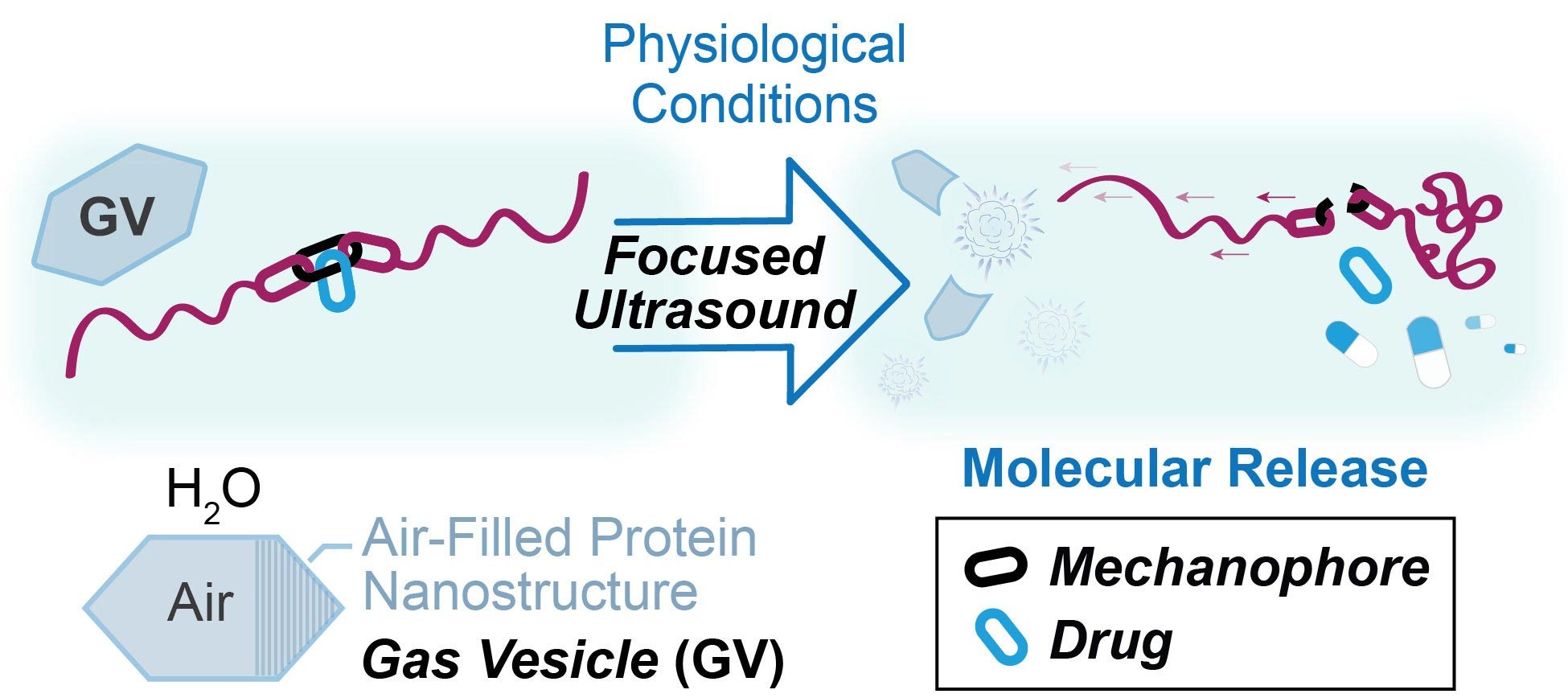
Working collaboratively, the two research teams married gas vesicles (air-filled capsules of protein found in some bacteria) and mechanophores (molecules that undergo a chemical change when subjected to physical force). Shapiro’s lab has previously used gas vesicles in conjunction with ultrasound to image individual cells and precisely move cells around. Robb’s lab, for its part, has created mechanophores that change color when stretched, making them useful for detecting strain in structures, and other mechanophores that can release a smaller molecule, including a drug, in response to a mechanical stimulus. For the new work, they devised a way to use ultrasound waves as that stimulus.
Ultrasound-Activated Mechanophores
“We’ve been thinking about this for a really long time,” Robb says. “It started when I first came to Caltech and Mikhail and I started having conversations about the mechanical effects of ultrasound.”
As they began researching the combination of mechanophores and ultrasound, they discovered a problem: Ultrasound could activate the mechanophores, but only at an intensity so strong that it also damaged neighboring tissues. What the researchers needed was a way to focus the energy of the ultrasound right where they wanted it. It turned out that Shapiro’s gas vesicle technology provided the solution.
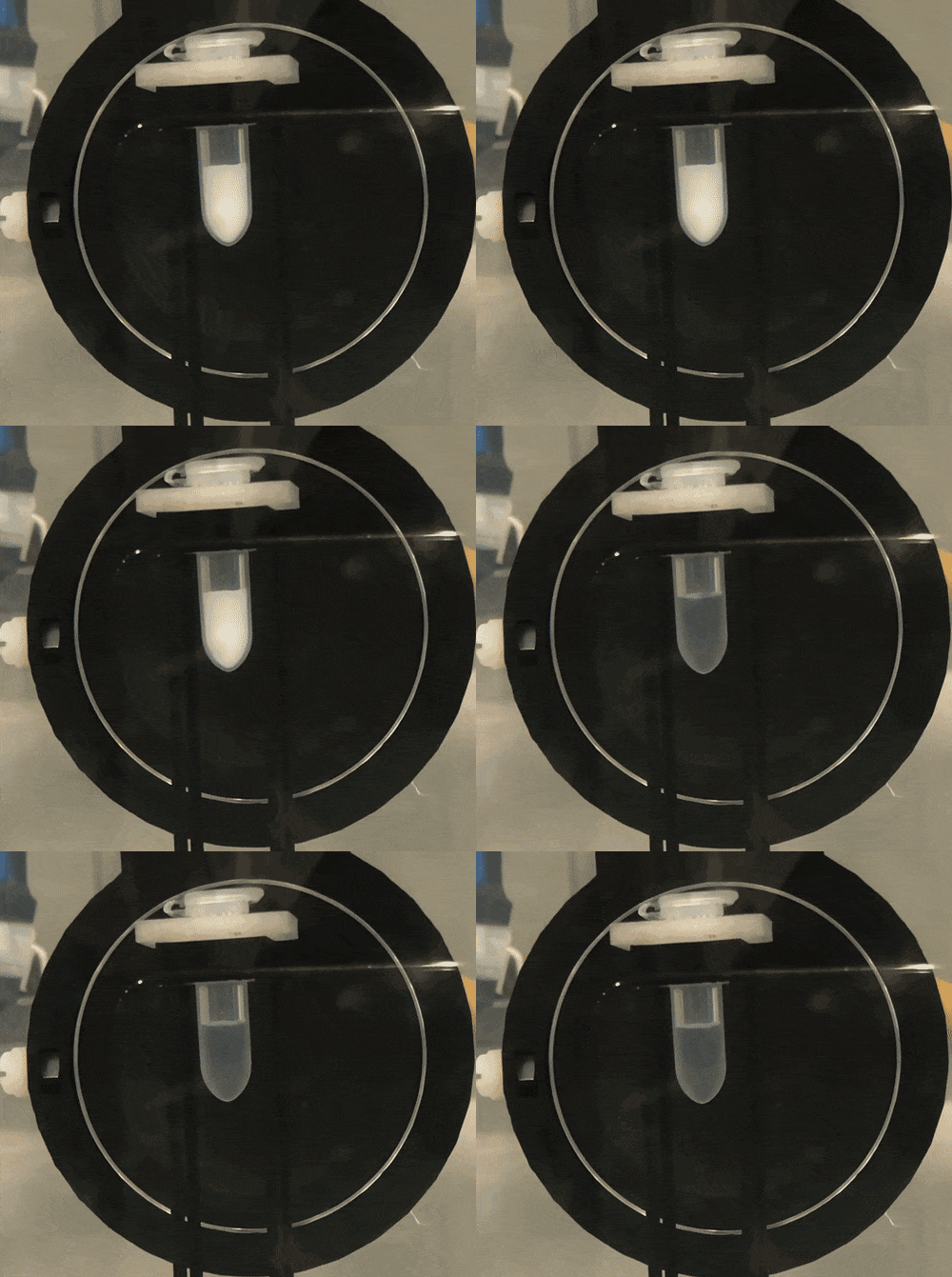
In his previous work, Shapiro made use of the vesicles’ tendency to vibrate or “ring” like a bell when bombarded with ultrasound waves. In the current research, however, the vesicles are rung so hard that they break, which focuses the ultrasound energy. The vesicles effectively become tiny bombs whose explosions activate the mechanophore.
“Applying force through ultrasound usually relies on very intense conditions that trigger the implosion of tiny dissolved gas bubbles,” says Molly McFadden (PhD ’23), study co-author. “Their collapse is the source of mechanical force that activates the mechanophore. The vesicles have heightened sensitivity to ultrasound. Using them, we found the same mechanophore activation can be achieved under much weaker ultrasound.”
Future Potential and Implications
Yuxing Yao, a postdoctoral scholar research associate in Shapiro’s lab, says this is the first time that focused ultrasound has been able to control a specific chemical reaction in a biological setting.
“Previously ultrasound has been used to disrupt things or move things,” Yao says. “But now it’s opening this new path for us using mechanochemistry.”
So far, the platform has only been tested under controlled laboratory conditions, but in the future, the researchers plan to test it in living organisms.
Reference: “Remote control of mechanochemical reactions under physiological conditions using biocompatible focused ultrasound” by Yuxing Yao, Molly E. McFadden, Stella M. Luo, Ross W. Barber, Elin Kang, Avinoam Bar-Zion, Cameron A. B. Smith, Zhiyang Jin, Mark Legendre, Bill Ling, Dina Malounda, Andrea Torres, Tiba Hamza, Chelsea E. R. Edwards, Mikhail G. Shapiro and Maxwell J. Robb, 19 September 2023, Proceedings of the National Academy of Sciences.
DOI: 10.1073/pnas.2309822120
Additional co-authors are chemistry graduate student Stella M. Luo and Ross W. Barber (PhD ’23); Elin Kang (BS ’23); Avinoam Bar-Zion, formerly of Caltech and now with Technion-Israel Institute of Technology; Cameron A. B. Smith, postdoctoral scholar fellowship trainee in chemical engineering; medical engineering graduate student Zhiyang Jin (MS ’18); chemical engineering graduate student Mark Legendre; Bill Ling (PhD ’23), postdoctoral scholar research associate in chemical Engineering; Dina Malounda of the Howard Hughes Medical Institute; Caltech undergraduate students Andrea Torres and Tiba Hamza; and Chelsea E. R. Edwards, formerly of Caltech, now at UC Santa Barbara.
Funding for the research was provided by Arnold and Mabel Beckman Foundation, the David and Lucile Packard Foundation, the Resnick Sustainability Institute, the Institute for
Collaborative Biotechnologies, and the National Institute of General Medical Sciences of the National Institutes of Health.
Mikhail Shapiro is an affiliated faculty member of the Tianqiao and Chrissy Chen Institute for Neuroscience.
Never miss a breakthrough: Join the SciTechDaily newsletter.
Follow us on Google and Google News.