
Close Menu
    Facebook X (Twitter) Instagram
    SciTechDaily
    • Biology
    • Chemistry
    • Earth
    • Health
    • Physics
    • Science
    • Space
    • Technology
    Facebook X (Twitter) Pinterest YouTube RSS
    SciTechDaily
    Home»Earth»Huacachina: The Only Natural Oasis in South America
    Earth

    Huacachina: The Only Natural Oasis in South America

    By Kasha Patel, NASA Earth ObservatoryDecember 27, 20204 Comments3 Mins Read
    Facebook Twitter Pinterest Telegram LinkedIn WhatsApp Email Reddit
    Share
    Facebook Twitter LinkedIn Pinterest Telegram Email Reddit
    Huacachina Annotated
    Landsat 8 captured this image of Huacachina and the adjacent sand dunes. Huacachina is located in southwestern Peru on the edge of the Atacama desert. (Click image for wide, high-resolution image.)

    If you accidentally stumbled upon the town of Huacachina, you might think it is a mirage. Huacachina is centered around a lagoon lined with lush vegetation—all located in the driest desert in the world. Snuggled between the biggest sand dunes in South America, it is the only natural oasis on the continent.

    On August 15, 2020, the Operational Land Imager (OLI) on Landsat 8 captured this image of Huacachina and the adjacent sand dunes. Huacachina is located in southwestern Peru on the edge of the Atacama desert. The town is located about 5 kilometers (3 miles) from the city of Ica.

    Roughly translating to “weeping woman” in Quechua, Huacachina has several mythological origin stories. One legends says a beautiful Incan princess named Huacachina was mourning the loss of her lover, and her tears created the lagoon. One day, a warrior saw her and startled the princess, who ran into the water to hide for hours. When she tried to leave, she had transformed into a mermaid. Another version says the princess was holding a mirror and admiring herself when the warrior saw her. When she ran away startled, the mirror fell and shattered. The glass became the tiny pool in the desert and consumed the princess, turning her into a mermaid. Many legends say Huacachina still lives in the pool and comes out at night to tempt swimmers.
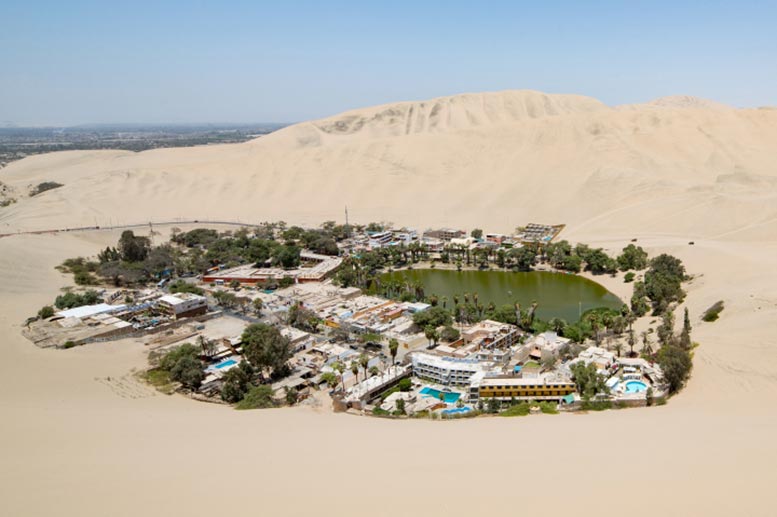
    Huacachina Oasis

    The oasis is actually formed by water from underground aquifers that seeps through the sand and helps promote the growth of palm trees, eucalyptus, and carob trees around the pool. The lagoon, which only covers about 2 acres, is encircled by businesses, hotels, and restaurants on its rim. The oasis town has a population of around 100 year-round residents. In recent years, water levels in the lagoon have decreased due to the drilling of nearby wells and increased evaporation during the hot summers. Consequently, the town has been feeding water into the lagoon from outside sources.

    Located about a five-hour bus ride from Lima, Huacachina has served as a popular tourist destination for more than 70 years. The town entertained many of Peru’s financial elite in the 1940s, and today entertains tens of thousands of tourists per year. Once called the “oasis of America,” Huacachina was featured on the 50 Nueva Sol currency note until 2006.

    The soaring sand dunes beyond the oasis rise several hundred feet in elevation—as tall as small mountains. They provide excellent sandboarding adventures: Adrenaline junkies can slide down the dunes like tubers or snowboarders. Visitors can also ride dune buggies across the dunes or hike, although the sand makes hiking strenuous.

    NASA Earth Observatory image by Lauren Dauphin, using Landsat data from the U.S. Geological Survey. Photograph by Havardtl and used under the Creative Commons Attribution 4.0 International license.

    Never miss a breakthrough: Join the SciTechDaily newsletter.
    Follow us on Google and Google News.

    Geography NASA NASA Earth Observatory Popular
    Share. Facebook Twitter Pinterest LinkedIn Email Reddit

    Related Articles

    Modern Oasis of Jubbah: A Long-Ago Lake Amid the Dunes

    From Russia With Questions: Distinctive Striping Pattern in Siberia Puzzles Researchers

    A Geologist’s Dream: A Short Journey to the Center of the Earth

    Spied by Satellite: Phytoplankton Factory in the Argentine Sea

    Elephant Island: The Incredible Survival Story of Ernest Shackleton and the Crew of HMS Endurance

    Robinson Crusoe Island Captured by Landsat 8 Satellite

    NASA Picturing Earth: Astronaut Photography In Focus [Video]

    NASA Scientists Map Beirut Blast Damage – Devastating Explosion Rocked Port Area

    NASA Advanced Rapid Imaging Satellite Maps Blast Damage: Beirut Explosion Aftermath

    4 Comments

    1. Luis Fuentes on December 27, 2020 11:28 am

      Fantástica

      Reply
    2. Claudio on December 27, 2020 6:46 pm

      Atacama desert? That is in Chile. Huacachani is located in PERU in the departament of ICA. If you are going to write something interesting get your facts straight

      Reply
      • Victor Walker on December 27, 2020 9:32 pm

        Before commenting you might want to try Google to get your facts straight. You would find:
        The National Geographic Society considers the coastal area of southern Peru to be part of the Atacama Desert and includes the deserts south of the Ica Region in Peru.

        i.e. The Atacama Desert extends into Peru, not just Chile.

        Reply
    3. Crystyna on December 30, 2020 5:57 pm

      Nothing left to say I see Claudio

      Reply
    Leave A Reply Cancel Reply

    • Facebook
    • Twitter
    • Pinterest
    • YouTube

    Don't Miss a Discovery

    Subscribe for the Latest in Science & Tech!

    Trending News

    New Study Reveals Why Ozempic Works Better for Some People Than Others

    Climate Change Is Altering a Key Greenhouse Gas in a Way Scientists Didn’t Expect

    New Study Suggests Gravitational Waves May Have Created Dark Matter

    Scientists Discover Why the Brain Gets Stuck in Schizophrenia

    Scientists Engineer “Tumor-Eating” Bacteria That Devour Cancer From Within

    Even “Failed” Diets May Deliver Long-Term Health Gains, Study Finds

    NIH Scientists Discover Powerful New Opioid That Relieves Pain Without Dangerous Side Effects

    Collapsing Plasma May Hold the Key to Cosmic Magnetism

    Follow SciTechDaily
    • Facebook
    • Twitter
    • YouTube
    • Pinterest
    • Newsletter
    • RSS
    SciTech News
    • Biology News
    • Chemistry News
    • Earth News
    • Health News
    • Physics News
    • Science News
    • Space News
    • Technology News
    Recent Posts
    • Is AI Really Just a Tool? It Could Be Altering How You See Reality
    • JWST Reveals a “Forbidden” Planet With a Baffling Composition
    • New Research Challenges 30-Year-Old Theory of Eye Development
    • The Protein “Sabotaging” Aging Muscle Recovery Could Be Key to Surviving Aging
    • This Diet–Gut Interaction Could Transform Fat Into a Calorie-Burning Machine
    Copyright © 1998 - 2026 SciTechDaily. All Rights Reserved.
    • Science News
    • About
    • Contact
    • Editorial Board
    • Privacy Policy
    • Terms of Use

    Type above and press Enter to search. Press Esc to cancel.