
Close Menu
    Facebook X (Twitter) Instagram
    SciTechDaily
    • Biology
    • Chemistry
    • Earth
    • Health
    • Physics
    • Science
    • Space
    • Technology
    Facebook X (Twitter) Pinterest YouTube RSS
    SciTechDaily
    Home»Earth»Huge Chunk of Ice Breaks Off Giant Iceberg As It Drifts Alarmingly Close to South Georgia
    Earth

    Huge Chunk of Ice Breaks Off Giant Iceberg As It Drifts Alarmingly Close to South Georgia

    By European Space Agency (ESA)December 21, 2020No Comments4 Mins Read
    Facebook Twitter Pinterest Telegram LinkedIn WhatsApp Email Reddit
    Share
    Facebook Twitter LinkedIn Pinterest Telegram Email Reddit
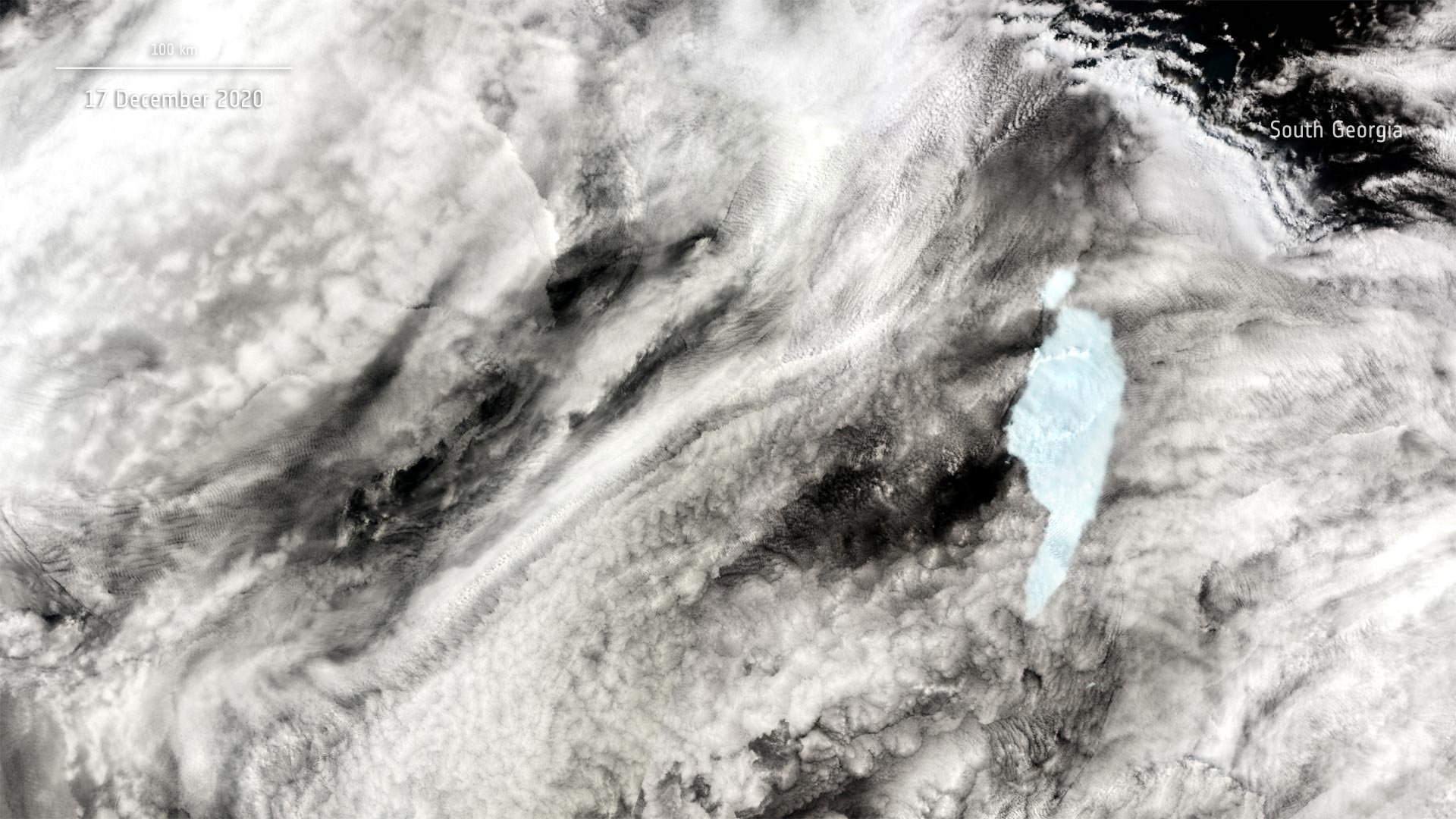
    A 68A Iceberg Loses Chunk of Ice
    New images captured by the Copernicus Sentinel-3 mission revealed that the A-68A iceberg has spun around in a clockwise direction, moving one end of the berg closer to the shelf and into shallow waters. In doing so, the berg could have scraped the seafloor, measuring less than 200 m deep, causing an enormous block of ice to snap off the iceberg’s upper tip. Credit: Contains modified Copernicus Sentinel data (2020), processed by ESA, CC BY-SA 3.0 IGO

    A large block of ice has broken off the northern tip of the A-68A iceberg as seen in new images captured by the Copernicus Sentinel-3 mission.

    Satellite missions have been used to track the A-68A berg on its journey since 2017, when it broke off the Larsen C ice shelf in Antarctica. Over the past weeks, the A-68A iceberg has drifted alarmingly close to the remote island of South Georgia, where scientists feared that the iceberg could ground in the shallow waters offshore and threaten wildlife.
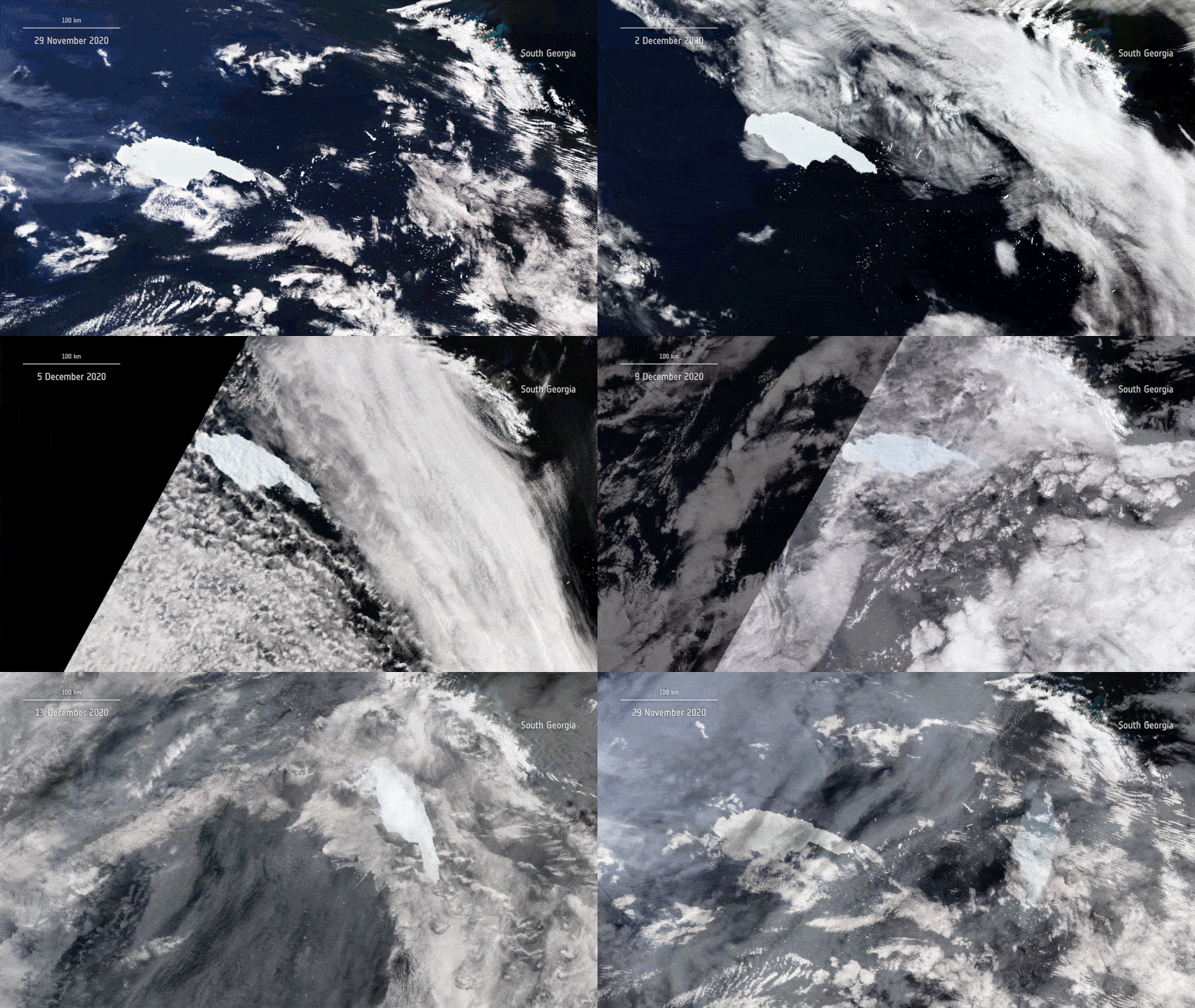
    A 68A Iceberg Loses Chunk
    A large block of ice has broken off the upper tip of the A-68A iceberg as seen by images captured by the Copernicus Sentinel-3 mission. This could be due to the interaction of the berg with the shallow seabed. Credit: Contains modified Copernicus Sentinel data (2020), processed by ESA, CC BY-SA 3.0 IGO

    New satellite images revealed yesterday that the iceberg has spun around in a clockwise direction, moving one end of the berg closer to the shelf and into shallow waters. In doing so, the berg could have scraped the seafloor, measuring less than 200 m (660 ft) deep, causing an enormous block of ice to snap off the iceberg’s northern tip.

    The new chunk of ice is around 18 km (11 mi) long and approximately 140 sq km (54 sq mi), around the same size as Seville, Spain, and can be seen detached from the main A-68A iceberg in the images. Despite its small appearance in the images, the new piece of ice is so large it will most likely be named A-68D by the US National Ice Centre in the coming days. Two other chunks of ice that previously broke off were named A-68B and A-68C.
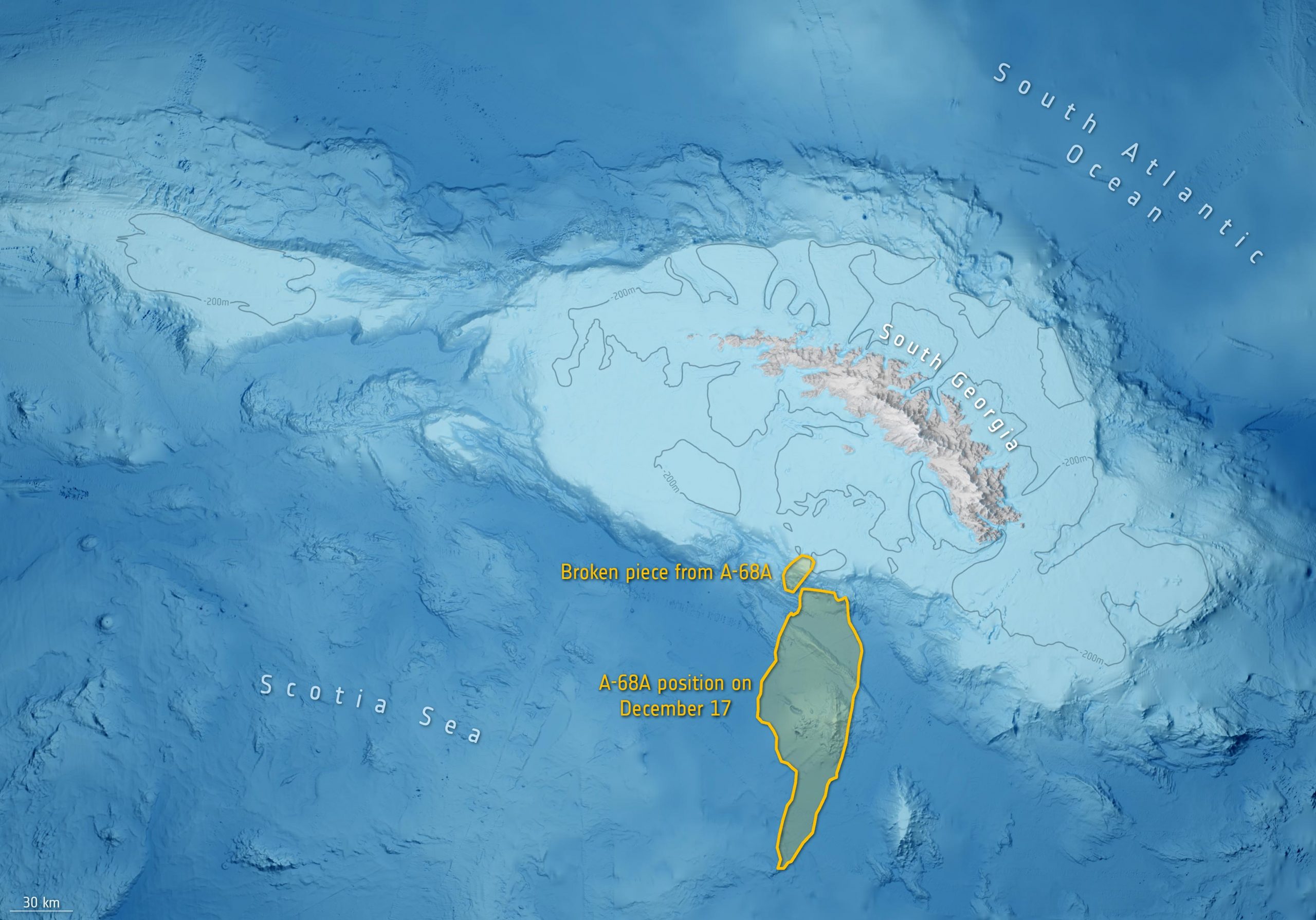
    Iceberg A 68A Position December 17 2020
    A-68A’s position on December 17, 2020. Credit: British Antarctic Survey/ESA

    The main A-68A iceberg is now approximately 3,700 sq km (1,430 sq mi) with a length of around 135 km (84 mi). Having lost many other pieces of ice over the past weeks, A-68A has now lost its title as the world’s largest iceberg. First place now passes onto the A-23A iceberg, which is currently stuck in the Weddell Sea, with a size of almost 4,000 sq km (1,540 sq mi).

    It is still unclear where the main A-68A iceberg will now travel. Carried by currents, it could continue its journey around the island of South Georgia as many other previous icebergs have done in the past, moving in a southeast direction, before turning north.

    The map below shows the different positions of the berg over the course of its three-year journey. The map highlights that during its first two years of freedom A-68 drifted slowly, impeded by sea ice. But as it moved in relatively open waters, the pace of the iceberg increased.
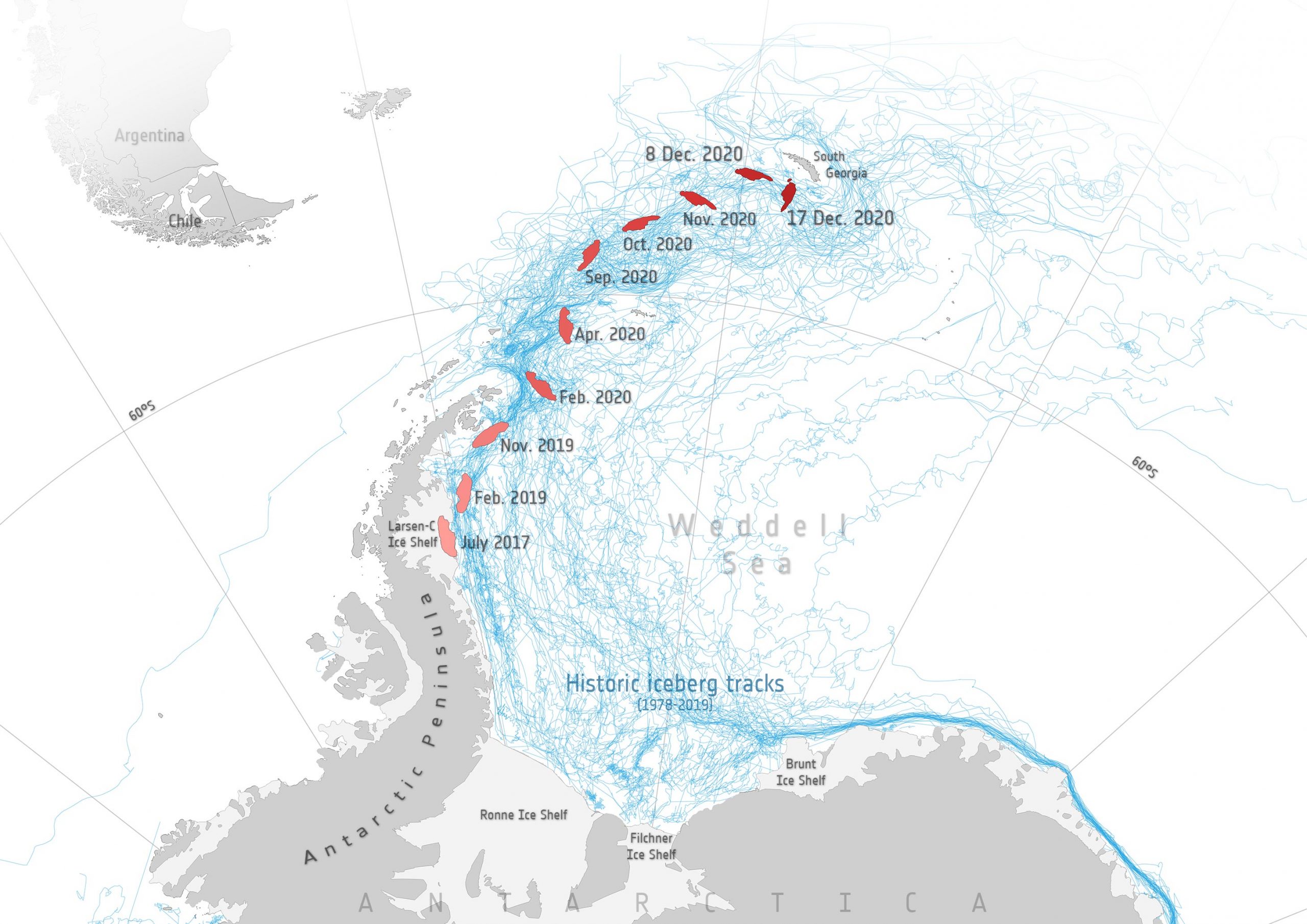
    Iceberg A 68A Journey
    The map shows the different positions of the berg over the course of its three-year journey. The map also includes historic iceberg tracks, based on data from a number of satellites including ESA’s ERS-1 and ERS-2 as part of the Antarctic Iceberg Tracking Database, and shows that A-68A is following this well-trodden path. Credit: Contains modified Copernicus Sentinel data (2020), processed by ESA; Antarctic Iceberg Tracking Database

    The map also includes historic iceberg tracks, based on data from a number of satellites including ESA’s ERS-1 and ERS-2 as part of the Antarctic Iceberg Tracking Database, and shows that A-68A is following this well-trodden path.

    Satellite missions are being used to track the berg on its journey over the past three years. The Sentinel-1 radar mission in particular, with its ability to see through clouds and the dark, has been instrumental in mapping the polar regions in winter.

    Never miss a breakthrough: Join the SciTechDaily newsletter.
    Follow us on Google and Google News.

    European Space Agency Iceberg
    Share. Facebook Twitter Pinterest LinkedIn Email Reddit

    Related Articles

    Halloween Crack in Antarctica

    Mega Iceberg – One of the Largest on Record – Released 150 Billion Tons of Freshwater Near Island

    Meet the World’s Largest Iceberg: A-76 Is Over 100 Miles Long

    Massive Iceberg – 10 Times the Size of San Francisco – Breaks Off Brunt Ice Shelf in Antarctica

    A-68A: Is This the End of One of the Largest Icebergs of All Time?

    Giant Iceberg on Collision Course With South Georgia Could Wreak Havoc [Video]

    Hit or Miss? Gigantic Iceberg Bears Down on South Georgia Island

    Massive Iceberg on Collision Course With South Georgia

    Tracking Colossal Iceberg – Larger Than Delaware – During a 3-Year, 650-Mile Journey

    Leave A Reply Cancel Reply

    • Facebook
    • Twitter
    • Pinterest
    • YouTube

    Don't Miss a Discovery

    Subscribe for the Latest in Science & Tech!

    Trending News

    Your Blood Pressure Reading Could Be Wrong Because of One Simple Mistake

    Astronomers Stunned by Ancient Galaxy With No Spin

    Physicists May Be on the Verge of Discovering “New Physics” at CERN

    Scientists Solve 320-Million-Year Mystery of Reptile Skin Armor

    Scientists Say This Daily Walking Habit May Be the Secret to Keeping Weight Off After Dieting

    New Therapy Rewires the Brain To Restore Joy in Depression Patients

    Giant Squid Detected off Western Australia in Stunning Deep-Sea Discovery

    Popular Sugar-Free Sweetener Linked to Liver Disease, Study Warns

    Follow SciTechDaily
    • Facebook
    • Twitter
    • YouTube
    • Pinterest
    • Newsletter
    • RSS
    SciTech News
    • Biology News
    • Chemistry News
    • Earth News
    • Health News
    • Physics News
    • Science News
    • Space News
    • Technology News
    Recent Posts
    • A Crucial Atlantic Current Is Weakening and Weather Could Change Worldwide
    • Scientists Stunned As Volcano Removes Methane From the Air
    • Scientists Discover Signs Africa May Be Splitting Apart Beneath Zambia
    • New Stroke Study Challenges Decades-Old Medical Beliefs
    • These Simple Plant Foods Are Linked to Lower Blood Pressure
    Copyright © 1998 - 2026 SciTechDaily. All Rights Reserved.
    • Science News
    • About
    • Contact
    • Editorial Board
    • Privacy Policy
    • Terms of Use

    Type above and press Enter to search. Press Esc to cancel.