
Close Menu
    Facebook X (Twitter) Instagram
    SciTechDaily
    • Biology
    • Chemistry
    • Earth
    • Health
    • Physics
    • Science
    • Space
    • Technology
    Facebook X (Twitter) Pinterest YouTube RSS
    SciTechDaily
    Home»Space»Fascinating Geology on Mars: Deep Fractures and Water-Carved Valleys
    Space

    Fascinating Geology on Mars: Deep Fractures and Water-Carved Valleys

    By European Space Agency (ESA)March 21, 2023No Comments7 Mins Read
    Facebook Twitter Pinterest Telegram LinkedIn WhatsApp Email Reddit
    Share
    Facebook Twitter LinkedIn Pinterest Telegram Email Reddit
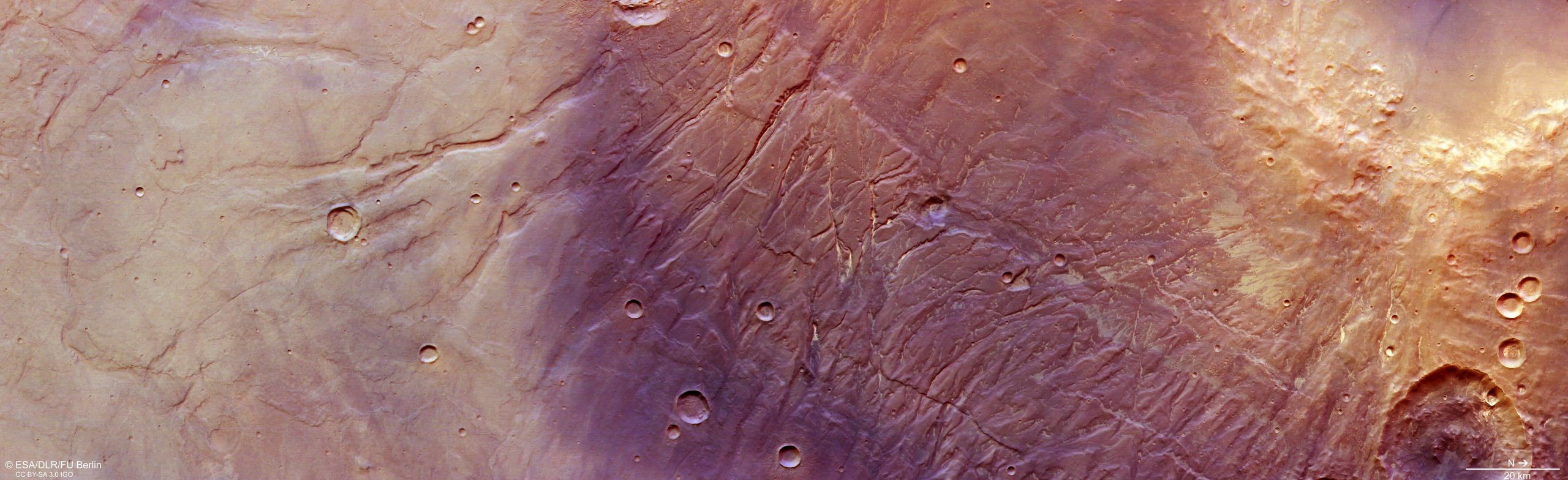
    Nectaris Fossae and Protva Valles
    This image from ESA’s Mars Express shows Nectaris Fossae and Protva Valles, complex geological features found on Mars. Round impact craters are scattered across the frame, and a band of fractured grooves, resembling scratches and scars carved into the rock, stretches from the top left to bottom right.
    This image comprises data gathered by Mars Express’ High Resolution Stereo Camera (HRSC) on May 23, 2022. It was created using data from the nadir channel, the field of view aligned perpendicular to the surface of Mars, and the colour channels of the HRSC. It is a ‘true color’ image, reflecting what would be seen by the human eye if looking at this region of Mars.
    Credit: ESA/DLR/FU Berlin, CC BY-SA 3.0 IGO

    Mars displays fascinating geology everywhere you look – and nowhere is this more true than in the fractured, wrinkled ground seen in this image from the European Space Agency’s (ESA) Mars Express.

    The scene, captured by the High Resolution Stereo Camera (HRSC) on the Mars Express orbiter, features the flanks of a vast volcanic plateau named Thaumasia Planum. The highest features visible here are a whopping 4,500 m (15,000 ft) taller than the lowest, as seen most clearly in the associated topographical map. Many thought to have changed very little since they formed nearly four billion years ago, giving an exciting glimpse into Mars’ earliest days.
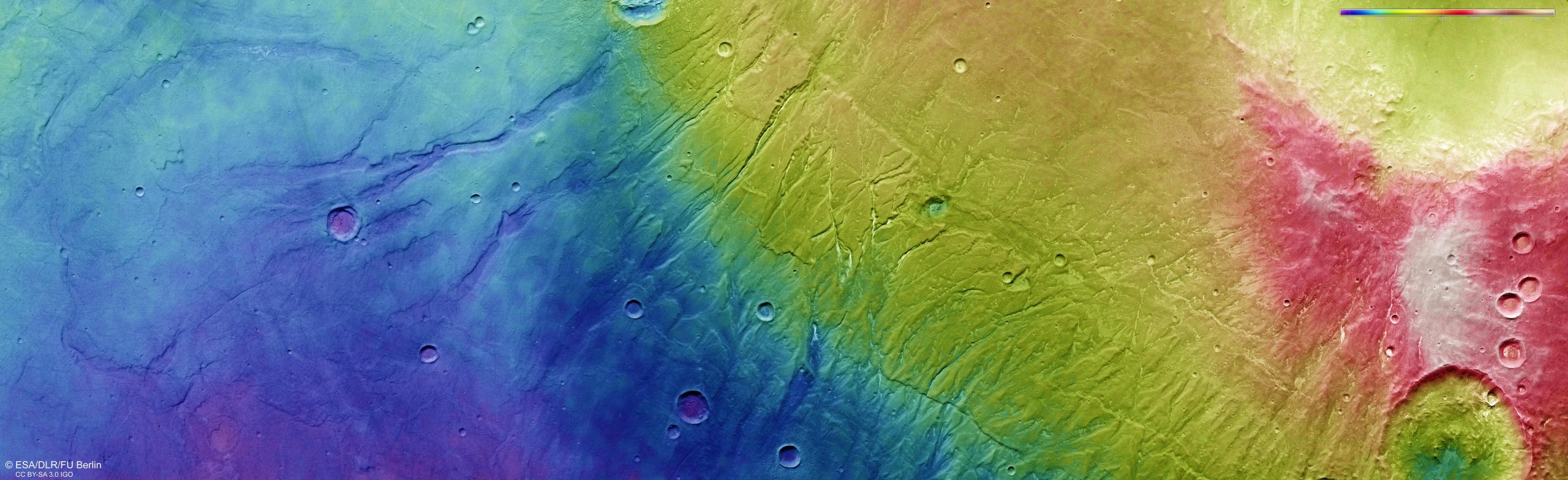
    Topography of Nectaris Fossae and Protva Valles
    This color-coded topographic image shows Nectaris Fossae and Protva Valles on Mars. It was created from data collected by ESA’s Mars Express on 23 May 2022. It is based on a digital terrain model of the region, from which the topography of the landscape can be derived. Lower parts of the surface are shown in blues and purples, while higher altitude regions show up in whites and reds, as indicated on the scale to the top right. Credit: ESA/DLR/FU Berlin, CC BY-SA 3.0 IGO

    Shifting Plates

    This complex region appears to have been shaped by both tectonics (deformation of the planetary crust) and by past running water.

    While Mars no longer displays signs of active tectonics, this has not always been the case.
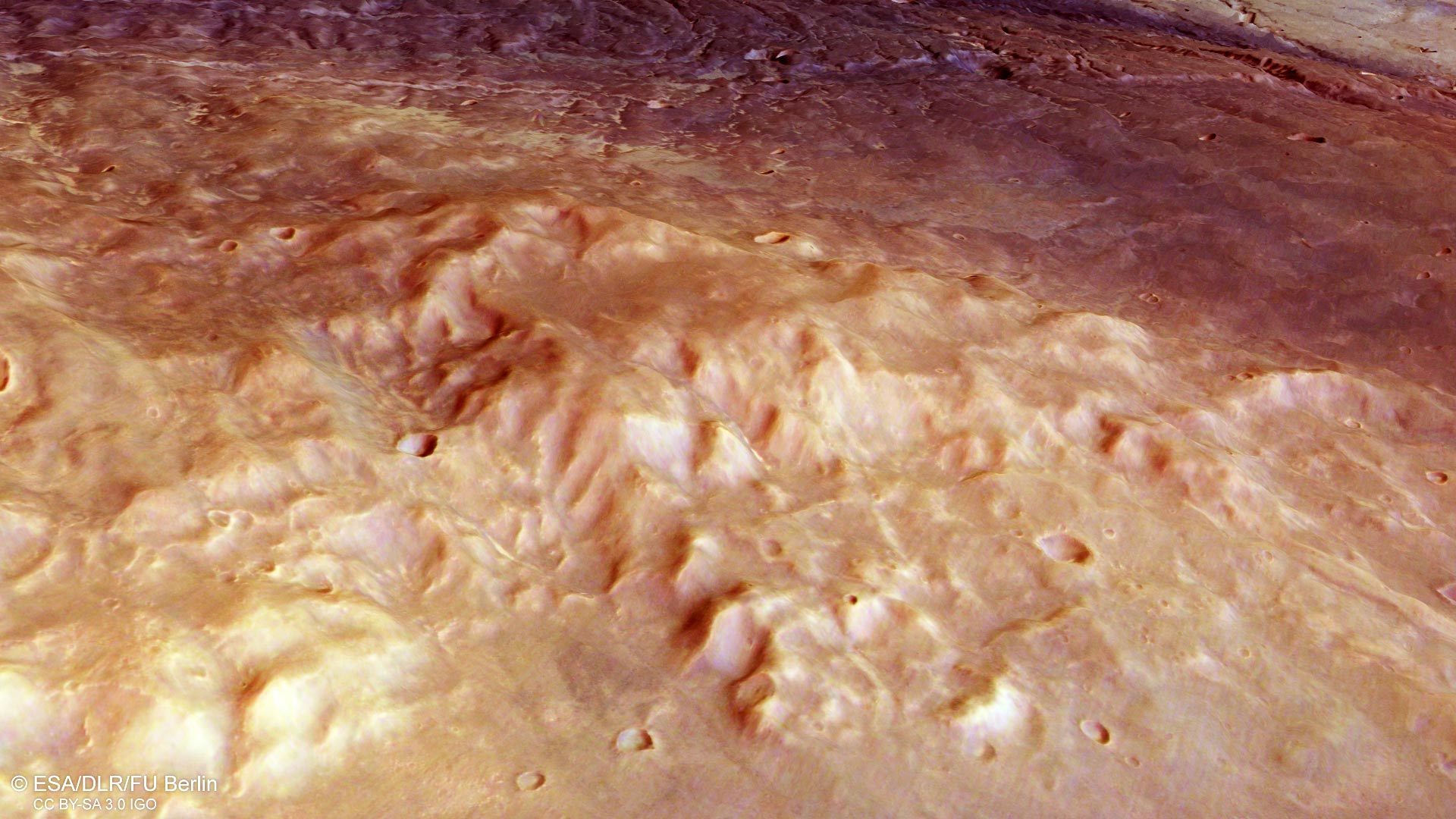
    Perspective View of Nectaris Fossae and Protva Valles
    This oblique perspective view of Nectaris Fossae and Protva Valles on Mars was generated from the digital terrain model and the nadir and color channels of the High Resolution Stereo Camera on ESA’s Mars Express. Bumpy textured mounds and grooves can be seen in the foreground, while a deeper fissure running roughly parallel to the top of the frame can be seen in the distance. Credit: ESA/DLR/FU Berlin, CC BY-SA 3.0 IGO

    Mars’ crust once experienced significant stresses in this region, creating the deep surface fractures today known as Nectaris Fossae. These are visible as near-vertical scars at the center of this image and have since been filled by light-colored dust. They are thought to have formed in relation to the colossal Valles Marineris canyon system, the largest such system not only on Mars but in the Solar System. Valles Marineris lies just to the north (right) of this region.

    Flowing Water

    After tectonism reworked this patch of Mars, water flowed across the surface, cutting into the rock and carving out deep valleys as it did so (features named Protva Valles – the plural ‘Valles’ referring to multiple channels). These channels can be seen spread across these images; some are broad and superficial and some far deeper. The dense patch of water-carved valleys to the bottom right of the image is intensely eroded.

    Nectaris Fossae and Protva Valles Annotated
    This image from ESA’s Mars Express shows Nectaris Fossae and Protva Valles, complex geological features found on Mars. Key features are labeled across the frame: the broad, deep incised, and intensely eroded valleys of Protva Valles; three prominent wrinkle ridges; and the dust-filled fractures of Nectaris Fossae. Credit: ESA/DLR/FU Berlin, CC BY-SA 3.0 IGO

    Protva Valles formed when water was far more plentiful across the surface of Mars, some 3.8 billion years ago, and has remained largely unchanged since.

    Built on Lava

    The underlying terrain here – Thaumasia Planum – formed in the very earliest days of Mars and is largely made up of immense lava flows several kilometers thick.
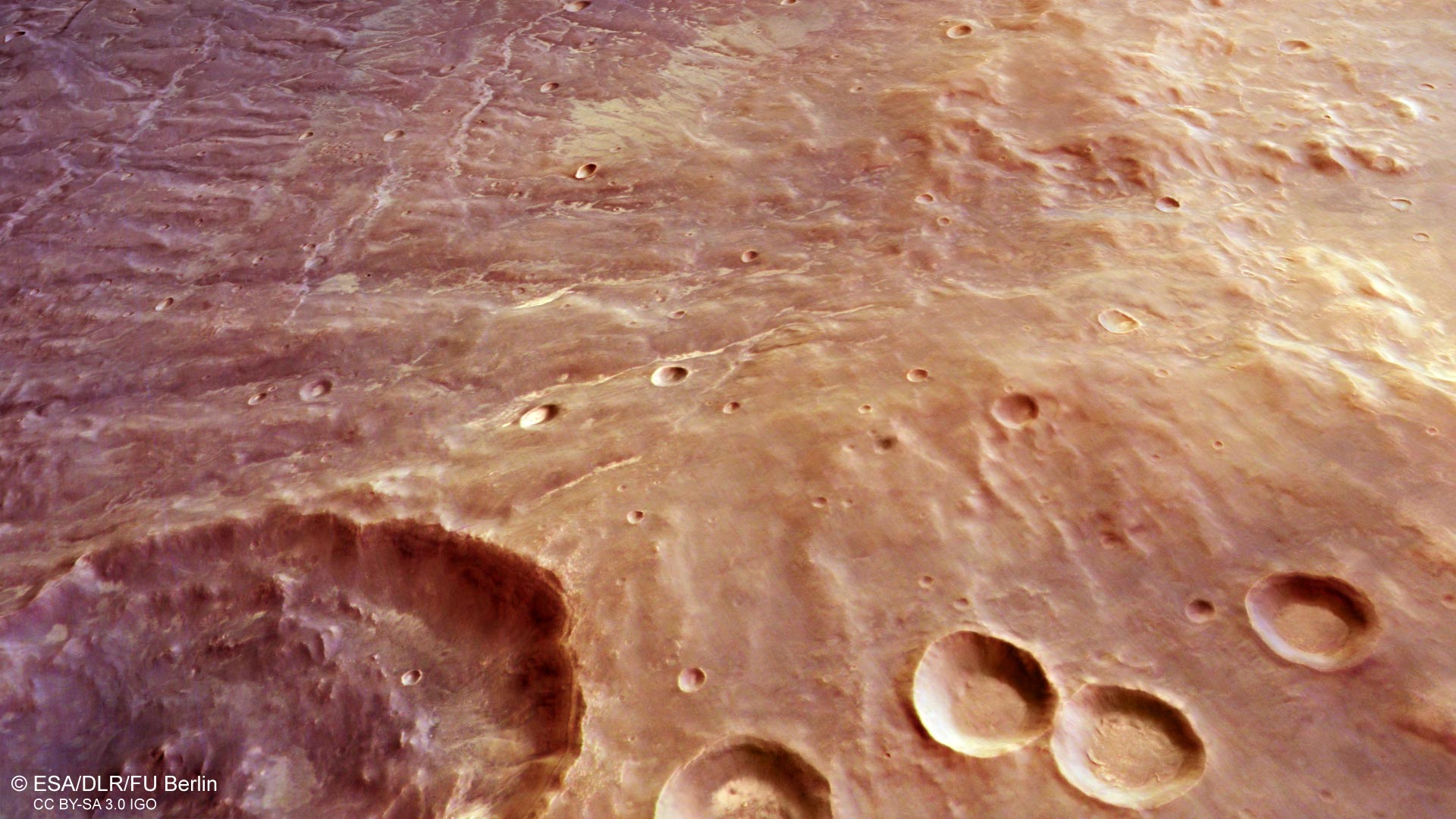
    Nectaris Fossae and Protva Valles in Perspective
    This oblique perspective view of Nectaris Fossae and Protva Valles on Mars was generated from the digital terrain model and the nadir and color channels of the High Resolution Stereo Camera on ESA’s Mars Express. A large impact crater features in the bottom left, stretching partially out of frame, with four smaller craters dotted across to its right. Some textures and grooves can be seen in the more distant surface. Credit: ESA/DLR/FU Berlin, CC BY-SA 3.0 IGO

    This time was a turbulent one, with many of Mars’ standout features just beginning to form. The Tharsis volcanoes, some of the largest in the Solar System, are located near to Thaumasia Planum; the load and stress of these volcanoes forming may have prompted this region to begin fracturing, before these volcanoes then flooded the area with lava.
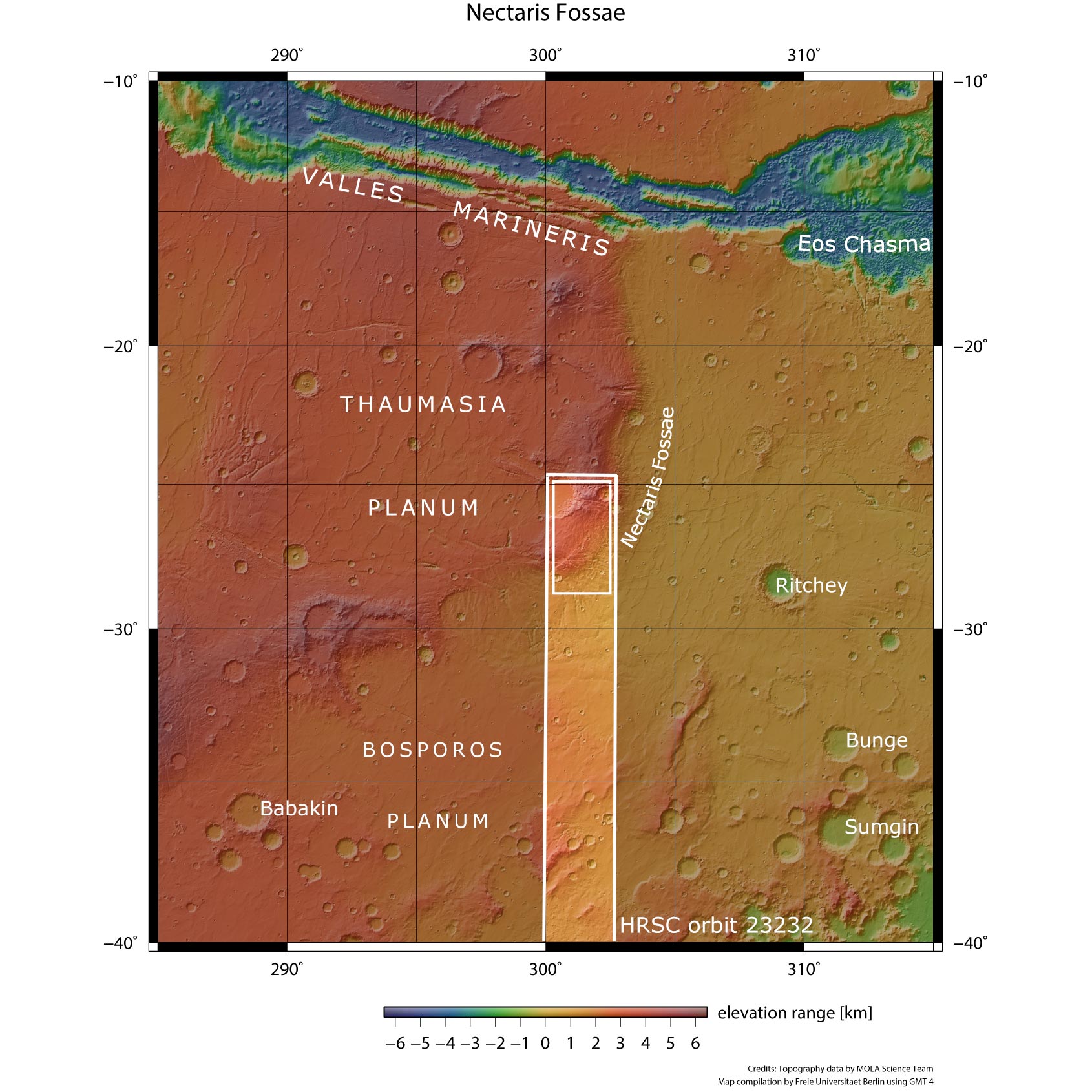
    Broader View of Nectaris Fossae and Protva Valles
    This image from ESA’s Mars Express shows Nectaris Fossae and Protva Valles on Mars. The area outlined by the bold white box indicates the area imaged by the Mars Express High Resolution Stereo Camera on May 23, 2022, during orbit 23232. Credit: NASA/MGS/MOLA Science Team

    As these lava flows cooled and solidified on unstable, shifting ground, they became compressed, resulting in ‘wrinkle ridges’. One of the most substantial ridges is seen to the bottom-right of center as an unsteady diagonal line scored into the surface.

    Following this extensive resurfacing by lava, Thaumasia Planum was covered in volcanic ash and dust, before the water flows cut through the lava to form the Protva Valles. The origin of these water flows remains unclear; they appear to emerge at different heights, implying that water may have seeped through subsurface layers of Mars.

    Nectaris Fossae and Protva Valles in 3D
    This stereoscopic image shows Nectaris Fossae and Protva Valles on Mars. It was generated from data captured by the High Resolution Stereo Camera (HRSC) on ESA’s Mars Express orbiter on May 23, 2022, during orbit 23232. The anaglyph, derived from data acquired by the nadir channel and one stereo channel of the HRSC, offers a three-dimensional view when viewed using red-green or red-blue glasses. Credit: ESA/DLR/FU Berlin, CC BY-SA 3.0 IGO

    Exploring Mars

    Mars Express has been orbiting the Red Planet since 2003, imaging the surface of Mars, mapping its minerals, identifying the composition and circulation of its tenuous atmosphere, probing beneath its crust, and exploring how various phenomena interact in the martian environment.

    Mars Express is a robotic space probe developed by the European Space Agency (ESA) that was launched in 2003 to study the planet Mars. It is the first planetary mission undertaken by the ESA and is currently still in operation.

    The High Resolution Stereo Camera (HRSC) is one of the primary instruments onboard Mars Express. It is a high-resolution camera capable of producing 3D images of the Martian surface. The HRSC has been used to create detailed maps of Mars, including topographic maps and color images of geological features such as canyons, valleys, and impact craters. The data collected by the HRSC has contributed significantly to our understanding of the geological and morphological characteristics of Mars. HRSC was developed and is operated by the German Aerospace Center (Deutsches Zentrum für Luft- und Raumfahrt; DLR).

    Never miss a breakthrough: Join the SciTechDaily newsletter.
    Follow us on Google and Google News.

    European Space Agency Mars Mars Express Planets
    Share. Facebook Twitter Pinterest LinkedIn Email Reddit

    Related Articles

    Mars As Never Seen Before: ESA’s Mars Express New Global Color Mosaic

    The Odyssey of Mars Express: Charting Two Decades of Red Planet Exploration

    Mars Express Uncovers Collapsed Chains of Craters on Giant Martian Volcano

    Mars’ Mega Volcano: A Tour of Ascraeus Mons’ Rugged Terrain

    Chaotic Crust Contains Clues to Mars’ Watery Past in Search for Signs of Past Life on the Red Planet

    The “Grandest Canyon” in the Solar System: Mars Express Captures Stunning Images of Massive Martian Canyon

    Martian Brain Freeze: Mars Express Reveals Utopia Planitia

    Mars Express: Making a Splash in a Lava Sea

    Intriguing Martian Scars: An Ancient Crater Triplet on Mars

    Leave A Reply Cancel Reply

    • Facebook
    • Twitter
    • Pinterest
    • YouTube

    Don't Miss a Discovery

    Subscribe for the Latest in Science & Tech!

    Trending News

    Bone-Strengthening Discovery Could Reverse Osteoporosis

    Scientists Uncover Hidden Trigger Behind Stem Cell Aging

    Scientists Find Way to Reverse Fatty Liver Disease Without Changing Diet

    Could Humans Regrow Limbs? New Study Reveals Promising Genetic Pathway

    Scientists Reveal Eating Fruits and Vegetables May Increase Your Risk of Lung Cancer

    Scientists Reverse Brain Aging With Simple Nasal Spray

    Scientists Uncover Potential Brain Risks of Popular Fish Oil Supplements

    Scientists Discover a Surprising Way To Make Bread Healthier and More Nutritious

    Follow SciTechDaily
    • Facebook
    • Twitter
    • YouTube
    • Pinterest
    • Newsletter
    • RSS
    SciTech News
    • Biology News
    • Chemistry News
    • Earth News
    • Health News
    • Physics News
    • Science News
    • Space News
    • Technology News
    Recent Posts
    • Alzheimer’s Symptoms May Start Outside the Brain, Study Finds
    • Cancer’s Secret Weapon? Scientists Reveal How Tumors “Learn” To Survive Treatment
    • Millions Take This Popular Supplement – Scientists Discover a Concerning Link to Heart Failure
    • What Makes Rubber So Strong? Scientists Finally Solve 100-Year-Old Mystery
    • Scientists Decode Mysterious Magnetic “Maze Domains” To Boost EV Efficiency
    Copyright © 1998 - 2026 SciTechDaily. All Rights Reserved.
    • Science News
    • About
    • Contact
    • Editorial Board
    • Privacy Policy
    • Terms of Use

    Type above and press Enter to search. Press Esc to cancel.