
Technology enhances the energy efficiency of streetlights and simultaneously reduces carbon emissions.
A new study conducted in collaboration between King Abdullah University of Science and Technology (KAUST) and King Abdulaziz City for Science and Technology (KACST) demonstrates how nanomaterials can play a crucial role in lowering the carbon emissions of LED (light-emitting diode) streetlights. The research team estimates that implementing this technology in the United States could reduce carbon dioxide emissions by over one million metric tons.
The key innovation is a nanomaterial called nanoPE, which improves thermal radiation from the LED surface, helping to lower its operating temperature. LEDs naturally generate heat, and elevated temperatures can damage their internal electronics and shorten their lifespan. In fact, around 75% of the energy consumed by LEDs is ultimately lost as heat. By reducing this thermal buildup, nanoPE can improve LED performance and longevity while significantly cutting energy-related emissions.
Study leader, KAUST Professor Qiaoqiang Gan, said, “LEDs are preferred light sources because of their superior efficiency and lifespan. But small enhancements can improve them even more, and that can make a big difference on sustainability because even small improvements have a big effect when used everywhere,” said Gan. He added that lighting is approximately 20% of the world’s annual electricity consumption and contributes to nearly 6% of global greenhouse gas emissions.
A Step Toward Sustainable Lighting
Dr. Hussam Qasem, General Manager of the Future Energy Technologies Institute at KACST and contributor to the study, said, “Our design significantly improves LED cooling while maintaining high illumination efficiency, making it a promising solution for sustainable lighting in Saudi Arabia.”
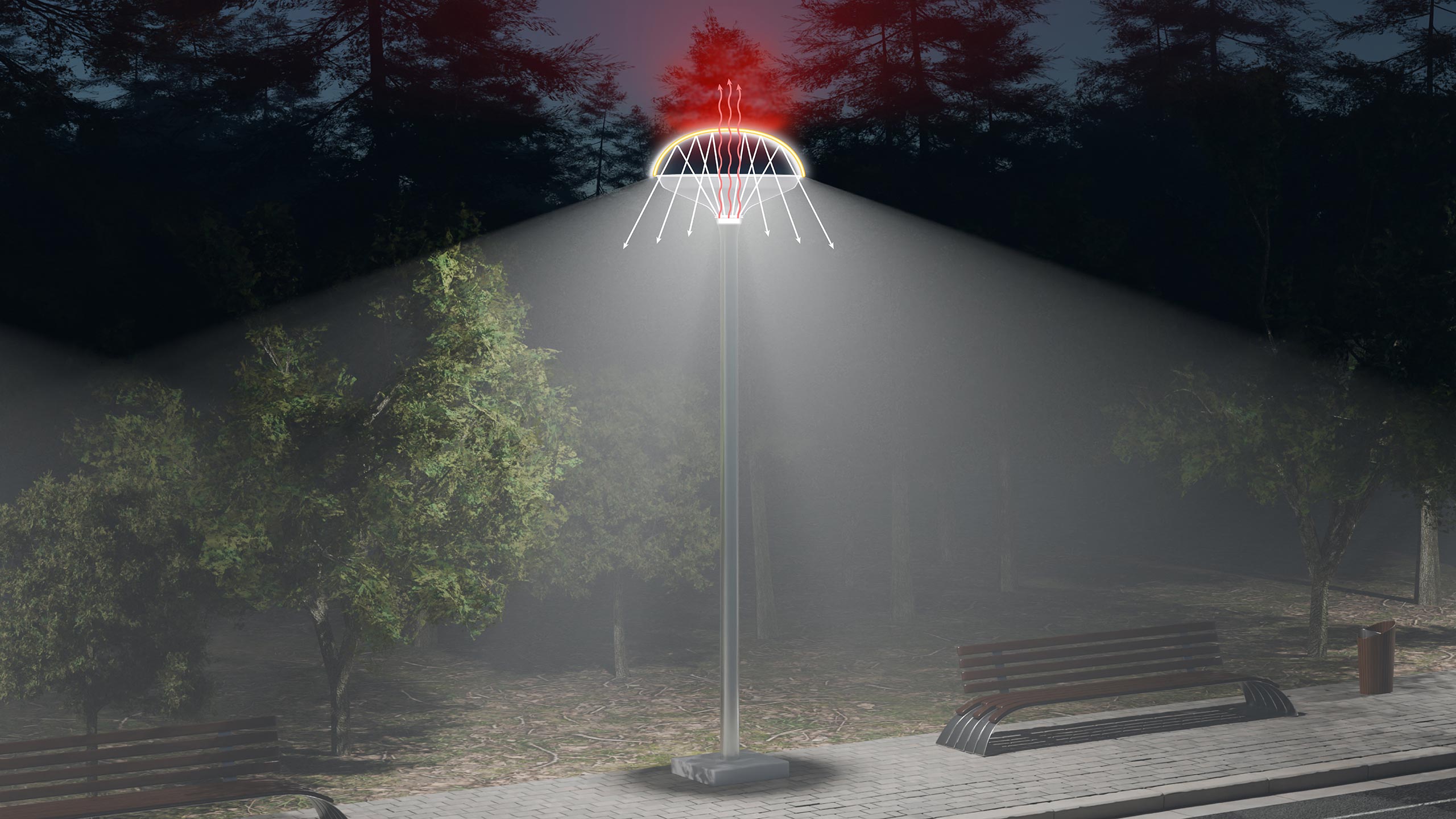
Typical LED streetlights direct their light toward the object to be illuminated, which is why they point toward the ground. They are also designed so that thermal radiation stays trapped inside the LED. On the other hand, streetlights coated with nanoPE are literally turned upside down so that they are directed towards the sky and away from the object to be illuminated.
The reason for this inversion is that NanoPE is designed so that infrared light, the light most responsible for thermal radiation, passes through it while visible light is reflected. The study showed that more than 80% of the infrared light emitted by LED streetlights coated with nanoPE passes through nanoPE and continues toward the sky. In contrast, more than 95% of the visible light emitted reflects off nanoPE and back to the ground, illuminating the area beneath.
NanoPE is based on polyethylene, the most widely produced plastic in the world. To create a nanoplastic that reflects low wavelength light (visible light) but passes high wavelength light (infrared), the scientists carefully made pores as small as 30 nm – about 1000 times smaller than the thickness of a human hair – into the plastic as well as stretching and transforming it into a thinner sheet.
Reference: “Sky cooling for LED streetlights” by Saichao Dang, Hasan H. Almahfoudh, Abdulrahman M. Alajlan, Hussam Qasem, Jiake Wang, Yingkun Zhu, Osman M. Bakr, Boon S. Ooi and Qiaoqiang Gan, 26 February 2025, Light: Science & Applications.
DOI: 10.1038/s41377-024-01724-7
Never miss a breakthrough: Join the SciTechDaily newsletter.
Follow us on Google and Google News.
2 Comments
That’d-ad be a million tons of carbon you’d be starving from the biosphere – which gives us oxygen – but you smart guys haven’t thought that out because all the science publications have been paid to say the sky is falling – which you went right ahead and believed – when the open atmosphere is not a ‘greenhouse’ – after all.
welcome to the comment posted just after the stupidest comment on the internet since Eugene Ray’s Time Cube.
Congratulations Robert. You’re “not even wrong”.
Maybe try a class first?