
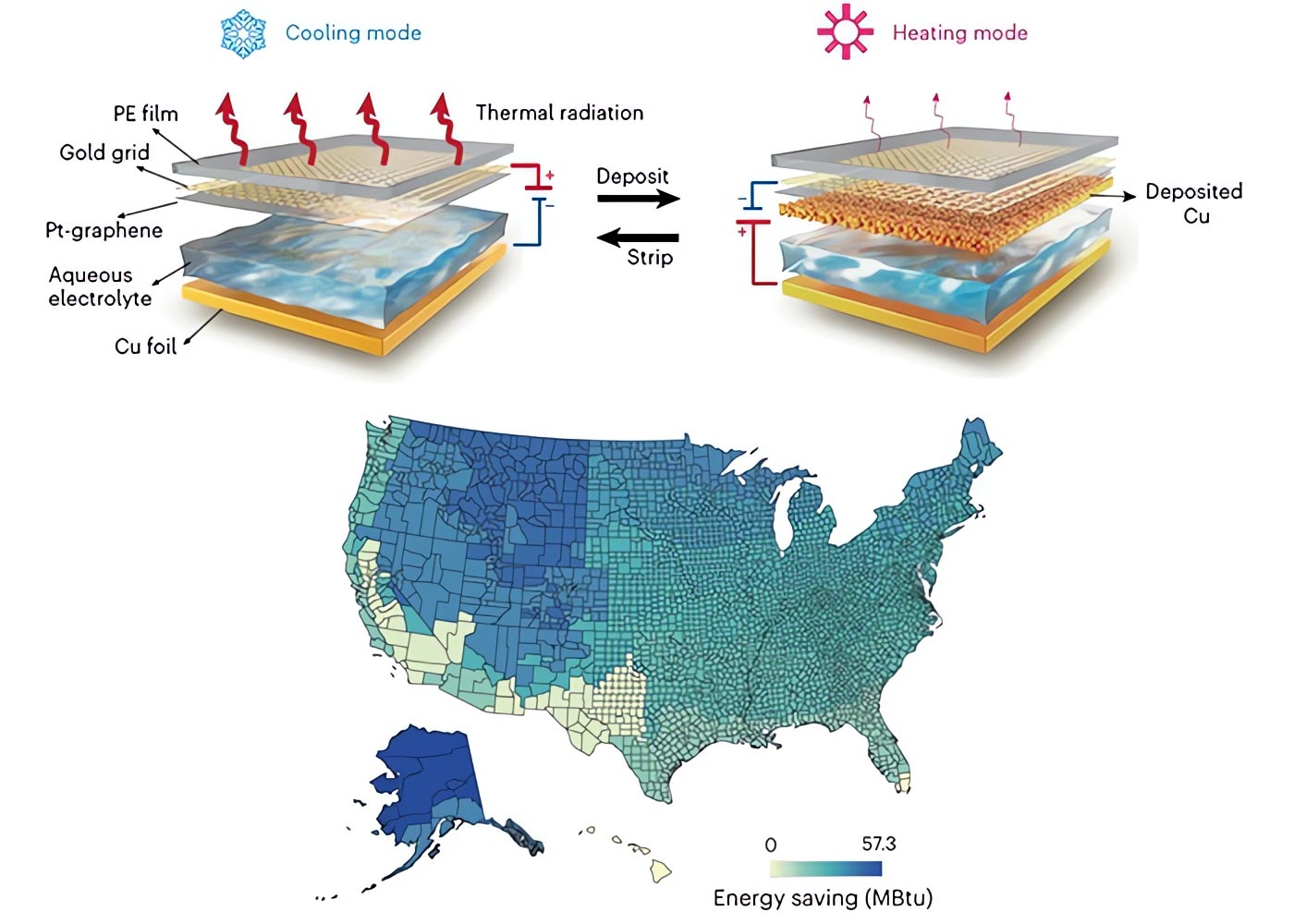
To address the challenge of saving energy in the face of increasingly frequent extreme weather events and variable weather, Pritzker Molecular Engineering researchers designed a building material that can change how much heat it absorbs or emits based on the outside temperature.
Researchers at the University of Chicago’s Pritzker School of Molecular Engineering (PME) have designed a chameleon-like building material that changes its infrared color—and how much heat it absorbs or emits—based on the outside temperature. On hot days, the material can emit up to 92 percent of the infrared heat it contains, helping cool the inside of a building. On colder days, however, the material emits just 7 percent of its infrared, helping keep a building warm.
“We’ve essentially figured out a low-energy way to treat a building like a person; you add a layer when you’re cold and take off a layer when you’re hot,” said Asst. Prof. Po-Chun Hsu, who led the research published in Nature Sustainability. “This kind of smart material lets us maintain the temperature in a building without huge amounts of energy.”
Driven by Climate Change
According to some estimates, buildings account for 30 percent of global energy consumption and emit 10 percent of all global greenhouse gas. About half of this energy footprint is attributed to the heating and cooling of interior spaces.
“For a long time, most of us have taken our indoor temperature control for granted, without thinking about how much energy it requires,” said Hsu. “If we want a carbon-negative future, I think we have to consider diverse ways to control building temperature in a more energy-efficient way.”
Researchers have previously developed radiative cooling materials that help keep buildings cool by boosting their ability to emit infrared, the invisible heat that radiates from people and objects. Materials also exist that prevent the emission of infrared in cold climates.
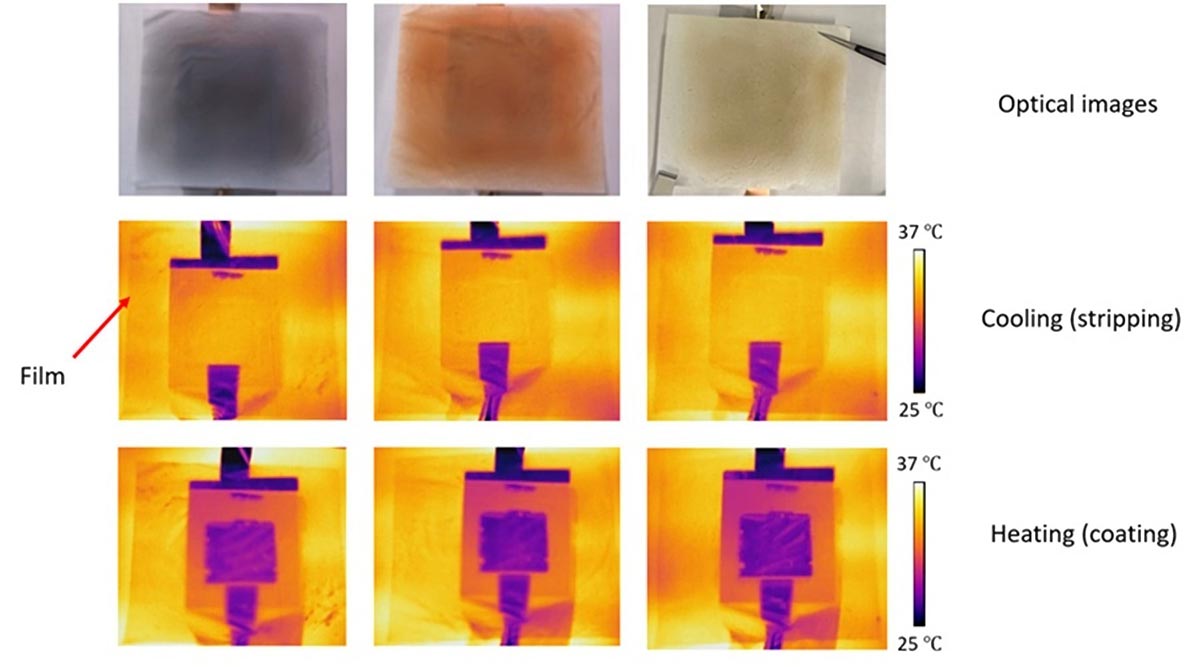
“A simple way to think about it is that if you have a completely black building facing the sun, it’s going to heat up more easily than other buildings,” said PME graduate student Chenxi Sui, the first author of the new manuscript.
That kind of passive heating might be a good thing in the winter, but not in the summer.
As global warming causes increasingly frequent extreme weather events and variable weather, there is a need for buildings to be able to adapt; few climates require year-round heating or year-round air conditioning.
From Metal to Liquid and Back
Hsu and colleagues designed a non-flammable “electrochromic” building material that contains a layer that can take on two conformations: solid copper that retains most infrared heat, or a watery solution that emits infrared. At any chosen trigger temperature, the device can use a tiny amount of electricity to induce the chemical shift between the states by either depositing copper into a thin film, or stripping that copper off.
In the new paper, the researchers detailed how the device can switch rapidly and reversibly between the metal and liquid states. They showed that the ability to switch between the two conformations remained efficient even after 1,800 cycles.
“This kind of smart material lets us maintain the temperature in a building without huge amounts of energy.”
Asst. Prof. Po-Chun Hsu
Then, the team created models of how their material could cut energy costs in typical buildings in 15 different U.S. cities. In an average commercial building, they reported, the electricity used to induce electrochromic changes in the material would be less than 0.2% of the total electricity usage of the building, but could save 8.4% of the building’s annual HVAC energy consumption.
“Once you switch between states, you don’t need to apply any more energy to stay in either state,” said Hsu. “So for buildings where you don’t need to switch between these states very frequently, it’s really using a very negligible amount of electricity.”
Scaling Up
So far, Hsu’s group has only created pieces of the material that measure about six centimeters across. However, they imagine that many such patches of the material could be assembled like shingles into larger sheets. They say the material could also be tweaked to use different, custom colors—the watery phase is transparent and nearly any color can be put behind it without impacting its ability to absorb infrared.
The researchers are now investigating different ways of fabricating the material. They also plan to probe how intermediate states of the material could be useful.
“We demonstrated that radiative control can play a role in controlling a wide range of building temperatures throughout different seasons,” said Hsu. “We’re continuing to work with engineers and the building sector to look into how this can contribute to a more sustainable future.”
Reference: “Radiative electrochromism for energy-efficient buildings” by Sui et al, 26 January 2023, Nature Sustainability.
DOI: 10.1038/s41893-022-01030-3
Funding: Nicholas Institute for Energy, Environment & Sustainability; Pratt School of Engineering at Duke University
Never miss a breakthrough: Join the SciTechDaily newsletter.
Follow us on Google and Google News.
2 Comments
“As global warming causes increasingly frequent extreme weather events and variable weather, …”
Once again, an assertion is made without facts in evidence to support it. At the very least, the statement should only be, “If global warming causes …”
With random events, the longer a system is observed, the more likely that low probability events will be observed. That is what “low probability” means.
Weather is driven by temperature/pressure differences, most notably with parcels of air that create what are called “fronts.” However, in general, heat energy is transported from the tropics to the poles. As the temperature difference declines, with the North Pole warming faster than the rest of Earth, one would logically expect more moderate weather with fewer extremes.
I would suggest that Materials Scientists should stick to their areas of expertise and just report on their findings, without the editorializing about things outside their area of study.
“… Building Material Changes Its Infrared Color …”
The color apparent to a human observing a reflective surface is not affected by the IR reflectance because humans cannot see IR.