
Breakthrough regulates household temperature without consuming natural gas or electricity.
Scientists have developed an all-season smart-roof coating that keeps homes warm during the winter and cool during the summer without consuming natural gas or electricity. Research findings reported in the journal Science point to a groundbreaking technology that outperforms commercial cool-roof systems in energy savings.
“Our all-season roof coating automatically switches from keeping you cool to warm, depending on outdoor air temperature. This is energy-free, emission-free air conditioning and heating, all in one device,” said Junqiao Wu, a faculty scientist in Berkeley Lab’s Materials Sciences Division and a UC Berkeley professor of materials science and engineering who led the study.
Today’s cool roof systems, such as reflective coatings, membranes, shingles, or tiles, have light-colored or darker “cool-colored” surfaces that cool homes by reflecting sunlight. These systems also emit some of the absorbed solar heat as thermal-infrared radiation; in this natural process known as radiative cooling, thermal-infrared light is radiated away from the surface.
The problem with many cool-roof systems currently on the market is that they continue to radiate heat in the winter, which drives up heating costs, Wu explained.
“Our new material – called a temperature-adaptive radiative coating or TARC – can enable energy savings by automatically turning off the radiative cooling in the winter, overcoming the problem of overcooling,” he said.
A Roof for All Seasons
Metals are typically good conductors of electricity and heat. In 2017, Wu and his research team discovered that electrons in vanadium dioxide behave like a metal to electricity but an insulator to heat – in other words, they conduct electricity well without conducting much heat. “This behavior contrasts with most other metals where electrons conduct heat and electricity proportionally,” Wu explained.

Vanadium dioxide below about 67 degrees Celsius (153 degrees Fahrenheit) is also transparent to (and hence not absorptive of) thermal-infrared light. But once vanadium dioxide reaches 67 degrees Celsius, it switches to a metal state, becoming absorptive of thermal-infrared light. This ability to switch from one phase to another – in this case, from an insulator to a metal – is characteristic of what’s known as a phase-change material.
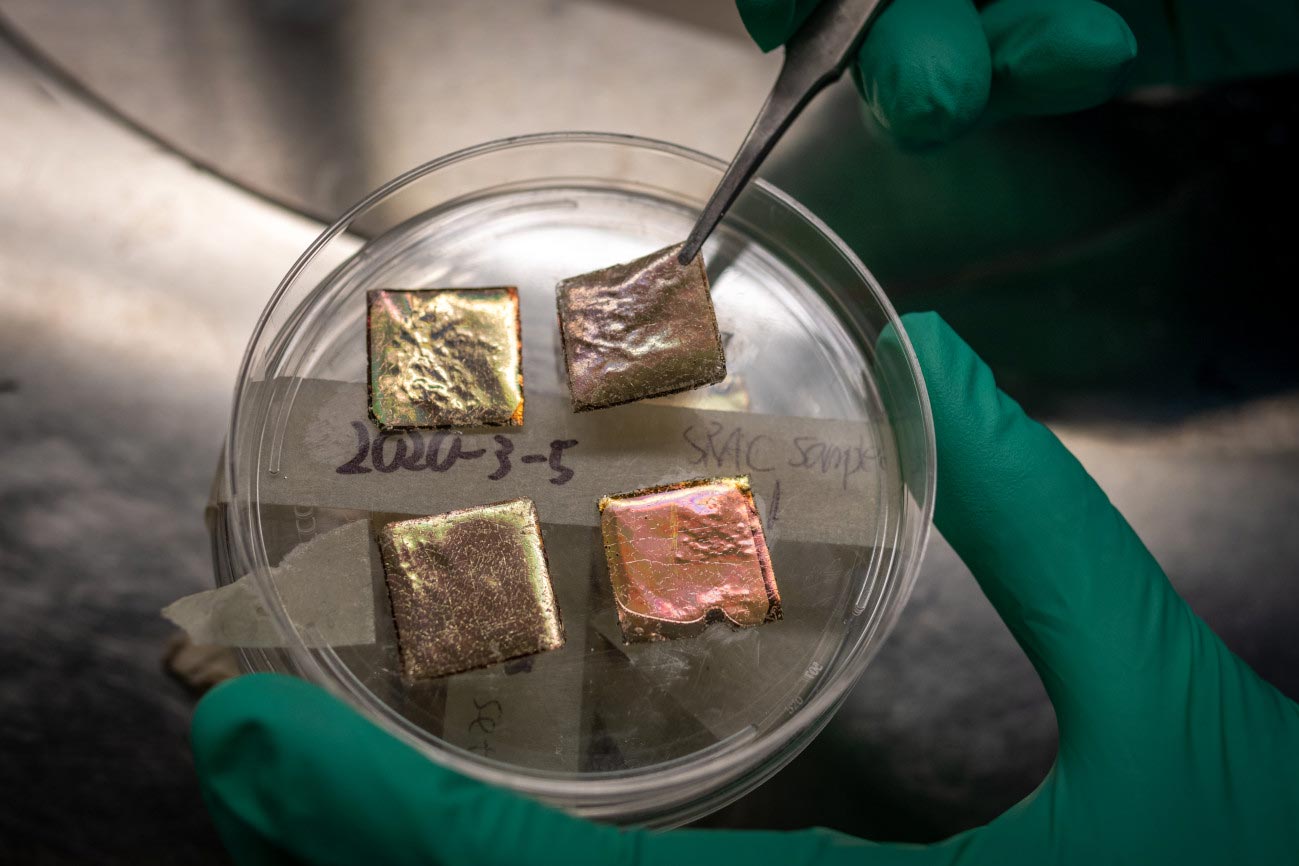
To see how vanadium dioxide would perform in a roof system, Wu and his team engineered a 2-centimeter-by-2-centimeter (0.8-inch-by-0.8-inch) TARC thin-film device.
TARC “looks like Scotch tape, and can be affixed to a solid surface like a rooftop,” Wu said.
In a key experiment, co-lead author Kechao Tang set up a rooftop experiment at Wu’s East Bay home last summer to demonstrate the technology’s viability in a real-world environment.
A wireless measurement device set up on Wu’s balcony continuously recorded responses to changes in direct sunlight and outdoor temperature from a TARC sample, a commercial dark roof sample, and a commercial white roof sample over multiple days.
How TARC Outperforms in Energy Savings
The researchers then used data from the experiment to simulate how TARC would perform year-round in cities representing 15 different climate zones across the continental U.S.
Wu enlisted Ronnen Levinson, a co-author on the study who is a staff scientist and leader of the Heat Island Group in Berkeley Lab’s Energy Technologies Area, to help them refine their model of roof surface temperature. Levinson developed a method to estimate TARC energy savings from a set of more than 100,000 building energy simulations that the Heat Island Group previously performed to evaluate the benefits of cool roofs and cool walls across the United States.
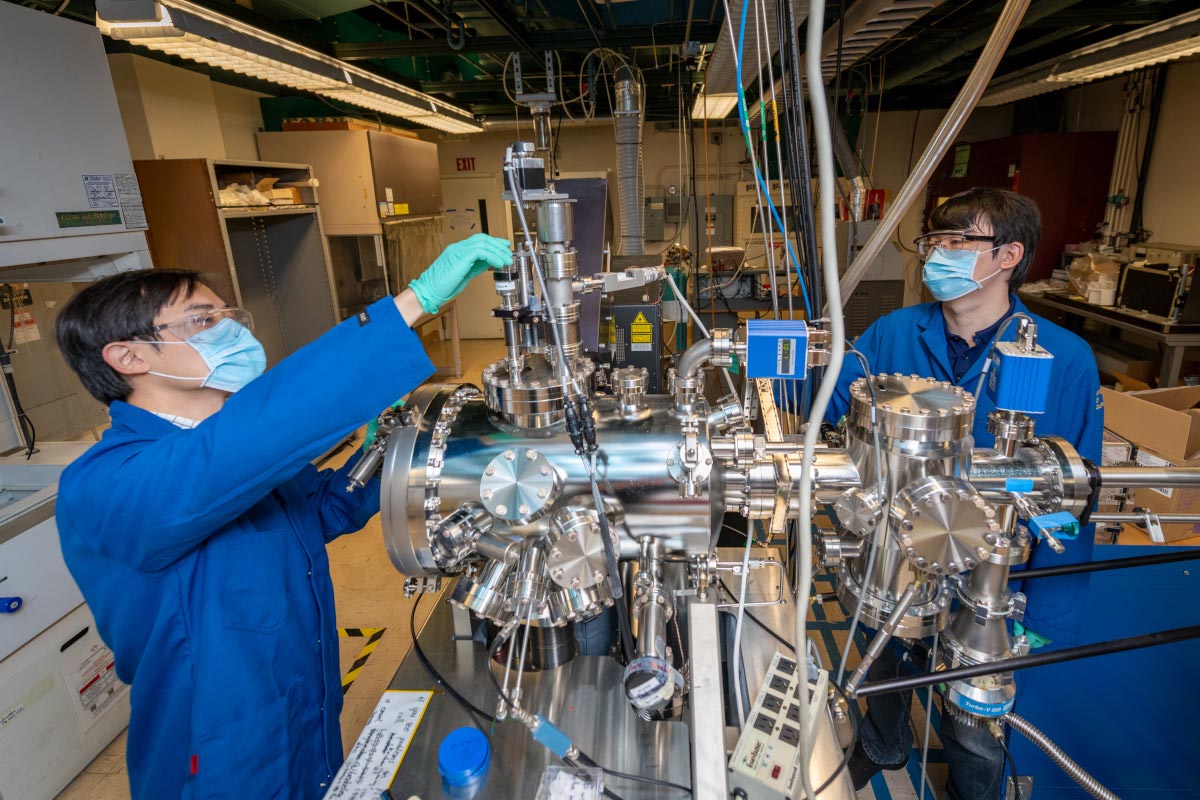
Finnegan Reichertz, a 12th grade student at the East Bay Innovation Academy in Oakland who worked remotely as a summer intern for Wu last year, helped to simulate how TARC and the other roof materials would perform at specific times and on specific days throughout the year for each of the 15 cities or climate zones the researchers studied for the paper.
The researchers found that TARC outperforms existing roof coatings for energy saving in 12 of the 15 climate zones, particularly in regions with wide temperature variations between day and night, such as the San Francisco Bay Area, or between winter and summer, such as New York City.
“With TARC installed, the average household in the U.S. could save up to 10% electricity,” said Tang, who was a postdoctoral researcher in the Wu lab at the time of the study. He is now an assistant professor at Peking University in Beijing, China.
Standard cool roofs have high solar reflectance and high thermal emittance (the ability to release heat by emitting thermal-infrared radiation) even in cool weather.
According to the researchers’ measurements, TARC reflects around 75% of sunlight year-round, but its thermal emittance is high (about 90%) when the ambient temperature is warm (above 25 degrees Celsius or 77 degrees Fahrenheit), promoting heat loss to the sky. In cooler weather, TARC’s thermal emittance automatically switches to low, helping to retain heat from solar absorption and indoor heating, Levinson said.
Findings from infrared spectroscopy experiments using advanced tools at Berkeley Lab’s Molecular Foundry validated the simulations.
“Simple physics predicted TARC would work, but we were surprised it would work so well,” said Wu. “We originally thought the switch from warming to cooling wouldn’t be so dramatic. Our simulations, outdoor experiments, and lab experiments proved otherwise – it’s really exciting.”
The researchers plan to develop TARC prototypes on a larger scale to further test its performance as a practical roof coating. Wu said that TARC may also have potential as a thermally protective coating to prolong battery life in smartphones and laptops, and shield satellites and cars from extremely high or low temperatures. It could also be used to make temperature-regulating fabric for tents, greenhouse coverings, and even hats and jackets.
Reference: “Temperature-adaptive radiative coating for all-season household thermal regulation” by Kechao Tang, Kaichen Dong, Jiachen Li, Madeleine P. Gordon, Finnegan G. Reichertz, Hyungjin Kim, Yoonsoo Rho, Qingjun Wang, Chang-Yu Lin, Costas P. Grigoropoulos, Ali Javey, Jeffrey J. Urban, Jie Yao, Ronnen Levinson and Junqiao Wu, 16 December 2021, Science.
DOI: 10.1126/science.abf7136
Co-lead authors on the study were Kaichen Dong and Jiachen Li.
The Molecular Foundry is a nanoscience user facility at Berkeley Lab.
This work was primarily supported by the DOE Office of Science and a Bakar Fellowship.
Never miss a breakthrough: Join the SciTechDaily newsletter.
Follow us on Google and Google News.