
Close Menu
    Facebook X (Twitter) Instagram
    SciTechDaily
    • Biology
    • Chemistry
    • Earth
    • Health
    • Physics
    • Science
    • Space
    • Technology
    Facebook X (Twitter) Pinterest YouTube RSS
    SciTechDaily
    Home»Space»World’s Next Gen Cosmic Observatory: Webb Space Telescope and Ariane 5 – Preparing for Launch [Video]
    Space

    World’s Next Gen Cosmic Observatory: Webb Space Telescope and Ariane 5 – Preparing for Launch [Video]

    By European Space Agency (ESA)December 17, 2021No Comments3 Mins Read
    Facebook Twitter Pinterest Telegram LinkedIn WhatsApp Email Reddit
    Share
    Facebook Twitter LinkedIn Pinterest Telegram Email Reddit
    James Webb Space Telescope’s Journey to Space
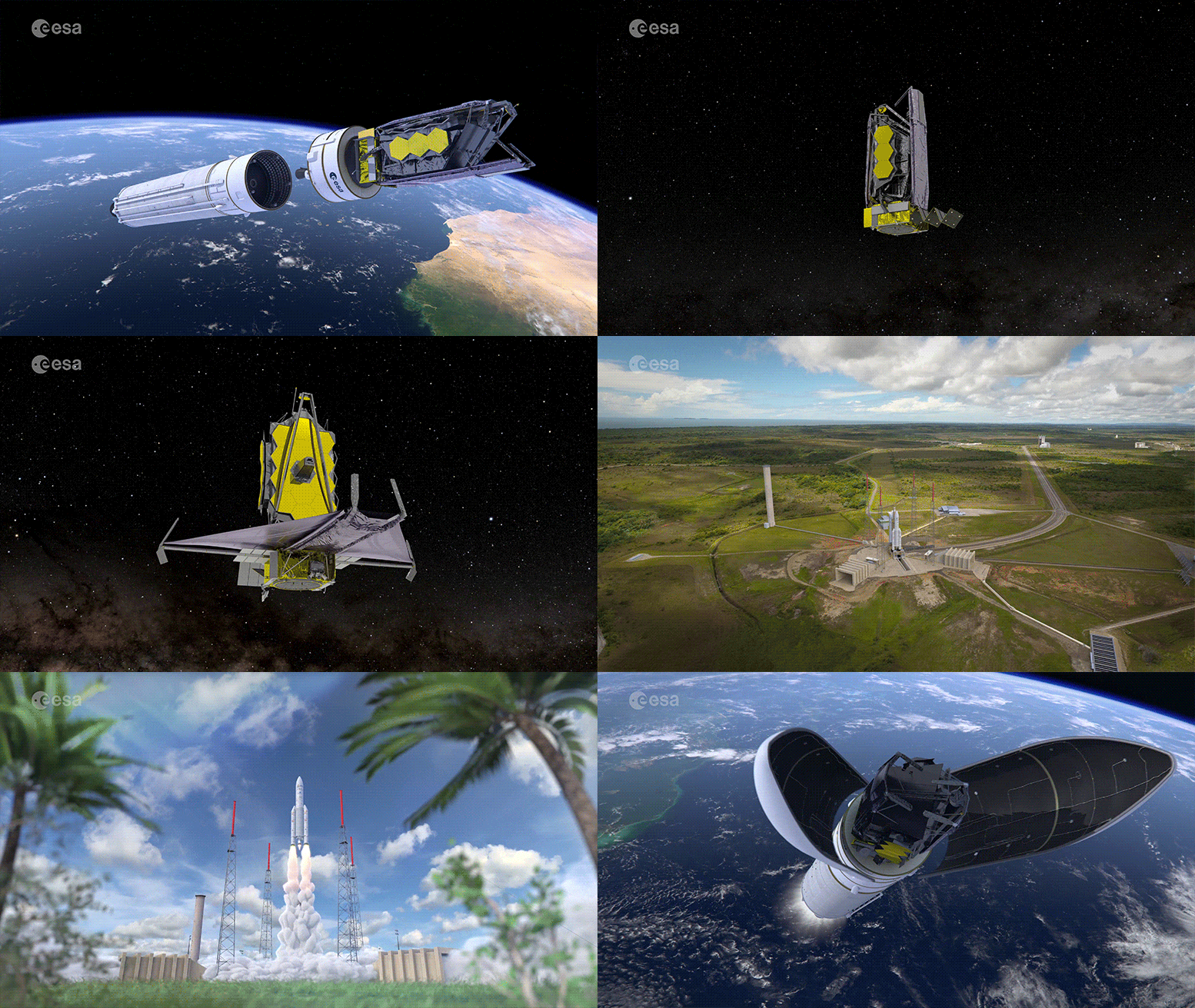
    The James Webb Space Telescope is scheduled to be launched aboard an Ariane 5 rocket from Europe’s Spaceport in French Guiana.

    The world’s next generation cosmic observatory, the James Webb Space Telescope, is due for launch on an Ariane 5 from Europe’s Spaceport in French Guiana.

    Webb is a joint project between NASA, the European Space Agency, and the Canadian Space Agency and is a remarkable feat of engineering and technology. The telescope is fitted with the largest astronomical mirror ever flown in space, sophisticated new scientific instruments, and a sunshield the size of a tennis court.

    Ariane 5 is one of the most reliable launch vehicles in the world and special modifications have been made for the preparation and launch of Webb.

    Webb will be the premier observatory of the next decade, serving thousands of astronomers worldwide. It will study every phase in the history of our Universe.

    Several innovative technologies have been developed for Webb. These include a primary mirror made of 18 separate segments that unfold and adjust to shape after launch. The mirrors are made of ultra-lightweight beryllium. Webb’s biggest feature is a tennis court sized five-layer sunshield that attenuates heat from the Sun more than a million times. The telescope’s four instruments — cameras and spectrometers — have detectors that are able to record extremely faint signals. One instrument (NIRSpec) has programmable microshutters, which enable observation up to 100 objects simultaneously. Webb also has a cryocooler for cooling the mid-infrared detectors of another instrument (MIRI) to a very cold 7 K so they can work.

    The James Webb Space Telescope will be the largest, most powerful telescope ever launched into space.

    Webb’s flight into orbit will take place on an Ariane 5 rocket from Europe’s Spaceport in French Guiana.

    Webb is the next great space science observatory, designed to answer outstanding questions about the Universe and to make breakthrough discoveries in all fields of astronomy. Webb will see farther into our origins – from the formation of stars and planets, to the birth of the first galaxies in the early Universe.

    During the first month in space, on its way to the second Lagrange point (L2), Webb will undergo a complex unfolding sequence. Key steps in this sequence are unfolding Webb’s sunshield – a five-layer, diamond-shaped structure the size of a tennis court – and the iconic 6.5-meter wide mirror, consisting of a honeycomb-like pattern of 18 hexagonal, gold-coated mirror segments.

    Working with partners, ESA was responsible for the development and qualification of Ariane 5 adaptations for the Webb mission and for the procurement of the launch service. As well as launch services, ESA contributes to two of the four science instruments (NIRSpec and MIRI), and provides personnel to support mission operations.

    Webb is an international partnership between NASA, the European Space Agency (ESA) and the Canadian Space Agency (CSA).

    Never miss a breakthrough: Join the SciTechDaily newsletter.
    Follow us on Google and Google News.

    Astronomy Astrophysics European Space Agency James Webb Space Telescope NASA
    Share. Facebook Twitter Pinterest LinkedIn Email Reddit

    Related Articles

    Major Milestone: NASA’s Webb Space Telescope Discovers Earliest Galaxies in the Universe

    Galactic Collision: Webb Space Telescope Explores Frenzied Star Formation in Merging Galaxies

    Webb Space Telescope To Provide Details of Two Intriguing “Super-Earths” in the Milky Way

    Webb Space Telescope: Uncovering Hidden Parts of Our Solar System

    Science With the Webb Space Telescope – What Questions Will It Answer?

    Seeing Farther: Webb Space Telescope Is Designed To Answer Fundamental Questions of the Universe

    James Webb Space Telescope – Cosmic Observatory Will Offer a New View of the Universe

    $10 Billion James Webb Space Telescope Fueled for Launch

    First James Webb Space Telescope General Observer Scientific Programs Selected

    Leave A Reply Cancel Reply

    • Facebook
    • Twitter
    • Pinterest
    • YouTube

    Don't Miss a Discovery

    Subscribe for the Latest in Science & Tech!

    Trending News

    Sitting Up Straight Could Actually Help You Make Better Decisions

    Never-Before-Seen Vortices Are Swirling Across the Sun

    This Common Amino Acid May Help the Body Fight Cancer and Viruses

    Low-Protein “Longevity Diet” Linked to Fat Loss, Muscle Preservation, and Healthy Aging

    How Prehistoric Poop Changed Earth’s Ecosystems Forever

    This Fossil Upends a Decades-Old Debate About Snake Evolution

    A Blood Test Years Before Cancer May Reveal a Hidden Warning Sign

    Starlink Satellites Reveal a Hidden Atmosphere 300 Miles Above Earth

    Follow SciTechDaily
    • Facebook
    • Twitter
    • YouTube
    • Pinterest
    • Newsletter
    • RSS
    SciTech News
    • Biology News
    • Chemistry News
    • Earth News
    • Health News
    • Physics News
    • Science News
    • Space News
    • Technology News
    Recent Posts
    • Tiny Fossil Overlooked for Decades Reveals a New Ice Age Species
    • Melting Sea Ice Could Be Changing the Clouds Above the Arctic
    • Ancient Neanderthal DNA May Give Some People More Muscle
    • These Overlooked Immune Cells Supercharge the Fight Against Cancer
    • The Surprising Reason a UTI Hurts So Much – and Why That Might Be a Good Thing
    Copyright © 1998 - 2026 SciTechDaily. All Rights Reserved.
    • Science News
    • About
    • Contact
    • Editorial Board
    • Privacy Policy
    • Terms of Use

    Type above and press Enter to search. Press Esc to cancel.