
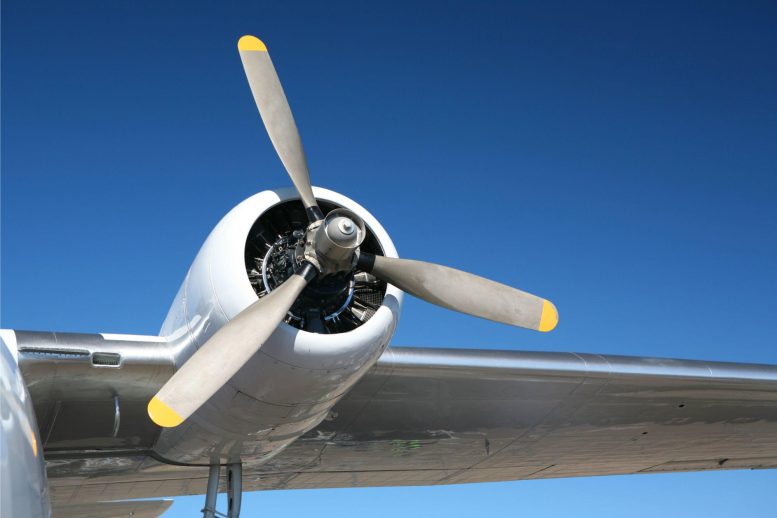
Optimized Six-Blade Propellers Reduce Noise Significantly While Maintaining Efficiency
The electrification of aviation is viewed as a crucial component in the creation of a fossil fuel-free future. However, electric aviation is faced with a challenge: the more energy-efficient the aircraft, the louder it becomes. Fortunately, researchers at Chalmers University of Technology in Sweden have developed an optimized propeller design that opens up the possibility for electric aviation to be both quiet and efficient.
Electrification has been touted as a key factor in mitigating emissions from the aviation industry in recent years. The main area of focus for electrification is short-distance electric propeller planes, as they present fewer obstacles in terms of range limitations. Propellers driven by electric motors are deemed to be the most efficient propulsion system for regional and domestic flights.
But while airplanes are electric, propellers cause another kind of emission – noise. The noise from the propeller blades wouldn’t just disturb air passengers. Future electric aircraft will need to fly at relatively low altitudes, with noise disturbance reaching residential areas and animal life.

Battling a trade-off dilemma
This is where the research community faces a dilemma. The ambition of developing electric aircraft that are both quiet and energy-efficient is somewhat thwarted by a trade-off problem.
“We can see that the more blades a propeller has, the lower the noise emissions. But with fewer blades, propulsion becomes more efficient and the electric aircraft can fly for longer. In that sense, there is a trade-off between energy efficiency and noise. This is something of an obstacle for electric aircraft that are both quiet and efficient,” explains Hua-Dong Yao, Associate Professor and researcher in fluid dynamics and marine technology at Chalmers University of Technology.
An optimized design for quiet and efficient propellers
But now, Hua-Dong Yao and his research colleagues may be one step closer to a solution. They have succeeded in isolating and exploring the noise that occurs at the tip of the propeller blades, or “tip vortices”, a known but less well-explored source of the noise. In isolating this noise, the researchers were able to fully understand its role in relation to other noise sources generated by propeller blades. By adjusting a range of propeller parameters, such as pitch angle, chord length, and a number of blades, the team found a way to optimize the propeller design and even out the trade-off effect between efficiency and noise. The method, described in the study published in the journal Aerospace, can now be used in the design process of quieter propellers for future electric aircraft.
“Modern aircraft propellers usually have two to four blades, but we’ve found that by using six blades designed using our optimization framework, you can develop a propeller that’s both relatively efficient and quiet. The propeller achieves a noise reduction of up to 5-8 dBA with only a 3.5 percent thrust penalty, compared to a propeller with three blades. That’s comparable to the noise reduction of someone going from speaking in a normal conversation voice to the sound you would perceive in a quiet room,” says Hua-Dong Yao.
- A-weighted decibel (dBA or dB(A)) is an expression of the relative loudness of sounds as perceived by the human ear. A-weighting gives more value to frequencies in the mid-range of human hearing and less value to frequencies at the edges as compared to a flat audio decibel measurement. A-weighting is the standard for determining hearing damage and noise pollution.
Reference: “Blade-Tip Vortex Noise Mitigation Traded-Off against Aerodynamic Design for Propellers of Future Electric Aircraft” by Hua-Dong Yao, Zhongjie Huang, Lars Davidson, Jiqiang Niu and Zheng-Wei Chen, 15 December 2022, Aerospace.
DOI: 10.3390/aerospace9120825
The study was funded by the Transport Area of Advance at Chalmers University of Technology.
Never miss a breakthrough: Join the SciTechDaily newsletter.
Follow us on Google and Google News.
12 Comments
Probably already being built in China after being stolen through industrial espionage.
Aircraft are the 1 form of transport that I’m extremely skeptical of it making sense to go electric. Batteries are heavy. Hydrocarbon combustion, besides having many decades of engineering optimization for aircraft, also has the advantage that as the fuel is used, the weight decreases, making it easier and more efficient to fly. The impact of weight on efficiency and safety is much easier to compensate for with both ground and water transport systems.
Desde mi punto de vista se debiera usar el hidrógeno en aviación y dejar la electricidad para la transportación terrestre. Al menos por ahora hasta que los avances y progresos lógicos futuros determinen una nueva opción o tendencia en cuanto a complejidad, economía y factibilidad.
Fire and explosion to watch !
I wonder if the new type of batteries china has developed or the new Tesla battery alongside a toroidal propeller design has been considered even in drone form.
I thought they solved this with toroidal propellers?
I remember, quite a few years ago, a design of a prop that was based the shape of the flukes of the largest whales, and was more efficent than the normal design. The blades had areas that we recessed like the whales flukes, which created less resistance in passing through water, with an improved amount of forward thrust, combined with less resistance in passing through water. I wonder if this would work through air, as well, and create less resistance for the prop when turning, with the same improved forward thrust?
When will you morons stop with the BS about electric air travel? It will NEVER HAPPEN!. Go look up energy density and all your lies and BS crumble.
“If Man were meant to fly God would have given him wings!”
And “How do you expect to field a proper arm without sturdy horses for you cavalry men?!”
What seems impossible today may be surprisingly obvious to future generations. There have always been men lacking in imagination that believe nothing can ever be done except in the manner to them. Visionaries set aside that blinkered perspective and ask “How *CAN* we do it?”, then set about building the future.
Your concerns about energy density are legitimate. Electric cars were relatively impractical when lead-acid batteries were the dominant storage medium. Then came lithium ion batteries, and storage capacity and travel range limits continue to improve.
I cannot tell you what technological breakthrough will facilitate electrified aviation.. If I knew that, I would sell everything and buy stock in the pioneer compan(ies). But I am intellectually humble enough to concede that there minds smarter than my own working to solve exactly the limitations you cite.
As I like to remind people: “A Boeing 747 looks nothing like the 1903 Wright Flyer. Most technologies require time to mature.”
when will the so called green energy eko nazis stop destroying our planet for nuclear electric energy, they call green? they are all that addicted making money from subsidiced energy from windmills and solar panels that we all have to pay for those kiars or fanatics! it,s not us! it,s the Melanchovic cycle that heats up the earth! so stop destroying us by asking for taxes that lead everyone into poverty! or green fuels, made from soy and corn? that,s all bulls***! we all know thta 8,4 billion people are simply too much to live all under the permission to have luxury and wellfare! that.s the f***ing reality! we were 1,5 billion in 1950 , now we are around 9? so stuff 2 rats into a cage or ten! nobody needs electric power…what we need is less restrictions and less taxes used for military that uses 50% of all resources! then we have enough leeway for gasoline and less taxes for a cheaper livestyle and less working hours…and stop lying about that fucking electricity s***! my house is wet, my bills are higher amd higher…for what? a Nato dictature in Europe now?
btw: there is a naca bideo about smaller more silent props simply bcs smaller and more blades reduces the tip soeed and thereby the noise and the vortices, it,s just that no blind a**hole in that military pushed industry ever recognized that! “silent star” the espionage vietnam based airplane had all that, low rpm, 6 blades, tapered…🤷♀️
“If Man were meant to fly God would have given him wings!”
And “How do you expect to field a proper arm without sturdy horses for you cavalry men?!”
What seems impossible today may be surprisingly obvious to future generations. There have always been men lacking in imagination that believe nothing can ever be done except in the manner to them. Visionaries set aside that blinkered perspective and ask “How *CAN* we do it?”, then set about building the future.
Your concerns about energy density are legitimate. Electric cars were relatively impractical when lead-acid batteries were the dominant storage medium. Then came lithium ion batteries, and storage capacity and travel range limits continue to improve.
I cannot tell you what technological breakthrough will facilitate electrified aviation.. If I knew that, I would sell everything and buy stock in the pioneer compan(ies). But I am intellectually humble enough to concede that there minds smarter than my own working to solve exactly the limitations you cite.
As I like to remind people: “A Boeing 747 looks nothing like the 1903 Wright Flyer. Most technologies require time to mature.”
You display an immemse lack of understand about how actual science works.
The role of the atmosphere in controlling the rate of heat loss from the planet’s surfsce was recognized and acknowledged during the 1800s. The role specific greenhouse gases: CO2, methane, and water vapor (a gaseous state of H2O) play in that heat retention became clear during the 20th century.
Climate scientists (the one’s with years of formal education and proper PhD’s in their fields of expertise, build mathematical models of these energy transfer interactions, then feed in historical data to see how well the model(s) track with the historical record. The impact of burning fossil carbon on temperature trends became obvious when including the effects of increasing greenhouse gases in the atmosphere was the only way for the models to line up with the historical data.
If anything, the effects of global warming are manifesting *more* rapidly than the initial models suggested, not because the models were imperfect (which, of course, they were. You learn, you tweak), but because climatologist did not want to publish alarmist predictions based on the earliest stages of their work. Arctic sea ice has been melting *faster* than initially projected (just ask US Navy submariners), glaciers have retreated faster than initially predicted, over night low temperatures and winter length of season temperatures have gotten warmer more quickly than initially predicted, drought and torrential rain events (hotter air can transport more absolute moisture) have accelerated more quickly than initially predicted. These are not the effects of millennium long cosmic cycles. These are the predicted effects of altering atmospheric chemistry and atmospheric heat transfer physics on the scale of decades(!), because humans have been pumping fossil carbon, that was sequestered for millions of years, into the atmosphere, and the growing human population and our shared aspirations for lives of greater ease, convenience, and material possessions has accelerated the rate of fossil carbon combustion for the last 150 years! These are just facts (Donald Trump and the FAUX News Know-Nothings notwithstanding).
A few million humans living an agrarian lifestyle wouldn’t move the [metaphorical] atmospheric needle, but 8 BILLION human seeking a moss production lifestyle continue to pump billions of pounds of additional CO2 into the atmosphere every year.
If you keep doing what you’re doing, you should rightly expect the trend lines to continue *and accelerate*. As Neil DeGrasse Tyson is attributed as saying: “When you don’t understand how anything works, everything seems like a conspiracy.” But once you take the time to actually learn what decades of dedicated peer-reviewed research has discovered, the natural consequences of our own actions are self-evident.
Some people just want to “say it ain’t so” because admitting that each of us is contributing to the problems to greater and lesser degrees, means accepting that the onus of taking informed and fact-guided action to change our choices and our behaviors is a responsibility that far too many people are willing to ignore because we’ve come to believe that we can have anything and everything we want without sny consequences to ourselves or others.
Nature does not care what we want. We muck with the life support systems of the planet — like temperature, rainfall, and ocean acidification — then the consequences come, like it or not. And ignorance, especially willful ignorance (“I don’t believe it, so it ain’t so!”) is no defense. Nature does not care what you believe or disbelieve. The rules of physics (energy transfer) and chemistry (fossil carbon plus combustion equals altered atmospheric composition) will follow their natural outcomes whether someone “believes” it or not.