
NASA is joining a government-wide push to decarbonize aviation through the Sustainable Aviation Fuel Grand Challenge, which targets 3 billion gallons of sustainable fuel production by 2030 and 100% coverage by 2050.
NASA Administrator Bill Nelson recently joined federal government and industry leaders at a White House event highlighting sustainable aviation and the administration’s focus on medium- and long-term goals to combat climate change.
The event highlighted a plan to reduce aviation carbon emissions through production of more than three billion gallons of sustainable fuel by 2030. Officials from the Departments of Transportation, Energy, and Agriculture announced a Sustainable Aviation Fuel Grand Challenge (SAFGC) to meet this goal, in partnership with industry and other federal agencies. SAFGC aims to reduce costs, enhance the sustainability of aviation, as well as expand the production and use of sustainable aviation fuel to meet 100% of U.S. demand by 2050.
Nelson delivered remarks underscoring NASA’s origins as an aeronautics research organization and history of improving aviation efficiency and safety. NASA innovations have made aircraft quieter and more fuel-efficient while reducing their harmful emissions, he said, making aviation more sustainable environmentally and economically.
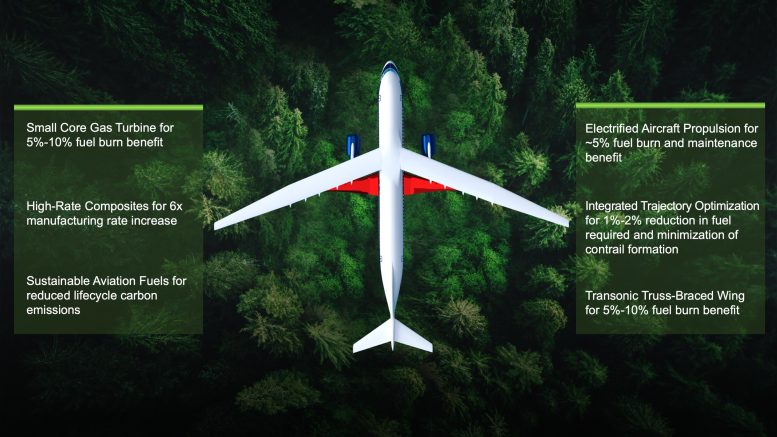
“Our aeronautics researchers are developing and testing new green technologies for next-generation aircraft, new automation tools for greener and safer airspace operations, and sustainable energy options for aircraft propulsion,” Nelson said.
Next-Generation Green Aircraft Development
NASA is investing in cost-sharing partnerships with U.S. companies to research and demonstrate high-risk, high-reward technology for next-generation, single-aisle aircraft that are at least 25% more fuel-efficient. These aircraft could see service by the early 2030s. Single-aisle aircraft generate the largest share of aviation carbon emissions of all aircraft class sizes.
“We’re working to keep U.S. companies economically competitive by helping them bring to market the next generation of environmentally-sustainable commercial transport aircraft,” said Bob Pearce, NASA’s associate administrator for aeronautics. “The fiercely competitive single-aisle market is an important path to economic recovery for aircraft manufacturers and airlines after COVID-19, and foreign governments are investing heavily in these technologies.”
Under its recently launched Sustainable Flight National Partnership, NASA will collaborate with the Federal Aviation Administration (FAA) and industry partners to accelerate the maturation of aircraft and engine technologies to enable a significant reduction in fuel consumption and carbon dioxide emissions. The partnership’s efforts include demonstrating new technology, such as the first-ever high-power, hybrid-electric propulsion systems for large transport aircraft, long and slender ultra-high efficiency wings, and advanced composite materials. NASA will also demonstrate advanced engine technologies based on its breakthrough innovations.
Advanced Propulsion and Battery Technologies
In collaboration with the Department of Energy, NASA will develop battery technologies that can provide the power required for electric aircraft with vertical takeoff and landing capability, as well as for short-range consumer aircraft. In the long term, these battery technologies could potentially achieve the energy density needed for longer-range electric aircraft as well.
A memorandum of understanding signed at the White House event calls for the development of a government-wide strategic plan to meet these goals. The SAFGC Roadmap will take a multi-generational approach, setting U.S. milestones at 2030, 2040, and 2050.
NASA will contribute to the nation’s commitment to sustainable aviation embodied in the SAFGC. Building on its ground and flight campaigns of the past decade, NASA researchers will continue sampling and characterizing the makeup of sustainable aviation fuel emissions to verify performance, and to ensure compatibility of sustainable aviation fuels with existing and future aircraft.
For information on the administration’s Sustainable Aviation Fuels efforts, see this new fact sheet.
Never miss a breakthrough: Join the SciTechDaily newsletter.
Follow us on Google and Google News.
2 Comments
Nice Article! Big Fan of NASA