
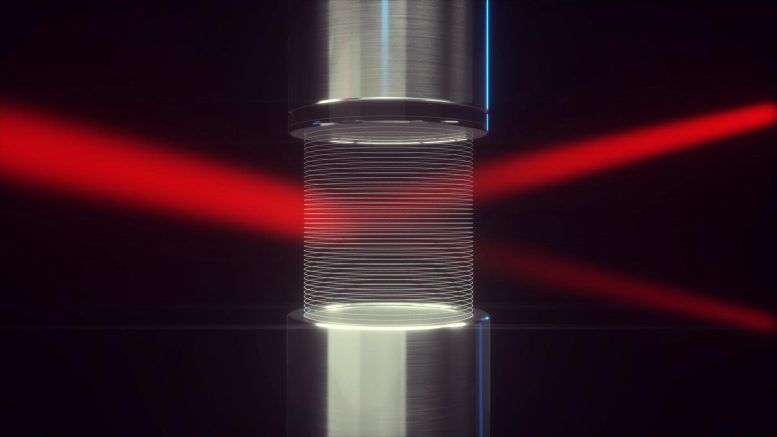
Innovative concept changes the direction of laser light with the help of sound waves.
Using a novel method, beams of laser light can be deflected using air alone. An invisible grating made only of air is not only immune to damage from the laser light, but it also preserves the original quality of the beam, reports the interdisciplinary research team in the journal Nature Photonics. The researchers have applied for a patent for their method.
Technique and Principle
The innovative technique uses sound waves in order to modulate the air in the region where the laser beam is passing. “We’ve generated an optical grating with the help of acoustic density waves,” explains first author Yannick Schrödel, a Ph.D. student at DESY and Helmholtz Institute Jena.
With the help of special loudspeakers, the researchers shape a pattern of dense and less dense areas in the air, forming a striped grating. In a way that is similar to how differential air densities bend the light in the Earth’s atmosphere, the density pattern takes on the role of an optical grating that changes the direction of the laser light beam.
“However, deflecting light by diffraction grating allows much more precise control of the laser light compared to deflection in the Earth’s atmosphere,” says Schrödel. “The properties of the optical grating are influenced by the frequency and intensity – in other words, the volume – of the sound waves.”
Laboratory Results and Potential
In the initial laboratory tests, a strong infrared laser pulse could be redirected in this way with an efficiency of 50 percent. Significantly higher efficiencies should be possible in the future, according to numerical models. For the first test, the scientists had to turn their special loudspeakers way up.
“We are moving at a sound level of about 140 decibels, which corresponds to a jet engine a few meters away,” explains scientist Christoph Heyl from DESY and the Helmholtz Institute Jena, who is leading the research project. “Fortunately, we are in the ultrasound range, which our ears don’t pick up.”
The team sees great potential in the technique for high-performance optics. In their experiments, the researchers used an infrared laser pulse with a peak power of 20 gigawatts, which corresponds to the power of around two billion LED bulbs. Lasers of this and even higher power classes are used, for example, for material processing, in fusion research, or for the latest particle accelerators.
“In this power range, the material properties of mirrors, lenses, and prisms significantly limit their use, and such optical elements are easily damaged by strong laser beams in practice,” explains Heyl. “In addition, the quality of the laser beam suffers. In contrast, we’ve managed to deflect laser beams in a quality-preserving way without contact.”
Further Applications and Insights
The principle of acoustic control of laser light in gases is not limited to the generation of optical gratings, the scientists emphasize. It can probably also be transferred to other optical elements such as lenses and waveguides.
“We’ve been thinking about this method for a long time and quickly realized that extreme sound levels are necessary. At first, these seemed technically unfeasible,” explains Heyl. “However, we did not give up and finally found a solution with the support of researchers at the Technical University of Darmstadt as well as the company Inoson. First, we tried out our technique with ordinary air. Next, for example, we will also use other gases in order to tap into other wavelengths and other optical properties and geometries.”
The deflection of light directly into ambient air, which has already been demonstrated, opens up promising applications, especially as a fast switch for high-power lasers. “The potential of contactless control of light and its extension to other applications can currently only be imagined,” explains Heyl. “Modern optics is based almost exclusively on the interaction of light with solid matter. Our approach opens up a completely new direction.”
Reference: “Acousto-optic modulation of gigawatt-scale laser pulses in ambient air” by Yannick Schrödel, Claas Hartmann, Jiaan Zheng, Tino Lang, Max Steudel, Matthias Rutsch, Sarper H. Salman, Martin Kellert, Mikhail Pergament, Thomas Hahn-Jose, Sven Suppelt, Jan Helge Dörsam, Anne Harth, Wim P. Leemans, Franz X. Kärtner, Ingmar Hartl, Mario Kupnik and Christoph M. Heyl, 2 October 2023, Nature Photonics.
DOI: 10.1038/s41566-023-01304-y
Researchers from the Technical University of Darmstadt, Aalen University of Applied Sciences, Universität Hamburg, Inoson GmbH in St. Ingbert, the Helmholtz Institute Jena, and DESY were involved in the work.
Never miss a breakthrough: Join the SciTechDaily newsletter.
Follow us on Google and Google News.
1 Comment
The formation and propagation of light cannot do without the interaction of vortex fields. According to topological vortex gravitational field theory, light may enhance or decay during its propagation. Variable frequency lasers may have stronger penetration and damage capabilities, and can also adjust the damage frequency through feedback. If you are really interested in optics, you can browse https://zhuanlan.zhihu.com/p/569722770.