
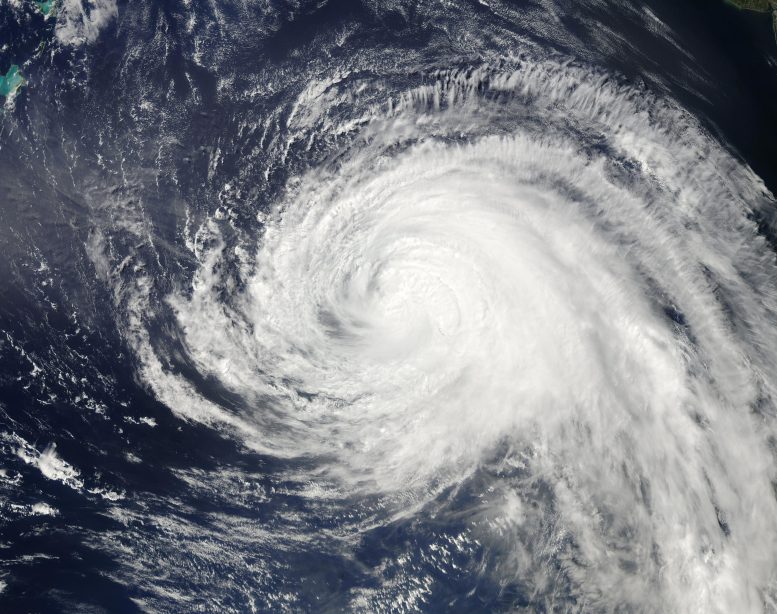
Long-term data from a deep-sea observatory shows hurricanes transport reef sediments and pollutants to the deep ocean, influencing carbon sequestration and ocean chemistry.
The impacts of hurricanes on land, ships, and offshore oil platforms are well known. However, their effects on the ocean, particularly below the surface, remain poorly understood and challenging to investigate.
A unique underwater observatory is helping to bridge that gap. Anchored to the seafloor in the Sargasso Sea, about 47 miles southeast of Bermuda, this subsurface platform collects sinking particles such as sediment, microplankton shells, organic matter, and pollutants at various depths. It samples every two weeks, contributing to a nearly 50-year record of deep-ocean changes.
Now, researchers with the Oceanic Flux Program (OFP) at the Marine Biological Laboratory (MBL) have used this long-term dataset to reveal, for the first time, the significant impact hurricanes can have on deep-sea environments.
A team led by MBL Assistant Research Investigator Rut Pedrosa-Pamies studied the sediments that Hurricanes Fabian (2003) and Igor (2010) transported from the Bermuda carbonate platform — a shallow-water reef refuge for marine life – and deposited to the deep ocean. They found significant effects that lasted for weeks. They recently published their data in the Journal of Geophysical Research – Oceans.
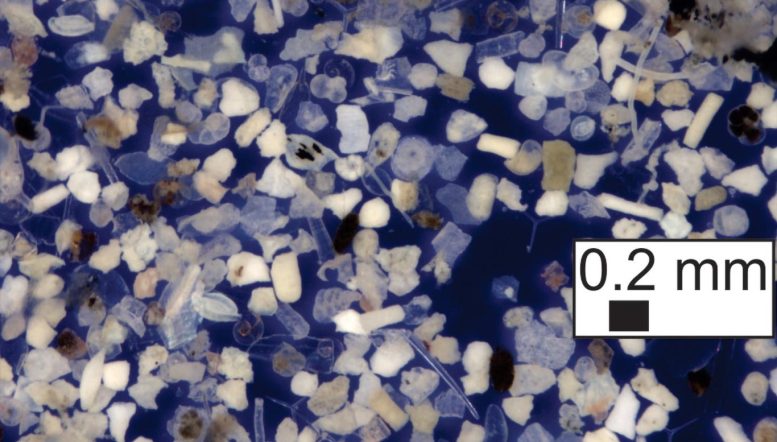
Hurricane Fabian, it turns out, delivered as much sediment to the deep ocean in just two weeks as would normally take a full year to accumulate. These sediments — carbonate-rich material that forms in the thriving ecosystem on reef platforms — have major effects on the ocean environment. If they get buried in deep sediments, they can sequester carbon for millennia or more. They can also provide a buffering effect to help offset ocean acidification, a consequence of rising atmospheric CO2 concentrations.
“This is the first time that a study has demonstrated, in near real-time, this hurricane-induced transport from a shallow carbonate platform to the deep ocean,” Pedrosa-Pamies says. “And it’s not just carbonate; [a hurricane] also transports a lot of other materials like phosphorus, lithogenic minerals, and also pollutants, such as lead.”
Fabian and Igor in the Deep Sea
“I’ve been interested in extreme weather events for a long time now,” Pedrosa-Pamies says. “When a hurricane passes through, there is an upwelling of cold, nutrient-rich waters” that nourish bacteria and plankton in the ocean’s upper layers, stimulating their productivity. But how hurricanes can impact the deep-ocean water column that surrounds shallow-water reefs has not been well studied.
The team also found that “not all hurricanes will trigger the same response,” she says. “It depends a lot on the ocean depth of the area, the upper-ocean conditions, the hurricane characteristics, etc.” Unlike Fabian, the carbonate platform particles resuspended by Hurricane Igor remained suspended for several weeks.
“That’s a key finding because it proves that particles that get suspended from these extreme weather events can last for a long time in the ecosystem and the water column,” Pedrosa-Pamies says. “And I’m sure this has implications for the microbiome at different water depths, and also in terms of sedimentation rates and how the particles are aggregating.”
Olivia Gadson
Shallow-water reefs are distributed around the world, and over time, they build up extensive platforms of carbonate. These platforms play an important role in ocean sedimentary processes and the carbon cycle, Pedrosa-Pamies says. They account for an estimated half of all shallow-water carbonate production, and more than a quarter of all the carbonate that gets buried in the deep ocean.
While the impact of Hurricanes Fabian and Igor is small at the global level, the knowledge gained from this work about the fundamental mechanisms of sediment transport during major storms should apply to the extensive carbonate platforms worldwide. It points out the important role that storms can play in carbon sequestration, and the buffering of ocean acidification.
From Bermuda to Woods Hole
The OFP has been running continuously since 1978 and is “the longest time series of its kind,” Pedrosa-Pamies says. “Without having this time series, studying episodic events, like hurricanes in this case, would not be possible. You cannot sit out there when there is a storm passing and collect particles, while you have wind and big waves.”
The proximity of the sampling to Bermuda is important, she explains, because “Bermuda is the northernmost subtropical coral reef and carbonate platform in the world, and it’s frequently impacted by hurricanes.”
The OFP recently published an analysis of the sinking particles at its moored platform off Bermuda over a 44-year period (1978-2022). The results are published in Progress in Oceanography.
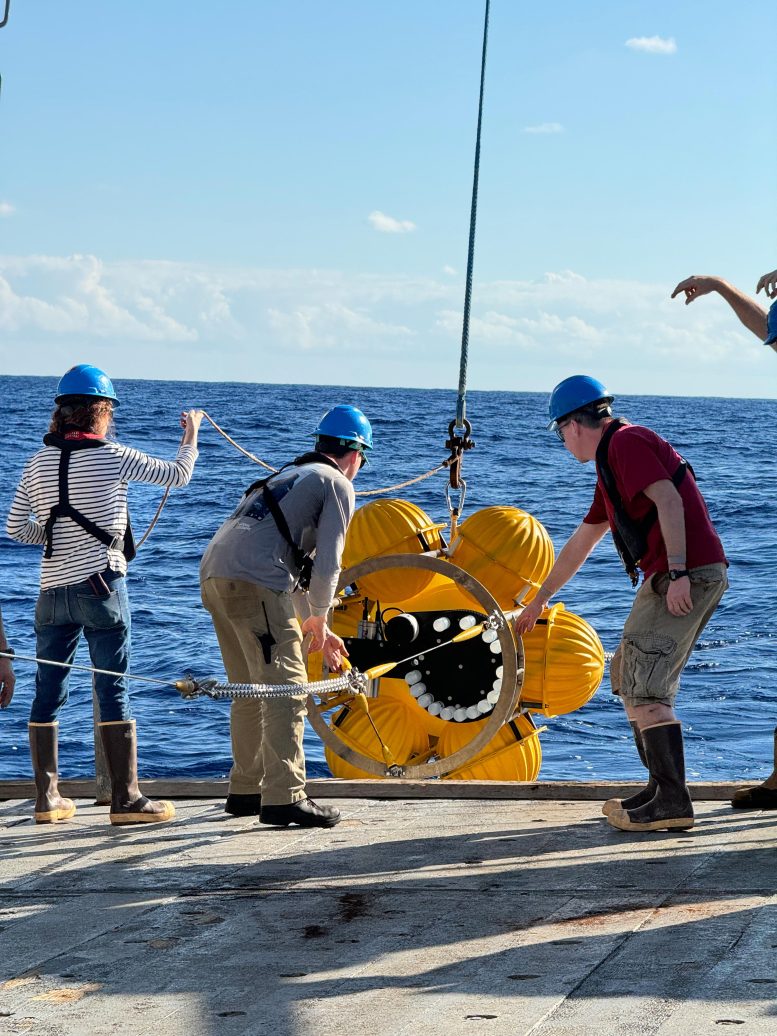
The process of pulling up the OFP’s deep mooring line aboard the ship and retrieving the samples for analysis, which is done every six months, is a challenging, day-long operation.
“I just cannot reinforce enough how important the team effort is in a time series like this. It would not be possible with help of the entire crew,” Pedrosa-Pamies says. “And they are all fantastic, and we’ve been working with them for a long time.”
Reference: “Hurricane-Driven Transport of Bermuda Reef Carbonate Platform Sediments to the Deep Ocean” by R. Pedrosa-Pamies, M. H. Conte, J. C. Weber and A. J. Andersson, 5 March 2025, Journal of Geophysical Research: Oceans.
DOI: 10.1029/2023JC020500
Funding: National Science Foundation
Never miss a breakthrough: Join the SciTechDaily newsletter.
Follow us on Google and Google News.
2 Comments
“They can also provide a buffering effect to help offset ocean acidification, …”
Are spaces in a sentence so valuable that the ambiguous (and usually incorrect) “acidification” can’t be replaced by the more accurate “lowering of pH?” Preciseness, or maximizing clarity, is important in science. When that concern is ignored, one should wonder if there is some motivation other than scientific clarity that is responsible for the choice of words — like political propaganda.
“Hurricane Fabian,…, delivered as much sediment to the deep ocean in just two weeks as would normally take a full year to accumulate.”
It is also true that the transport of river and stream sediments is greatest during extreme events, especially things like 500 and 1,000-year floods. It points to the need to not depend on using short time-periods to formulate hypotheses or equations to describe general or long behavior of sediment transport and erosion.