

The study tracks mammoth evolution over a million years using mitogenomes, showing shifts in diversity and lineage tied to Pleistocene demographic events.
A recent genomic study has revealed previously unknown genetic diversity in mammoth lineages that spans more than a million years, offering new perspectives on their evolutionary history.
Researchers successfully extracted and analyzed 34 new mitochondrial genomes (mitogenomes) from mammoth specimens, including 11 from the Early and Middle Pleistocene periods. These specimens range in age from 1.3 million to 125,000 years old. Published in Molecular Biology and Evolution, the study highlights how ancient DNA can be used to explore genetic variation over deep time.

“Our analyses provide an unprecedented glimpse into how major deep-time demographic events might have shaped the genetic diversity of mammoths through time,” said Dr. J. Camilo Chacón-Duque, a researcher at the Department of Zoology, Stockholm University, and the Centre for Palaeogenetics, and the study’s lead author.

A million years of mammoth evolution
Most of today’s biodiversity evolved during the last 2.5 million years. Understanding the evolutionary processes that shaped this diversity requires access to genetic information throughout this timeframe. Until now, very few DNA samples have surpassed the 100-thousand-year threshold due to preservation challenges. By recovering DNA from mammoth specimens spanning over more than a million years, this study showcases the importance of temporal sampling in characterising the evolutionary history of species.
By analysing these new mitogenomes alongside over 200 previously published mammoth mitogenomes, the researchers were able to find that diversification events across mammoth lineages seem to coincide with well-described demographic changes during the Early and Middle Pleistocene. Their findings support an ancient Siberian origin for major mammoth lineages and reveal how shifts in population dynamics might have contributed to the expansion and contraction of distinct genetic clades.
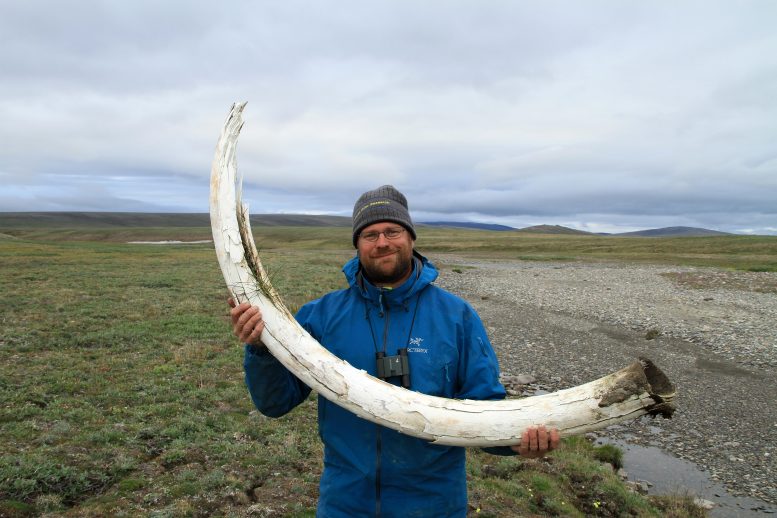
“With the ever-decreasing costs of sequencing technologies, mitogenomes have been somewhat forgotten. However, our study shows that they remain crucial for evolutionary biology since they are more abundant than nuclear DNA,” said Dr Jessica A. Thomas Thorpe, researcher at the Wellcome Sanger Genome Institute (UK) and co-first author of the study.
A big contribution to evolutionary biology
The study not only advances our understanding of mammoth evolution but also contributes to the broader field of ancient DNA research. The team developed and applied an improved molecular clock dating framework, refining how genetic data can be used to estimate the ages of specimens beyond the radiocarbon dating limit. This methodological advancement offers a powerful tool for future research on extinct and endangered species.
“These results add to our earlier work where we reported million-year-old genomes for the first time. I’m very excited that now we have genetic data from many more mammoth specimens sampled across the last million years, which helps us understand how mammoth diversity has changed through time,” said senior author Professor Love Dalén at Stockholm University and the Centre for Paleogenetics.
Key Findings and Future Implications
- The study includes 34 newly sequenced mammoth mitogenomes, with 11 dating back over 100,000 years, increasing substantially the number of mammoth DNA samples beyond this time point, pushing the boundaries of ancient DNA research.
- The team identified the oldest known mammoth DNA in North America, from a specimen found in the Old Crow River, Yukon Territory, Canada and dating to more than 200,000 years ago.
- Their results confirm previous research (van der Valk et al., 2021), showing that mammoths from around a million years ago do not closely resemble later mammoths.
- The study refines DNA-based methods for estimating the ages of ancient specimens, paving the way for more accurate reconstructions of evolutionary histories.
By combining cutting-edge molecular techniques with computational advances, this research highlights the critical role of deep-time DNA in uncovering the genetic past of extinct species. Future studies may apply these methodologies to other long-extinct or endangered species, further enriching our understanding of evolutionary biology.
Reference: “A Million Years of Mammoth Mitogenome Evolution” by J Camilo Chacón-Duque, Jessica A Thomas Thorpe, Wenxi Li, Marianne Dehasque, Patricia Pečnerová, Axel Barlow, David Díez-del-Molino, Kirstin Henneberger, Chenyu Jin, Kelsey N Moreland, Johanna L A Paijmans, Tom van der Valk, Michael V Westbury, Flore Wijnands, Ian Barnes, Mietje Germonpré, Elizabeth Hall, Susan Hewitson, Dick Mol, Pavel Nikolskiy, Mikhail Sablin, Sergey Vartanyan, Grant D Zazula, Anders Götherström, Adrian M Lister, Michael Hofreiter, Peter D Heintzman and Love Dalén, 9 April 2025, Molecular Biology and Evolution.
DOI: 10.1093/molbev/msaf065
Never miss a breakthrough: Join the SciTechDaily newsletter.
Follow us on Google and Google News.
6 Comments
If you’re going to get science right, in general, the first thing is to QUESTION ALL that is not sufficiently proven by evidence and logic. If there is ANY DOUBT that the evidence or logic is not 100% solid, then it must NOT be assumed correct or factual. It MUST be left open for question, prior to, while and after engaging in further further science. Concerning the Mammoths, it is the DATING of the remains/bones that must left open for further analysis. I say this because so many times with respect to the related science, we are to believe that Mammoths in the far north survived the event that caused the Ice Age, which came in sudden fashion. Because it has been studied intensely by Agassiz and many of his era and later, who collectively formulated and agreed on it’s sudden arrival, circa 115k BC, that part CAN BE assumed correct going in. But no other dating has been collectively analyzed as intensely, by the broad scientific community, in comparative terms (i.e., multiple, double-blind analyses of core bone samples, using multiple labs that are NOT associated with the sponsor or director of such studies, etc.) So studies like this put, as is said, ‘the cart in front of the horse’. As for logic, we KNOW of the Ice Age, where there was a sudden dramatic and lasting climate change, where glaciation pushed down to 30 to 40 degrees latitude in the Northern Hemisphere. Logic tells us that NO Mammoth would have survived in those latitudes; that ALL Mammoths alive at that time would have simultaneously PERISHED (circa 115k BC). But oddly the science attempts to have us believe some did survive well above those latitudes? How is that conclusion even possible? What thereafter did they eat up there? ALL their regular fodder suddenly disappeared. So first thing, let’s clear up that silliness and have a broadly accepted conclusion that the existing DATING NEEDS to be questioned and re-evaluated for accuracy.
wut da sigma
Amen!
Imagine finding things almost every day that makes you have to rewrite everything you thought you knew.
Yep. Like day one, you figure out that the Easter bunny is a lie, then Santa, and some other big lie on day three, …and so on until you’re too old to remember or care. But what’s new here on poor Earth?
Mr. Wagner, what do you mean by the words “Ice Age” (capitalization yours)? You seem to be referring to the most recent stadial of ~115KY. The Pleistocene Ice Age consists arguably of 15-17 stadials/interstadials over the duration of the epoch. There’s exceedingly convincing evidence that the last stadial (and perhaps lesser evidence for preceding stadials) that all higher latitudes were not glaciated for any period within the stadial. I believe your brush is too broad and you may be a victim of your own confirmation bias by raising a question on the validity of the entirety of the published work by categoric assumptions. I professionally propose that you reevaluate your post and refine it. But my suggestion itself is subject to peer review and critique. It comes with a scientist’s mindset and the rigor of both of our pursuits of truth.