
Close Menu
    Facebook X (Twitter) Instagram
    SciTechDaily
    • Biology
    • Chemistry
    • Earth
    • Health
    • Physics
    • Science
    • Space
    • Technology
    Facebook X (Twitter) Pinterest YouTube RSS
    SciTechDaily
    Home»Space»Hubble Peers at 10 Billion Year Old Globular Cluster NGC 6752
    Space

    Hubble Peers at 10 Billion Year Old Globular Cluster NGC 6752

    By SciTechDailyFebruary 11, 2012No Comments2 Mins Read
    Facebook Twitter Pinterest Telegram LinkedIn WhatsApp Email Reddit
    Share
    Facebook Twitter LinkedIn Pinterest Telegram Email Reddit
    globular-cluster-ngc-6752
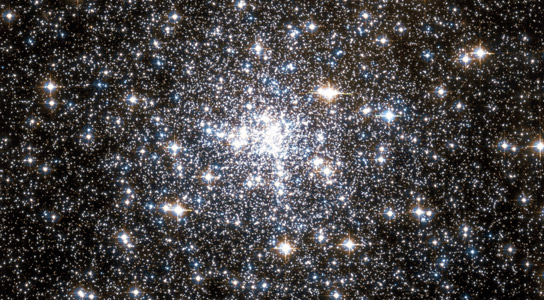
    Globular cluster NGC 6752 is 13,000 light-years away in the constellation Pavo.

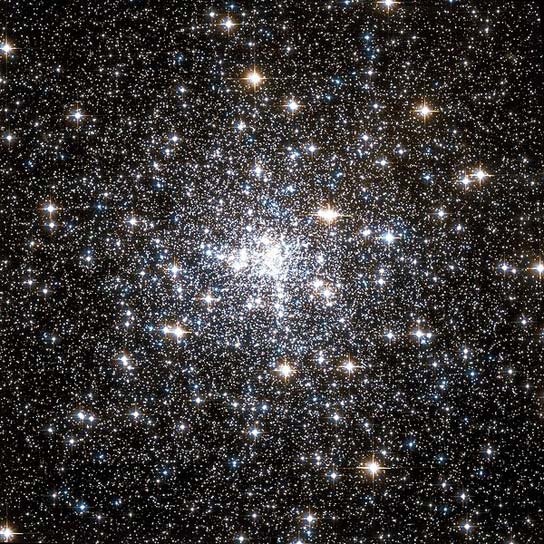
    These images captured by the Hubble Space Telescope showcase a globular cluster, NGC 6752, a spherical grouping of gravitationally bound celestial bodies that’s over 10 billion years old, which means that it’s 5 billion years older than our solar system and was formed only 3.75 billion years after the formation of the universe.

    Currently, there are between 150 and 158 globular clusters in the Milky Way and NGC 6752 is one of the brightest and oldest. It contains a high number of blue straggler stars, some of which can be seen in the images. The stars display characteristics of stars that are younger than their neighbors, despite models suggesting that most of the stars within globular clusters should have been formed at the same time. This created somewhat of a quandary.
    new-images-hubble-ngc-6752

    More astronomical studies and computer modeling may shed light on this situation. A high number of the stars in NGC 6752’s core region are binary systems, about 38%. Collisions between stars in this tumultuous and turbulent environment could produce these blues stragglers, but this hasn’t been confirmed as of yet.

    NGC 6752 is 13,000 light-years away, in the constellation Pavo. It’s the third brightest in the sky after 47 Tucanae and Omega Centauri.

    Never miss a breakthrough: Join the SciTechDaily newsletter.
    Follow us on Google and Google News.

    Astronomy Binary Star Globular Cluster Stars
    Share. Facebook Twitter Pinterest LinkedIn Email Reddit

    Related Articles

    The Star That Almost Vanished: Astronomers Solve a Cosmic Mystery

    The Seven-Year Photobomb: Astronomers Discover Source of Distant Star’s Unusual Dimming

    New Research Shows That Something Strange Is Going On in the Butterfly Nebula

    Astronomers Reach an Important Milestone in the Study of Cluster Mergers

    New Model May Rule Out the Presence of Dark Matter

    Hubble Captures New Image of Messier 9

    Spectra Creates Doubt on Cause of Eta Carinae Stellar Explosion

    Astronomers Combine Hundreds of Images of Carina Nebula to Reveal Thousands of Stars in Stellar Nursery

    Hubble Observes Rare Blue Stars in Andromeda’s Core

    Leave A Reply Cancel Reply

    • Facebook
    • Twitter
    • Pinterest
    • YouTube

    Don't Miss a Discovery

    Subscribe for the Latest in Science & Tech!

    Trending News

    JWST Finds a “Star” 100 Billion Times Brighter Than Any Star Should Be

    Scientists Find a Hidden Biological Link Across Different Forms of Autism

    Astronomers Discover a Ghostly River of Stars That Could Reveal Dark Matter

    Why Is Colorectal Cancer Rising in People Under 50? New Clues Point to the Environment

    Quantum Fluctuations Break a Crystal’s Symmetry Rules

    Why Does an Irregular Heartbeat Strike 40 Years Early in Some People?

    Scientists Reveal How ADHD Could Fuel Creative Thinking

    Scientists Find Just 3 Minutes of Sprinting Can Transform Blood Chemistry

    Follow SciTechDaily
    • Facebook
    • Twitter
    • YouTube
    • Pinterest
    • Newsletter
    • RSS
    SciTech News
    • Biology News
    • Chemistry News
    • Earth News
    • Health News
    • Physics News
    • Science News
    • Space News
    • Technology News
    Recent Posts
    • AI Decodes a Hidden DNA Signal Linked to Disease-Causing Mutations
    • Billions of Invasive Fish Have Taken Over the Great Lakes. Scientists Say We Can Still Stop Their Next Invasion
    • Scientists Turn Red Strawberries White With a Single Gene Edit
    • NASA’s Artemis II Crew Flew Farther Than Any Humans Ever. Now They’re Being Honored
    • The Sun’s Corona Usually Looks White. In Spain, It Turned Gold
    Copyright © 1998 - 2026 SciTechDaily. All Rights Reserved.
    • Science News
    • About
    • Contact
    • Editorial Board
    • Privacy Policy
    • Terms of Use

    Type above and press Enter to search. Press Esc to cancel.