
Johns Hopkins researchers grew a mini human brain with connected regions and blood vessels. It acts like an early-stage fetal brain and could unlock new ways to study and treat complex mental disorders.
Researchers at Johns Hopkins University have developed a groundbreaking lab-grown brain model that includes both neural tissue and early-stage blood vessels. This innovative “whole-brain” organoid could open new paths for understanding complex mental health conditions like autism.
“We’ve made the next generation of brain organoids,” said lead author Annie Kathuria, an assistant professor in JHU’s Department of Biomedical Engineering who studies brain development and neuropsychiatric disorders. “Most brain organoids that you see in papers are one brain region, like the cortex or the hindbrain or midbrain. We’ve grown a rudimentary whole-brain organoid; we call it the multi-region brain organoid (MRBO).”
Key Takeaways
- This research marks one of the first times scientists have been able to generate an organoid with tissues from each region of the brain connected and acting in concert.
- Most brain organoids replicate sections of the brain rather than the whole brain.
- Having a human cell-based model of the brain opens possibilities for studying schizophrenia, autism, and other neurological diseases that affect the whole brain—work that typically is conducted in animal models.
Published in Advanced Science, the study is among the first to demonstrate a lab-created brain model that incorporates tissue from multiple brain regions working together. This human-cell-based model offers a promising alternative to traditional animal research and could provide new insights into conditions like schizophrenia, autism, and other disorders that affect the entire brain.
Building the Brain Piece by Piece
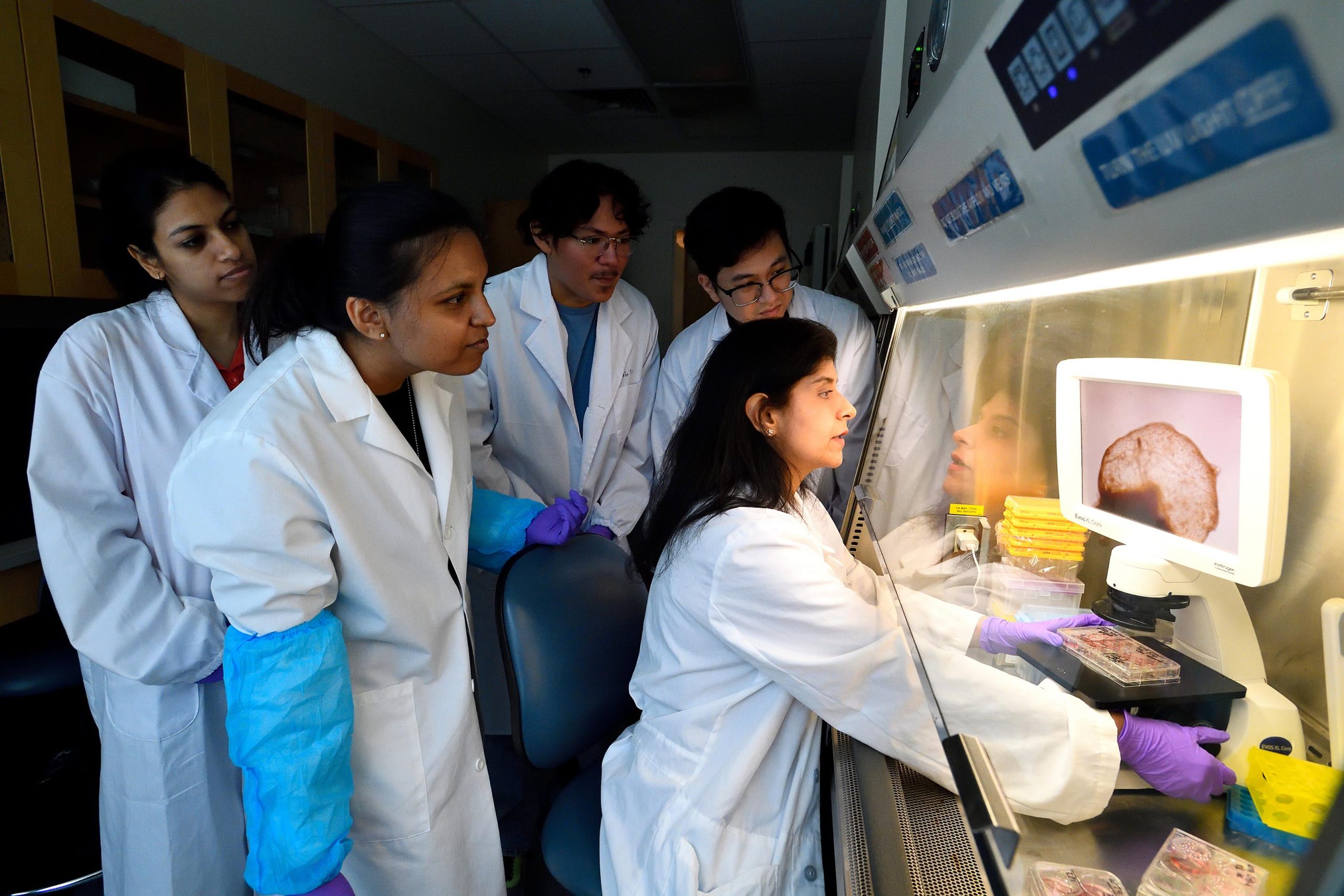
To create the whole-brain organoid, Kathuria’s team began by separately cultivating neural cells from different parts of the brain, along with primitive blood vessels. These components were then brought together using adhesive proteins that helped the tissues bind. As the merged organoid developed, it began to show coordinated electrical activity, functioning as an interconnected network.
The resulting mini-brain contained a diverse range of neuron types similar to those found in the developing brain of a 40-day-old human fetus. In fact, the researchers observed about 80 percent of the cellular diversity seen in early-stage human brain development. While far smaller than a fully formed human brain—with around 6 to 7 million neurons compared to the adult brain’s tens of billions—this organoid offers a powerful model for studying how the brain develops as a whole.
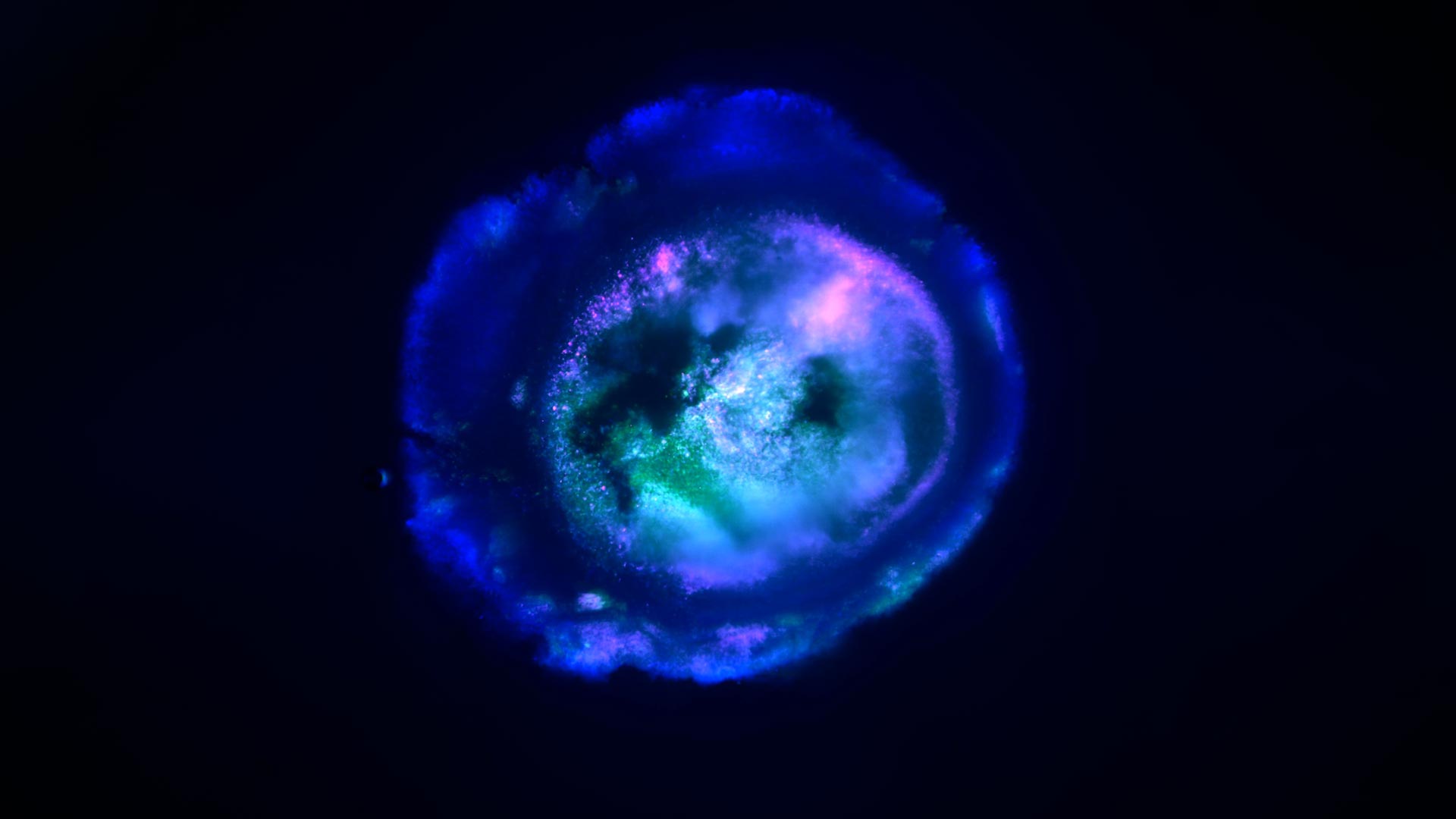
Johns Hopkins researchers used light sheet microscopy to confirm cerebral organoids, endothelial organoids, and mid/hindbrain organoids fused into one Multi-Region Brain Organoid. Credit: Kathuria Lab, Johns Hopkins University
Blood-Brain Barrier Emerges
The researchers also saw the creation of an early blood-brain barrier formation, a layer of cells that surround the brain and control which molecules can pass through.
“We need to study models with human cells if you want to understand neurodevelopmental disorders or neuropsychiatric disorders, but I can’t ask a person to let me take a peek at their brain just to study autism,” Kathuria said. “Whole-brain organoids let us watch disorders develop in real time, see if treatments work, and even tailor therapies to individual patients.”
A New Frontier for Drug Discovery
Using whole-brain organoids to test experimental drugs may also help improve the rate of clinical trial success, researchers said. Roughly 85% to 90% of drugs fail during Phase 1 clinical trials. For neuropsychiatric drugs, the fail rate is closer to 96%. This is because scientists predominantly study animal models during the early stages of drug development. Whole-brain organoids more closely resemble the natural development of a human brain and likely will make better test subjects.
“Diseases such as schizophrenia, autism, and Alzheimer’s affect the whole brain, not just one part of the brain. If you can understand what goes wrong early in development, we may be able to find new targets for drug screening,” Kathuria said. “We can test new drugs or treatments on the organoids and determine whether they’re actually having an impact on the organoids.”
Reference: “Multi-Region Brain Organoids Integrating Cerebral, Mid-Hindbrain, and Endothelial Systems” by Anannya Kshirsagar, Hayk Mnatsakanyan, Sai Kulkarni, John Guo, Kai Cheng, Luke Daniel Ofria, Oce Bohra, Ram Sagar, Vasiliki Mahairaki, Christian E Badr and Annie Kathuria, 8 July 2025, Advanced Science.
DOI: 10.1002/advs.202503768
Never miss a breakthrough: Join the SciTechDaily newsletter.
Follow us on Google and Google News.
1 Comment
Why you growing brains? Mines not good enough? I swear, Love the Lord and I’ll talk to God, coz I swear again your covered in sin, you should try to moleculize your ideas into practicality instead of nonsense. Everyone knows where thoughts go. Up in the air… and they’re saved there. Change your mind and your ways to follow your heart you brainiac freak… LIKE ANOTHER BRAIN IS WHAT WE NEED!