
Scientists have simulated faint radio signals from the Universe’s “Dark Ages,” a period before the first stars formed, revealing that these whispers from ancient hydrogen could expose the true nature of dark matter.
The signals, nearly impossible to detect from Earth, may soon be captured by future Moon missions, which offer a radio-quiet refuge shielded from human interference.
Probing the Universe’s Dark Secrets
An international team of scientists has used powerful computer simulations to explore how extremely faint radio waves from the early Universe could reveal key details about dark matter. These signals, which future missions on the far side of the Moon are expected to detect, may provide new clues about one of physics’ greatest mysteries, according to a study published in Nature Astronomy on September 16, 2025.
Ordinary matter—the kind that forms stars, planets, and everything visible—accounts for only about 20 percent of all matter in the cosmos. The remaining 80 percent is thought to be dark matter, an unseen form of matter that neither emits nor reflects light. Although it cannot be observed directly, dark matter has a powerful gravitational influence that shapes galaxies such as the Milky Way and determines the large-scale structure of the Universe.
Cold vs. Warm Dark Matter Debate
A major question in dark matter research concerns the mass of its particles. If the particles are very light, less than about 5 percent of an electron’s mass, dark matter would be “warm,” preventing the formation of small structures like dwarf galaxies. Heavier particles, in contrast, would make it “cold,” encouraging the growth of smaller cosmic features.
To uncover which scenario is correct, astronomers study the smallest cosmic structures made of gas and stars. Understanding the mass of dark matter particles is essential for physicists as they work to refine theoretical models describing what dark matter really is.
Searching for Clues in Early Gas Clouds
A research team led by Hyunbae Park, a Postdoctoral Fellow at The University of Tsukuba (who conducted this work while at the University of Tokyo’s Kavli Institute for the Physics and Mathematics of the Universe (Kavli IPMU, WPI)), together with Kavli IPMU Professor and Max Planck Institute for Astrophysics Visiting Scientist Naoki Yoshida, has turned its attention to tiny gas clouds that existed during the cosmic Dark Ages—the first 100 million years after the Big Bang, before any stars or galaxies had formed.
Modeling the evolution of stars and galaxies is notoriously difficult because these systems involve complex physical processes that are still not fully understood. To overcome these uncertainties, the researchers focused on an earlier and simpler period of cosmic history. This approach allowed them to recreate the conditions of the early Universe and simulate its small-scale structures with a level of detail never achieved before.
Simulations of the Cosmic Dark Ages
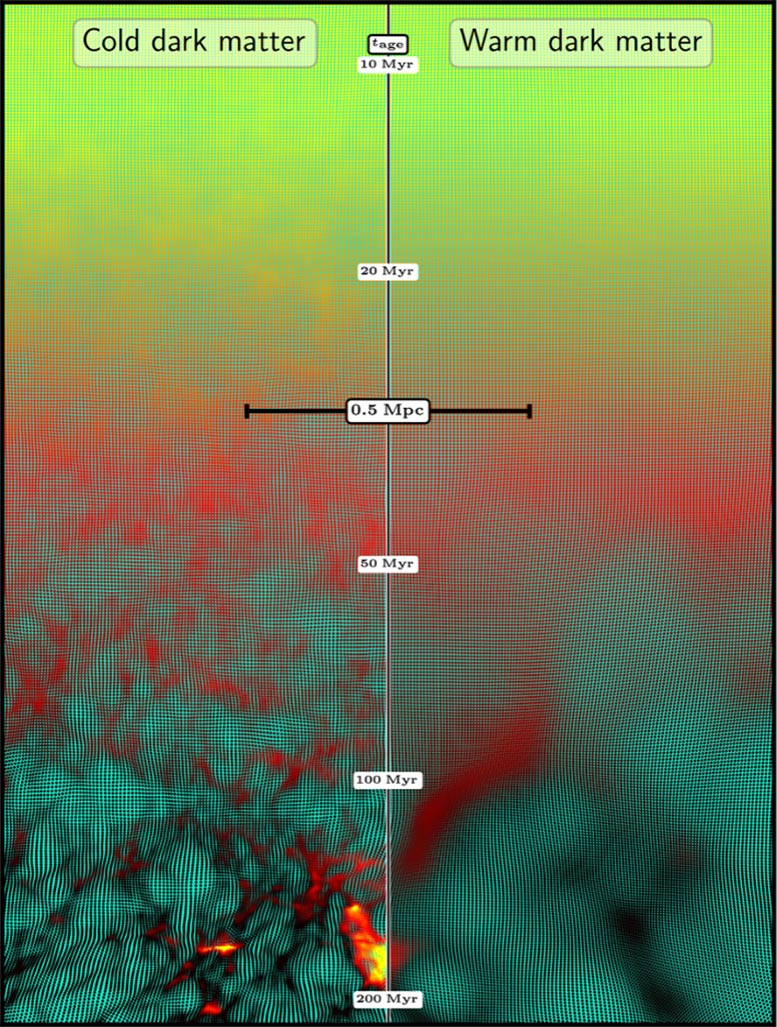
The simulation results (Figure 1) revealed how gas gradually cooled as the Universe expanded while developing small gas clumps via gravitational interaction with dark matter during the Dark Ages. The gas in these clumps became much denser than in the average Universe and heated up due to compression. This variation in density and temperature was imprinted in the 21-centimeter radio emission from hydrogen atoms.
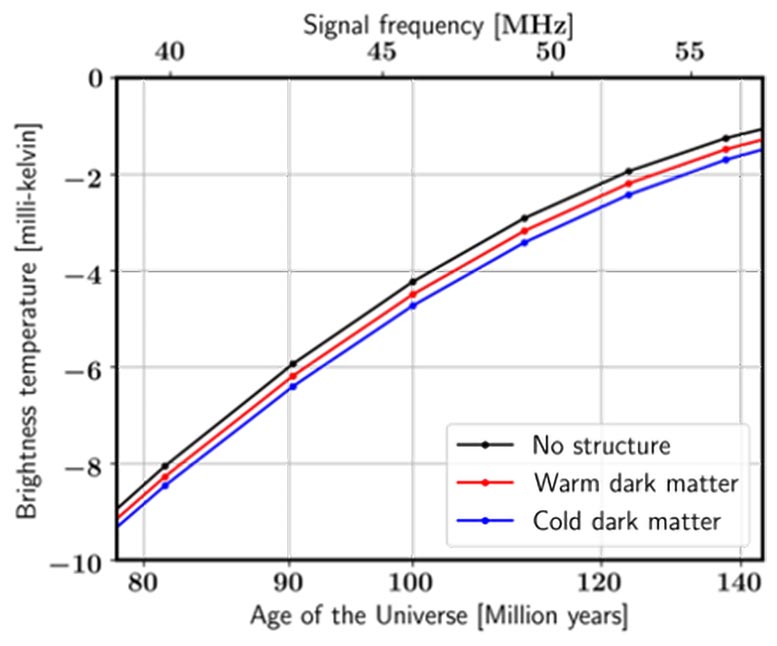
The team modeled this ancient signal from the primordial gas clouds and found that its sky-averaged strength depends sensitively on whether dark matter is warm or cold (Figure 2). According to the researchers, this difference could allow future lunar experiments to distinguish between competing dark matter scenarios.
Listening for the Hydrogen Signal
The Dark Ages signal is expected to appear at frequencies around 50 MHz or lower with a characteristic frequency modulation, and the difference between the two dark matter scenarios is less than a milli-kelvin in brightness temperature (Figure 2).
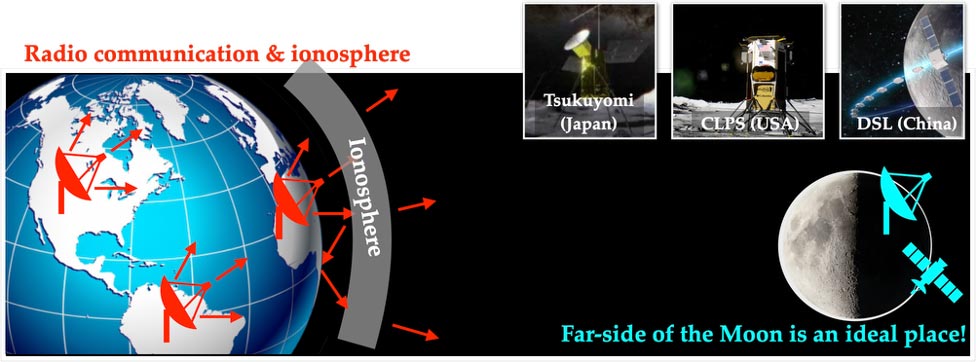
These frequencies are heavily contaminated by human-made signals on Earth, and further obscured by the ionosphere making it virtually impossible to detect the signal from ground-based observatories. In contrast, the far side of the Moon offers a radio-quiet environment, shielded from terrestrial interference, and is considered an ideal location for detecting the elusive Dark Ages signal (Figure 3).
Why the Moon Is the Best Observatory
Although building radio observatories on the Moon poses major technological and financial challenges, an increasing number of nations are pursuing such missions as part of the new space race, combining scientific ambition with technological advancement.
With this growing international momentum, it is now considered feasible to determine the mass of dark matter particles through lunar-based observations in the coming decades. Among these nations, Japan is actively developing the Tsukuyomi project, which plans to deploy radio antennas on the Moon.
The team’s research provides essential theoretical guidance for these near-future missions to maximize their scientific return.
Reference: “The signature of subgalactic dark matter clumping in the global 21-cm signal of hydrogen” by Hyunbae Park, Rennan Barkana, Naoki Yoshida, Sudipta Sikder, Rajesh Mondal and Anastasia Fialkov, 16 September 2025, Nature Astronomy.
DOI: 10.1038/s41550-025-02637-0
Never miss a breakthrough: Join the SciTechDaily newsletter.
Follow us on Google and Google News.
3 Comments
Dark matter is a myth. The shortage of matter in galaxies can be explained by taking gravity is proportional to square of the speed. If so, the G of Milkyway will be nearly 7 times that of solar system, and that means it requires only one-seventh of matter to create the required force. That is, speed compensates the shortage of matter.
Dark matter is observed in many independent ways such as cosmic microwave background power peaks, weak lensing and structure formation. We know it exists.
Gravity is sourced by mass as is observed and supported by both pre-relativistic (Newton’s law of universal gravity) and relativistic (general relativity) gravitational physics. We know how it works (since general relativity is among the best tested theories we have).
If you suggest else, provide a quantified theory with well defined observables (what is “speed”, what is “force” and what is the expected result?). Unless you do, it is just an attempt at mysticism. We know how that works too …
“These signals, which future missions on the far side of the Moon are expected to detect, may provide new clues about one of physics’ greatest mysteries, according to a study published in Nature Astronomy on September 16, 2025.”
Well, exactly. Until we have arrays on the moon to detect the 21 cm hydrogen line (aka, the H I line, a spectral line emitted by neutral hydrogen atoms when the electron in the atom flips its spin, transitioning between two energy states) we have no idea what is going on. Until then, these theoretical/simulation studies are not a confirmation of dark matter or the dark ages.