
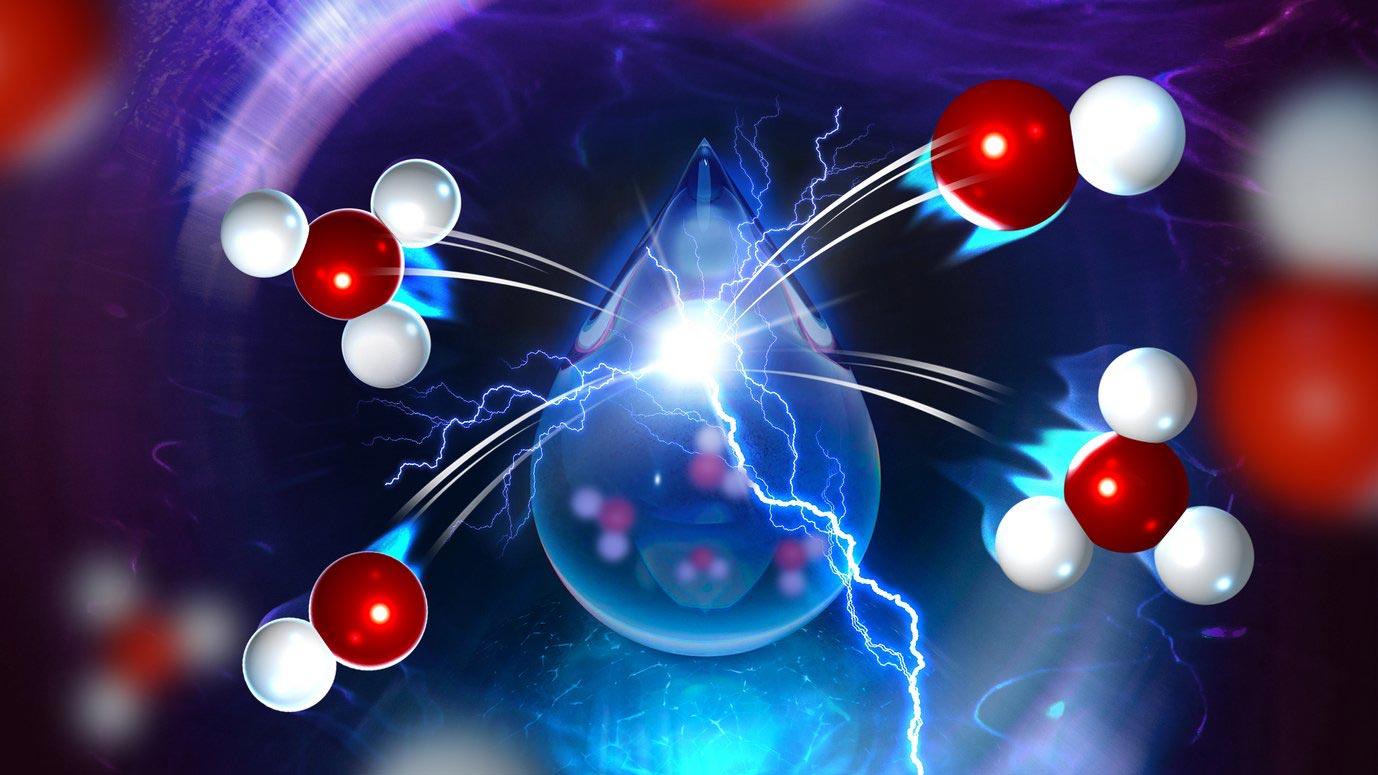
A new study identifies how water becomes ionized under electrochemical conditions.
Hydrogen is expected to play a major role in future energy systems, which makes a clear understanding of electrolysis increasingly important. Scientists at the Max Planck Institute for Polymer Research and the Yusuf Hamied Department of Chemistry at the University of Cambridge have taken a closer look at a closely related phenomenon known as water autodissociation.
Although the basic chemistry of how water splits is well understood under normal conditions, far less is known about how this process unfolds in the intense electric fields found inside electrochemical devices.
Why water rarely splits on its own
In the natural world, systems of all sizes follow a small set of fundamental rules. Objects move in ways that lower their energy, such as falling downward under gravity. At the same time, the balance between order and disorder also plays a crucial role. Over time, systems tend to become more disordered, a tendency that applies even at the molecular scale and is described by the concept of “entropy”.
Both energy and entropy shape how chemical reactions proceed. A process can occur spontaneously if it lowers energy or increases entropy, meaning greater disorder. Under everyday conditions, such as in a glass of water, water autodissociation is blocked on both fronts. It neither lowers energy nor increases disorder, which makes the reaction extremely rare. When strong electric fields are introduced, however, the situation changes and the reaction can speed up dramatically.
Electric fields flip the driving force
Researchers at the Max Planck Institute for Polymer Research and the Yusuf Hamied Department of Chemistry at the University of Cambridge have now identified an unexpected mechanism that controls water autodissociation under these powerful electric fields. Their results, published in the Journal of the American Chemical Society, challenge the long-held assumption that the reaction is governed mainly by energy alone.
“Water autodissociation has been extensively studied in bulk conditions, where it’s understood to be energetically uphill and entropically hindered,” says Yair Litman, group leader at the Max Planck Institute. “But under the strong electric fields typical of electrochemical environments, the reaction behaves very differently.”
Using advanced molecular dynamics simulations, Litman and co-author Angelos Michaelides show that strong fields dramatically enhance water dissociation—not by making the reaction more energetically favorable, but by making it entropically favorable. The electric field initially orders water molecules into a highly structured network. When ions form, they disrupt this order, increasing the system’s entropy—or disorder—which ultimately drives the reaction forward.
“It’s a complete reversal of what happens at zero field,” explains Litman. “Instead of entropy resisting the reaction, it now promotes it.”
Rethinking water splitting under bias
The study also shows that under strong electric fields, the pH of water can drop from neutral (7) to highly acidic levels (as low as 3), with implications for how we understand and design electrochemical systems.
“These results point to a new paradigm,” says Michaelides. “To understand and improve water-splitting devices, we need to consider not just energy, but entropy—and how electric fields reshape the molecular landscape of water.”
The research highlights the need to rethink how reactivity is modeled in aqueous environments under bias and opens up new possibilities for catalyst design, particularly in electrochemical and “on-water” reactions.
Reference: “Entropy Governs the Structure and Reactivity of Water Dissociation Under Electric Fields” by Yair Litman and Angelos Michaelides, 25 September 2025, Journal of the American Chemical Society.
DOI: 10.1021/jacs.5c12397
Never miss a breakthrough: Join the SciTechDaily newsletter.
Follow us on Google and Google News.