
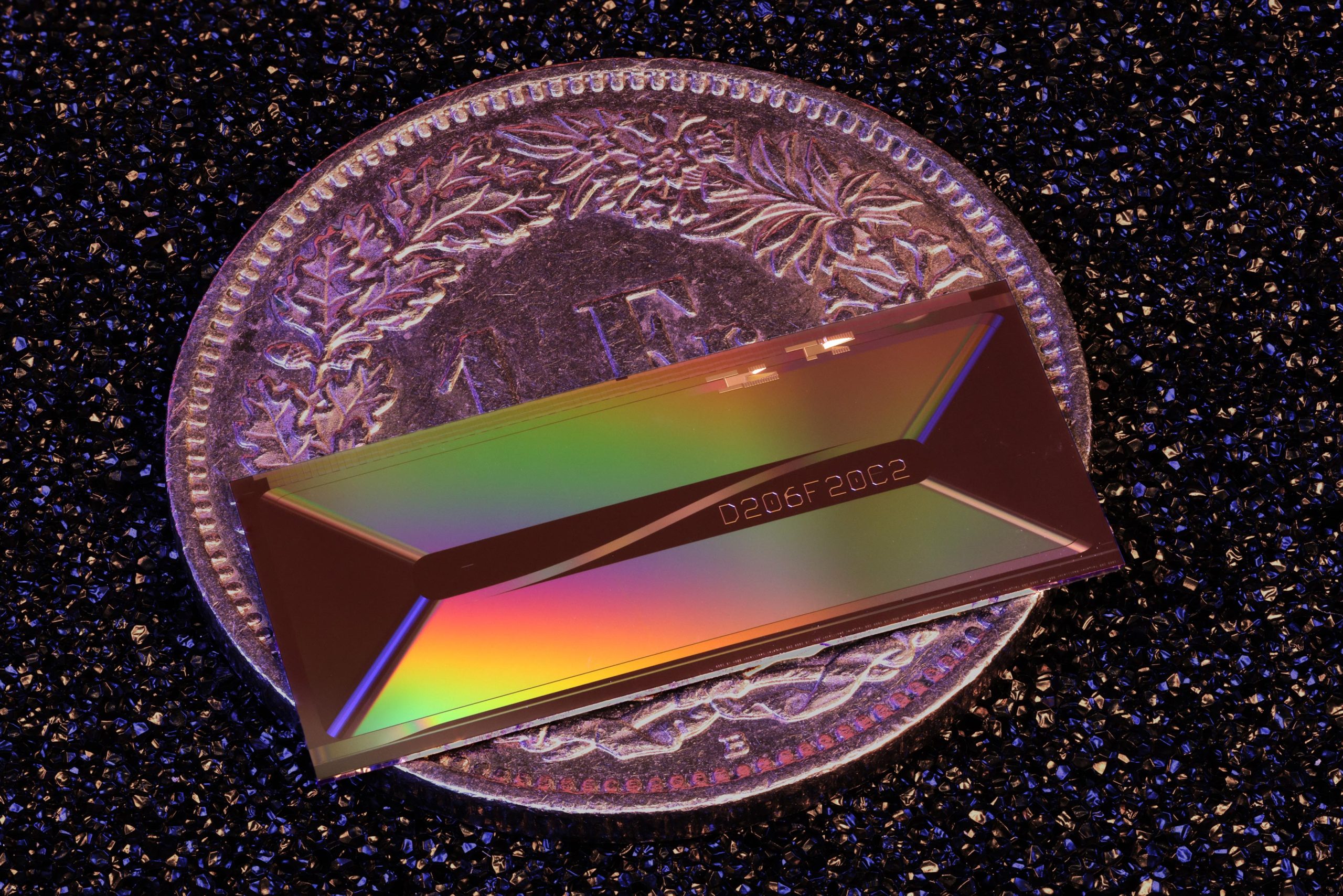
Scientists have finally packed a laboratory-class ultrafast laser onto a tiny photonic chip.
Ultrafast lasers generate bursts of light that last only a few hundred femtoseconds, each one just a quadrillionth of a second long. These extremely short pulses are used in a wide range of technologies, including precision manufacturing, eye surgery, and optical frequency combs, the Nobel Prize-winning innovation that powers the world’s most accurate optical atomic clocks.
Despite their importance, ultrafast lasers have generally remained large, costly systems that occupy entire optical tables in research laboratories. After more than two decades of work by scientists around the world, shrinking these devices onto a photonic chip has remained an elusive goal.
Now researchers led by Professor Tobias J. Kippenberg at EPFL have achieved that milestone. Writing in Nature, the team reports the first integrated ultrafast laser capable of matching the performance of traditional tabletop femtosecond lasers, producing pulses as short as 147 femtoseconds with energies reaching 1.05 nanojoules.
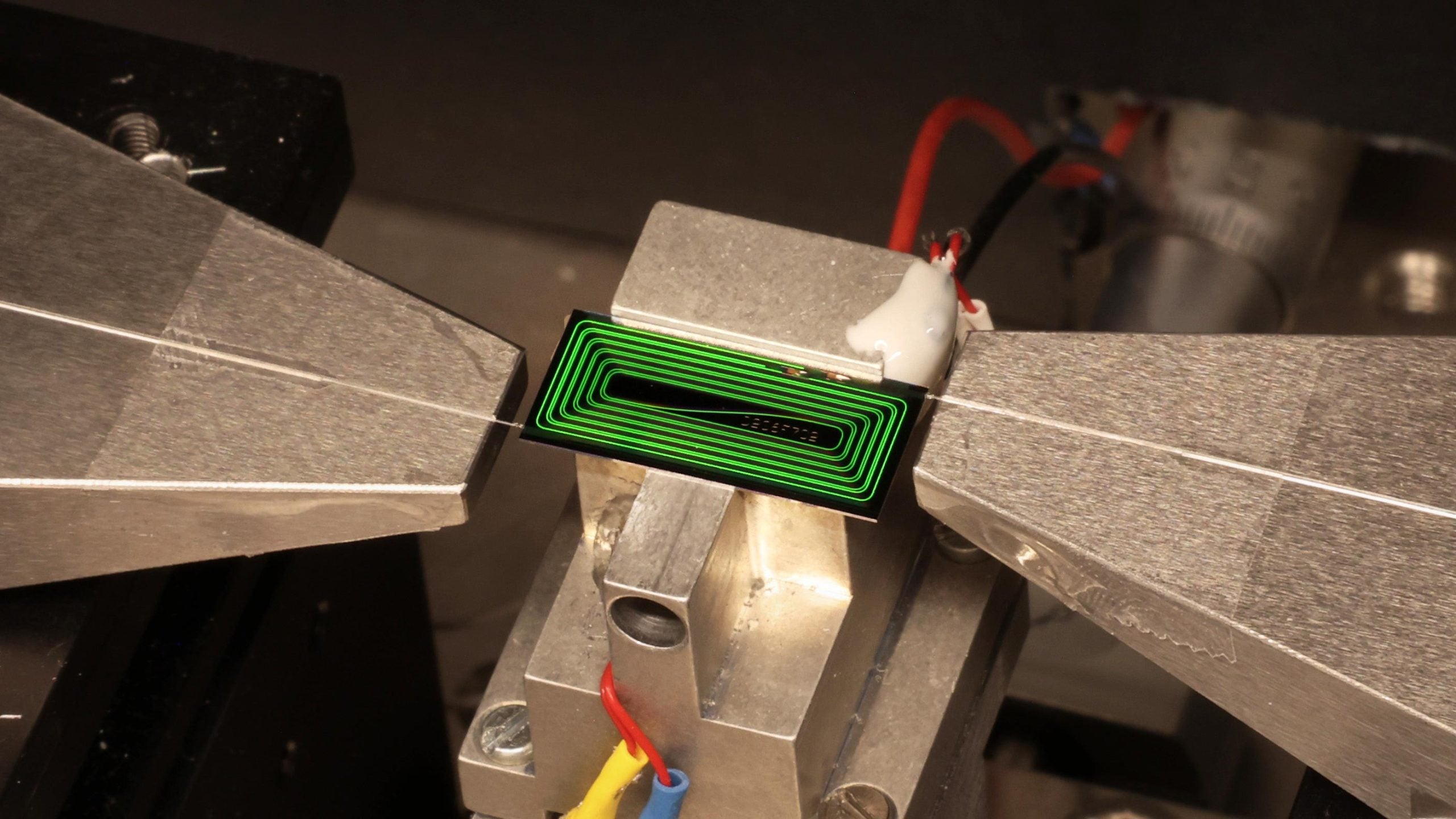
Bringing Ultrafast Lasers to Photonic Chips
Photonic chips manipulate light using microscopic structures called waveguides that are patterned onto a wafer. In many ways, they function like electronic chips, except they direct light rather than electrical currents. These chips are already widely used in telecommunications and have helped shrink many optical technologies that once required much larger equipment.
“For more than twenty years, a high-pulse-energy femtosecond laser on chip was widely regarded as a holy grail of integrated photonics,” says Kippenberg. “Our result shows that it is not only possible, but that it can be achieved with a surprisingly elegant architecture that the integrated-photonics community had overlooked.”
An Overlooked Laser Design
To reach this goal, the researchers adopted a little-used laser architecture known as the Mamyshev oscillator.
Inside the laser cavity, a nonlinear waveguide is placed between two optical filters, each of which passes a different portion of the light spectrum. As a strong pulse travels through the waveguide, its spectrum broadens, allowing some of that light to pass through both filters and continue circulating within the cavity. Weaker light does not broaden enough and is filtered out.
“This design is especially attractive because it does not require any component that is difficult to make on this erbium-doped silicon nitride chip,” explains Zheru Qiu, a co-leading author of the paper.
According to Qiu, the design offers another major advantage. Photonic chips confine light to extremely small waveguides, which increases nonlinear interactions between light waves. In many conventional laser designs, these interactions can destabilize the laser pulses. The Mamyshev oscillator, however, is far less sensitive to those effects, making it particularly well suited for integrated photonic devices.
Tiny Device, Major Potential
The laser cavity measures 42 centimeters in length, yet it can be folded onto a chip occupying roughly the area of a match head. That makes it dramatically smaller than conventional fiber-based ultrafast laser systems.
Because photonic chips can be fabricated at the wafer level using manufacturing techniques similar to those used for computer chips, more than 1,000 laser cavities could potentially be produced in a single batch. This capability could significantly reduce costs while expanding access to ultrafast laser technology for sensing, spectroscopy, and precision measurement applications.
“With kilowatt-level peak powers, the chip can drive demanding applications that have long depended on large, expensive laboratory lasers,” says Qiu.
The advance could eventually lead to compact and affordable devices for detecting environmental pollutants, identifying hidden material defects, and performing medical diagnostics. It may also help pave the way for portable optical atomic clocks that could support future communication and navigation technologies.
Reference: “High-pulse-energy integrated mode-locked laser using a Mamyshev oscillator” by Zheru Qiu, Xuan Yang, Xurong Li, Jianqi Hu, Zhongshu Liu, Yichi Zhang, Xinru Ji, Jiale Sun, Grigory Lihachev, Zihan Li, Ulrich Kentsch and Tobias J. Kippenberg, 3 June 2026, Nature.
DOI: 10.1038/s41586-026-10517-4
Other Contributors
- EPFL Institute of Electrical and Microengineering
- Helmholtz-Zentrum Dresden-Rossendorf (HZDR)
Never miss a breakthrough: Join the SciTechDaily newsletter.
Follow us on Google and Google News.
1 Comment
nice thank you