
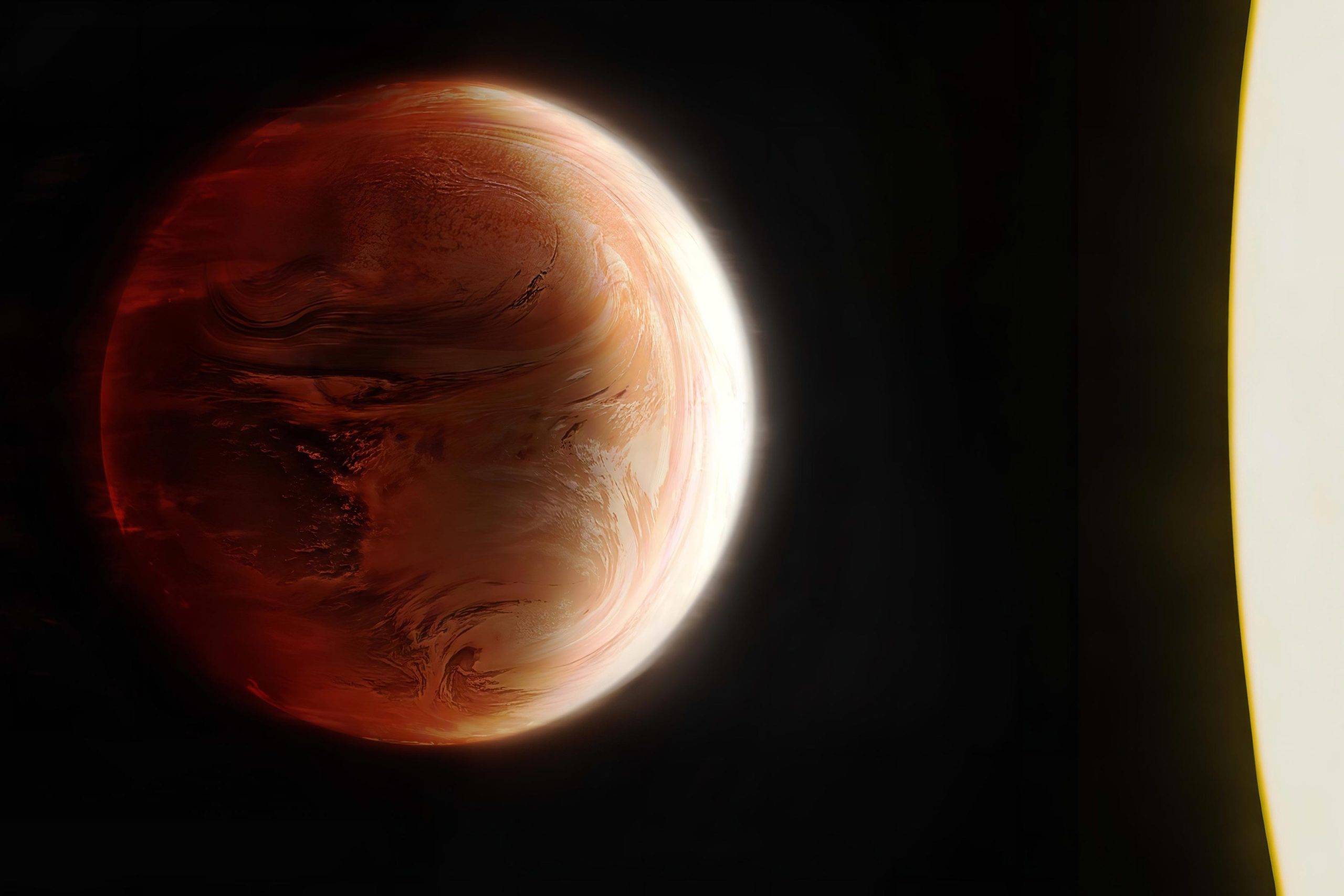
James Webb has revealed that the sunrise and sunset sides of WASP-121 b have surprisingly different atmospheres.
Astronomers using the James Webb Space Telescope (JWST) have discovered striking differences between the morning and evening sides of the atmosphere of WASP-121 b, an ultra-hot gas giant located far beyond our solar system. The findings provide the clearest evidence yet that conditions along the planet’s day-night boundary, known as the terminator region, vary dramatically from one side to the other.
The research team, led by Cyril Gapp, a PhD student at the Max Planck Institute for Astronomy (MPIA) in Heidelberg, Germany, detected atmospheric differences that scientists had previously predicted through theoretical models but had never directly observed in such detail.
James Webb Reveals Differences Between Dawn and Dusk
The discovery comes from measurements of infrared light from the planet’s host star as WASP-121 b passes in front of it. During these transits, some starlight filters through the planet’s atmosphere before reaching Earth. By analyzing how that light changes, astronomers can learn about atmospheric temperatures and chemical makeup.
The observations revealed an imbalance in how infrared light is absorbed on the two sides of the planet’s terminator. According to the researchers, this asymmetry points to significant differences in temperature and atmospheric chemistry between the dawn and dusk regions.
“With its unprecedented observational quality, JWST gives us the most detailed glimpses into distant planets to date: By measuring how star light absorption changes as WASP-121 b rotates, we probe its atmosphere longitude by longitude.” – Cyril Gapp, MPIA
The data show that the evening terminator absorbs more starlight than the morning terminator. This matches existing theories suggesting that powerful winds transport heat from the intensely hot dayside toward the cooler nightside. As these winds move eastward with the planet’s rotation, they warm the evening side. Higher temperatures cause the atmosphere in that region to expand, increasing the planet’s apparent size and allowing it to absorb more stellar radiation.
Observations from JWST’s NIRSpec (Near-infrared spectrograph) instrument also revealed a stronger carbon monoxide (CO) signal toward the end of the transit, along with a slight overall decrease in brightness. Researchers believe the stronger signal results from temperature changes rather than an actual increase in carbon monoxide abundance.
Water (H2O), however, appears to tell a different story. The measurements suggest a genuine decrease in water molecules in the atmosphere. The upper atmosphere becomes hot enough to break water molecules apart into their constituent components. This finding provides additional evidence that intense winds are heating the evening terminator.
A Planet With Permanent Day and Night
Detecting these subtle atmospheric differences required taking advantage of a common characteristic of many hot gas giant exoplanets. Because they orbit very close to their stars, tidal forces gradually synchronize their rotation and orbital periods. As a result, one side permanently faces the star while the opposite side remains in perpetual darkness.
WASP-121 b represents one of the most extreme examples of this phenomenon.
“WASP-121b is particularly extreme, with average temperatures on the dayside hemisphere being around 2770 Kelvin, while those on the nightside are closer to about 1000 Kelvin,” co-author Tom Evans-Soma from the University of Newcastle, Australia, explains. He previously determined the planet’s temperature range and is also affiliated with MPIA.
Those temperatures correspond to nearly 2,500 degrees Celsius (4,525 degrees Fahrenheit) on the dayside and about 725 degrees Celsius (1,340 degrees Fahrenheit) on the nightside.
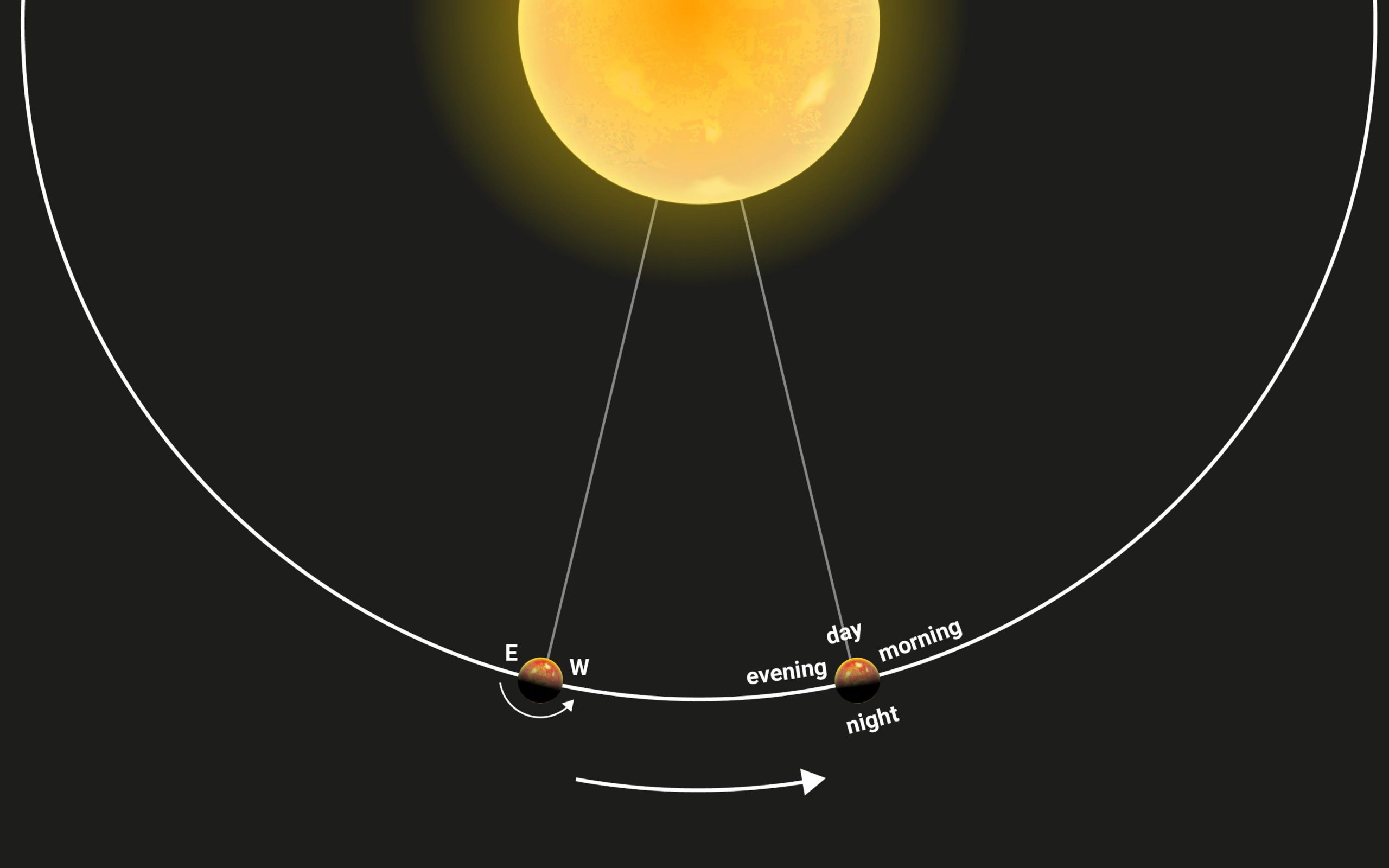
As the planet crosses in front of its star, it rotates slightly between ingress and egress. This small change allows astronomers to observe different portions of the atmosphere during the transit. Although most of the visible hemisphere is the nightside, the viewing geometry also provides partial views toward the brighter dayside through both the dawn and dusk regions. The side leading the orbit corresponds to morning, while the trailing side corresponds to evening.
Scientists use spectrographs to split incoming light into its component wavelengths, much like a prism separates sunlight into a rainbow. Because different gases absorb specific wavelengths, researchers can identify the chemical ingredients present in the atmosphere.
This animation illustrates the orbit of the exoplanet WASP-121 b around its host star, as well as its tidal locking. The perspective shifts from a top-down view of the orbit to the alignment during observation. During the transit, it becomes apparent that at the beginning and the end of the passage, a portion of the planet’s illuminated dayside appears as a narrow crescent. Credit: T. Müller (MPIA/HdA)
Tracking Atmospheric Changes Across the Planet
As WASP-121 b rotates during transit, the atmospheric signal changes over time. Those time variations can be translated into differences across longitude.
For WASP-121 b, the planet rotates by roughly 30 degrees during a full transit. That amount is enough to distinguish the morning (dawn) and evening (dusk) terminators with remarkable precision.
Normally, astronomers combine data from the entire transit to improve the signal. For this study, however, Gapp and his colleagues allowed the signal to vary throughout the transit as the planet rotated. Statistical analysis showed that this approach fit the observations significantly better, providing strong evidence that the detected atmospheric differences are real.
Possible Role of Mineral Clouds
To test whether temperature differences could explain the observations, the researchers used atmospheric models that simulate how heat moves through the upper layers of a gas giant planet.
The models successfully reproduced the general asymmetry expected from temperature variations across the atmosphere. However, the actual observations showed a stronger effect than the simulations predicted.
This discrepancy led researchers to suspect that additional cooling processes may be occurring on the morning side of the planet. One possibility involves clouds.
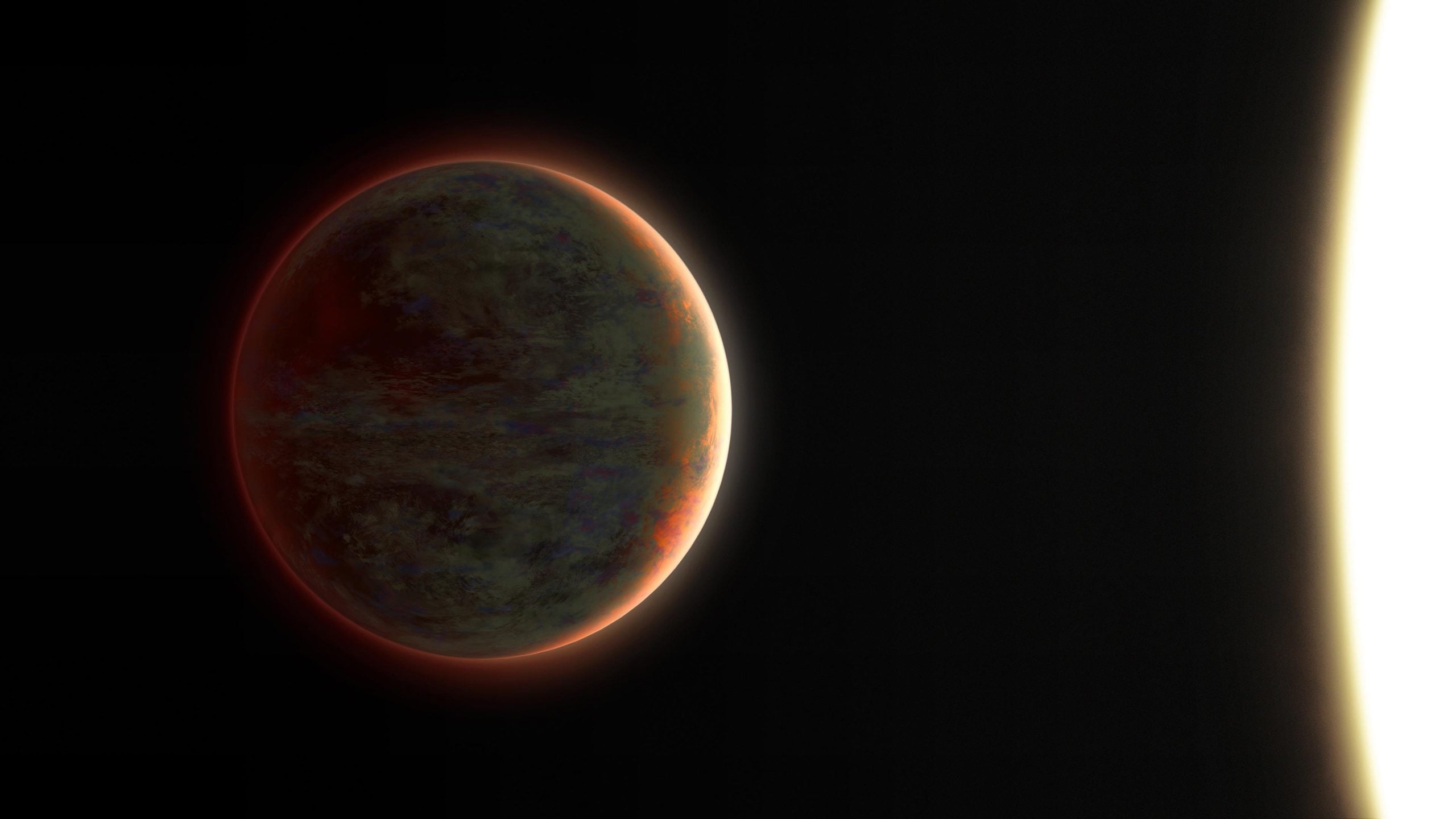
Previous studies have suggested that WASP-121 b may host clouds made not of water droplets, but of minerals such as silicates. Such clouds can block infrared radiation rising from hotter layers below, making the atmosphere appear cooler than it actually is.
Modeling cloud formation, condensation, and evaporation in a constantly changing planetary atmosphere remains extremely challenging. As a result, many atmospheric models, including those used in this study, do not fully account for clouds, which can lead to incomplete predictions.
When the researchers modified their simulations to approximate the effects of clouds on infrared radiation, the results matched the observations more closely. Even so, more advanced modeling will be needed before scientists can confidently confirm the presence of clouds.
A New Way To Study Extreme Exoplanets
Future improvements to atmospheric models are expected to strengthen this technique even further.
The researchers have already identified additional ultra-hot gas giant planets with the right temperatures and rotation rates for similar observations. By applying the same method to more worlds, astronomers hope to build a larger sample that reveals how atmospheric conditions vary across longitude and whether common patterns emerge among these extreme planets.
Reference: “Atmospheric asymmetries in WASP-121 b revealed by rotational transits detected with JWST” by Cyril Gapp, Aurélien Falco, Thomas M. Evans-Soma, David K. Sing, Shashank Dholakia, Vivien Parmentier, Jérémy Leconte, Eva-Maria Ahrer and Guangwei Fu, 10 June 2026, Nature Astronomy.
DOI: 10.1038/s41550-026-02887-6
MPIA astronomers involved in this study were Cyril Gapp (also Heidelberg University), Thomas M. Evans-Soma (also University of Newcastle, Australia), and Eva-Maria Ahrer.
Other researchers were: Aurélien Falco (Sorbonne Université, Paris, France), David K. Sing (Johns Hopkins University, Baltimore, USA), Shashank Dholakia (University of Queensland, St. Lucia, Australia), Vivien Parmentier (Université de la Côte d’Azur, Nice, France), Jérémy Leconte (Université Bordeaux, France), and Guangwei Fu (Johns Hopkins University).
The JWST observations used in this study were conducted as part of GO program #1729 (PI: Thomas Evans-Soma, Co-PI: Tiffany Kataria) titled “A NIRSpec Phase Curve for the ultrahot Jupiter WASP-121b” and GTO program #1201 (PI: David Lafreniere) labeled “NIRISS Exploration of the Atmospheric diversity of Transiting exoplanets (NEAT).”
NIRSpec (Near Infrared Spectrograph) was built by European industry to the European Space Agency’s (ESA) specifications and managed by the ESA JWST Project at ESTEC (European Space Research and Technology Centre), the Netherlands. The prime contractor was Airbus Defence and Space in Ottobrunn, Germany. MPIA contributed to the development and manufacture of NIRSpec’s filter and grating wheels. The NIRSpec detector and micro-shutter array subsystems were provided by NASA’s Goddard Space Flight Center (GSFC).
The James Webb Space Telescope is the world’s leading observatory for space research. It is an international program led by NASA and its partners ESA and CSA (Canadian Space Agency).
Never miss a breakthrough: Join the SciTechDaily newsletter.
Follow us on Google and Google News.