
Researchers developed a brain-controlled gaming system that learns from the brain’s natural wiring, enabling fast BCI training and potentially transforming medicine, mental health, and human-computer interaction.
It may not be long before video game controllers become optional.
Researchers at Yale University have developed a new brain-computer interface (BCI) that allows people to play video games using only their brain activity. By using real-time fMRI (functional MRI), the team demonstrated that users can control a computer efficiently through their thoughts alone.
The findings were published in Nature Neuroscience.
The study revealed that brain activity follows established neural pathways. Researchers found that learning to use a BCI becomes much easier when the system is designed to work with those existing pathways rather than against them. When a BCI aligns with the brain’s natural organization, users gain control quickly, and their brain activity adapts to support learning. Systems that do not match this structure produce little or no improvement.
Why Natural Brain Pathways Matter for BCI Learning
“The implications are broad, from helping people with motor or communication disorders to developing treatments for depression or anxiety to building the next generation of consumer games and technologies: interventions designed around the brain’s natural geometry are likely to be faster, more effective, and more accessible,” said Erica Busch, the first author of the study, who recently completed her Ph.D. at Yale.
A BCI enables people to interact with computers through brain activity.
Although researchers have worked on these systems for years, many human BCIs have had limited success. Earlier fMRI-based systems, which rely on real-time neurofeedback from scans that track changing patterns of brain activity, often required as many as 10 lengthy training sessions. Even then, improvements were relatively small. Roughly one-third of participants never learned to control the system, regardless of how much they practiced.
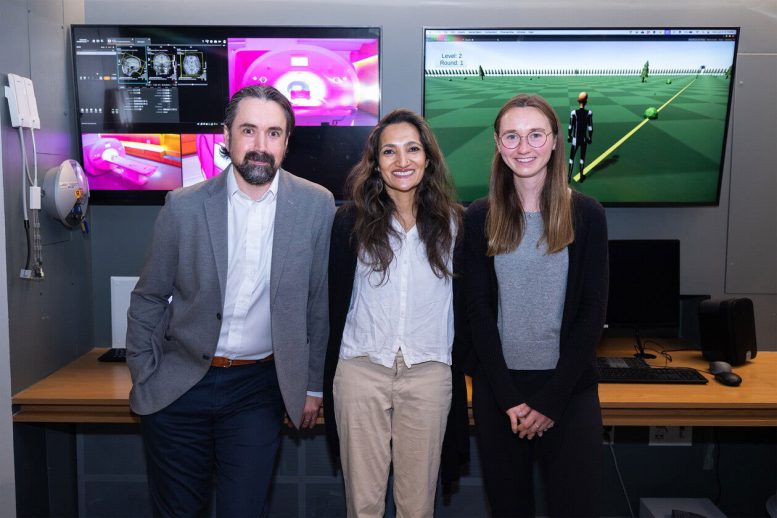
Busch and her colleagues believed the problem stemmed from how these systems were designed. Often, BCIs required the brain to learn patterns that did not fit its natural organization. The researchers proposed that more advanced tools capable of tailoring neurofeedback to each brain’s underlying structure could significantly improve both learning speed and performance.
“Could we build a system smart enough to discover that geometry in real time, using noninvasive brain imaging?” said Smita Krishnaswamy, associate professor of genetics at Yale School of Medicine (YSM) and of computer science at Yale School of Engineering & Applied Science (Yale Engineering) and a corresponding author of the study.
Building a Personalized Brain-Computer Interface
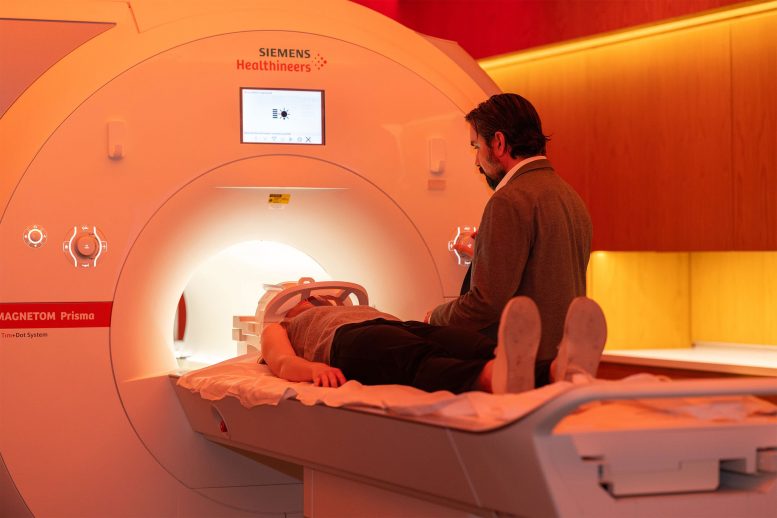
To test the idea, the researchers recruited healthy young adults for four fMRI sessions. During the first session, participants played a video game in which they navigated an avatar through a virtual arena using a joystick while their brain activity was recorded.
The team focused on brain regions involved in navigation and spatial movement. They then applied an algorithm developed in earlier research called T-PHATE. This mathematical method identifies the natural structure of an individual’s brain activity, known as a “neural manifold.”
For the study, participants tried to control a video game avatar purely by thinking. Credit: Video courtesy of Erica Busch, ’26 Ph.D., first author of the study
Using each participant’s neural manifold, the researchers created three different brain-to-game control systems. One followed the brain’s strongest and most natural activity patterns, called the “intuitive mapping.” Another relied on less dominant but still natural activity patterns, known as the “within-manifold perturbation.” The third required activity patterns that the brain does not naturally generate, referred to as the “outside-manifold perturbation.”
Next, the researchers built a closed-loop system that analyzed a new brain scan every two seconds and immediately converted that information into movement commands for the avatar. During the remaining three sessions, participants attempted to control the avatar using only their thoughts, with one session devoted to each mapping approach.
Faster Learning Through Neural Manifolds
The results showed that participants learned to control the avatar in less than an hour when the BCI followed the brain’s natural manifold, and in some cases much more quickly. In contrast, participants were unable to learn the mapping that fell outside those natural neural patterns during the same period.
The effects extended beyond behavior. As participants learned, their brains reorganized their activity to better match the demands of the BCI. In certain conditions, the degree of this reorganization predicted performance. The changes also spread beyond the targeted brain regions, indicating that BCI learning can influence broader neural networks.
“The manifold is both a constraint and an opportunity: it determines what people can learn, and how fast,” said Nick Turk-Browne, director of the Wu Tsai Institute and the Susan Nolen-Hoeksema Professor of Psychology in the Yale Faculty of Arts and Sciences (FAS) and a corresponding author of the study.
According to the researchers, these findings may help explain why some skills are easier to learn than others. Success may depend not only on effort or ability but also on how well a task aligns with the brain’s existing neural structure.
Implications for Mental Health and Human Enhancement
The potential applications extend far beyond laboratory experiments. In mental health, the findings suggest that conditions such as depression and anxiety may be more effectively addressed through approaches that gradually work with the brain’s existing patterns rather than attempting to completely reshape them.
The research could also lead to more reliable BCIs for people with motor or communication impairments. More broadly, it raises the possibility of enhancing cognitive performance by training healthy individuals in ways that align with the brain’s natural organization.
“We spend tremendous resources trying to become better versions of ourselves through education, practice, therapy, and more,” Busch said. “Understanding the structure of our own mind and brain may help us do that far more effectively.”
Reference: “Human learning of noninvasive brain–computer interfaces via manifold geometry” by Erica L. Busch, E. Chandra Fincke, Guillaume Lajoie, Smita Krishnaswamy and Nicholas B. Turk-Browne, 9 June 2026, Nature Neuroscience.
DOI: 10.1038/s41593-026-02311-2
The work was supported by grants from the U.S. National Science Foundation, the Canadian Institute for Advanced Research, the Sloan Foundation, and the National Institutes of Health, which is part of the U.S. Department of Health and Human Services.
Never miss a breakthrough: Join the SciTechDaily newsletter.
Follow us on Google and Google News.
2 Comments
gooooooooooooood
And no doubt future control of robotic drones to kill or spy on yet more people. Well done, scientists! Why are my fellow scientists so unconscious of human stupidity and and our desire to murder each other?