
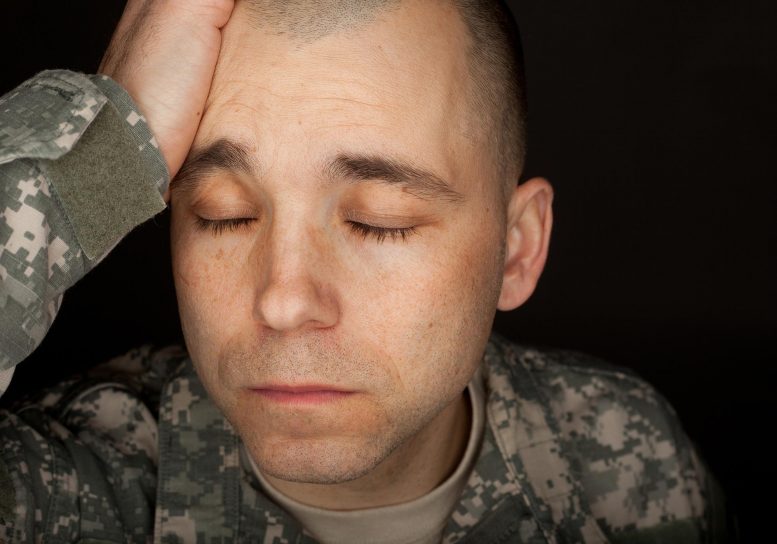
Gene changes in PTSD brains may explain gender differences and guide future therapies.
A post-mortem analysis of brain tissue from people who had been diagnosed with post-traumatic stress disorder (PTSD) may help explain enduring mysteries about the disorder, such as why women are more susceptible to it and whether a dampened immune system response plays a role in dealing with stress, a team headed by Yale University researchers has found.
Prefrontal Cortex Gene Activity Reveals Key Differences
The analysis of gene expression patterns in brain tissue located in four regions of the prefrontal cortex — areas of the brain associated with higher cognitive function and executive control — revealed distinct differences in those who had been diagnosed with PTSD and those who had not. Major differences in gene activity particularly affected two cell types in PTSD patients — interneurons, which inhibit neural activity, and microglia, immune system cells in the central nervous system, the researchers reported on December 21, 2020, in the journal Nature Neuroscience.
“The findings suggest that together these changes might contribute to an impaired ability to respond to traumatic stress,” said Matthew Girgenti, a research scientist in the Yale Department of Psychiatry and lead author of the study.
About 8% of the general population has been diagnosed with PTSD. But among those who have experienced severe psychological stress — including combat veterans, refugees, and victims of assault — as many as 35% exhibit PTSD symptoms. These symptoms include re-experiencing traumatic events, avoidance of others, and hyperarousal when exposed to events that remind the individuals of their traumatic experience.
While the types of cells most profoundly impacted by PTSD were the same in men and women, there were distinct differences between genders in where within the prefrontal cortex the genes impacting those cells were expressed. These differences might help explain why women are more than twice as likely to develop PTSD and other anxiety disorders than men and why they are likely to experience more severe symptoms, the findings suggest.
Biological Links to Other Psychiatric Disorders
About half of PTSD patients are also diagnosed with some form of depression. However, gene expression patterns found in brain tissue are more closely linked biologically with schizophrenia and bipolar disorder than depression, the researchers found.
“This is a new beginning for the PTSD field,” noted Yale’s John Krystal, the Robert L. McNeil, Jr. Professor of Translational Research, professor of psychiatry, neuroscience, and psychology, and co-senior author of the paper. “We need new treatments for PTSD, and studies like this will provide the scientific foundation for a new generation of medication development efforts.”
Reference: “Transcriptomic organization of the human brain in post-traumatic stress disorder” by Matthew J. Girgenti, Jiawei Wang, Dingjue Ji, Dianne A. Cruz, Traumatic Stress Brain Research Group, Murray B. Stein, Joel Gelernter, Keith A. Young, Bertrand R. Huber, Douglas E. Williamson, Matthew J. Friedman, John H. Krystal, Hongyu Zhao and Ronald S. Duman, 21 December 2020, Nature Neuroscience.
DOI: 10.1038/s41593-020-00748-7
The study was supported by the National PTSD Brain Bank, a U.S. Department of Veterans Affairs-based tissue bank which collects, processes, and shares research specimens for scientific research. The bank is led by Matthew Friedman of the White River Junction VA Medical Center and Dartmouth University, who is a co-senior author of the study.
Other co-senior authors from Yale are Hongyu Zhao and the late Ronald Duman.
Never miss a breakthrough: Join the SciTechDaily newsletter.
Follow us on Google and Google News.
1 Comment
I am interested in the “loss” perspective of this study, that posits that the PTSD studied is a deficit collection of symptoms possibly related to brain structure. I suggest that it might also be accurate to study the galaxy of brain components in those who are more resilient as a gifted category as compared to the “normal” people who respond in survival behaviors completely understandable in the trigger situations experienced by human beings.