
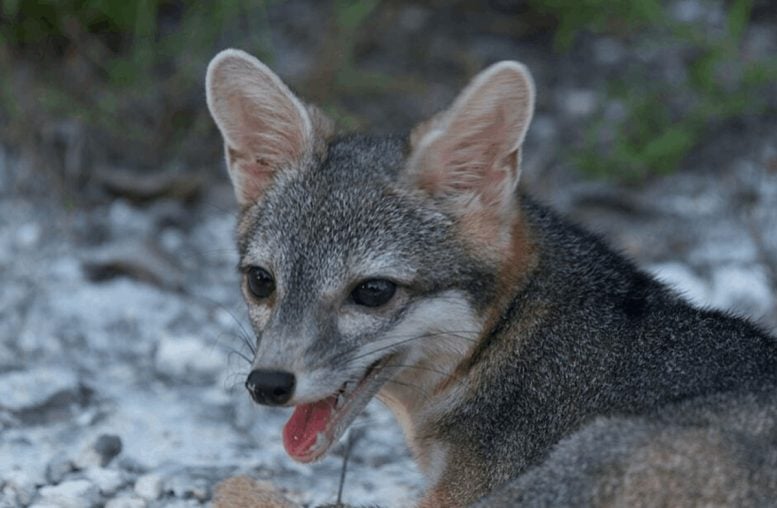
A confirmed sighting of the critically endangered Cozumel dwarf fox has renewed calls for urgent research and conservation to prevent the disappearance of this unique island species.
For more than two decades, the Cozumel dwarf fox existed almost as a biological ghost. Known primarily from ancient subfossil remains and a handful of unconfirmed reports, the tiny island canid had largely vanished from scientific view, leaving researchers uncertain whether it still survived in the wild.
Now, a recently published short communication in Neotropical Biology and Conservation has provided rare evidence that the species persists. Researchers Travis D. Bayer, Maggie A. McGreal, and A. Rafael Chacón D. describe the rescue of an adult male Cozumel dwarf fox after residents reported a disoriented animal near kilometer 29 (18 miles) along Cozumel’s coastal highway on September 14, 2023. Staff from the Fundación de Parques y Museos de Cozumel located the fox and safely captured it.
The fox underwent several days of observation and a complete health evaluation before being released on September 17, 2023. It was returned to the wild in the Laguna Colombia State Reserve, a protected area selected because it provides suitable habitat and is far from major roadway dangers.
The Cozumel dwarf fox (Urocyon sp.) is among the rarest members of the dog family worldwide. This unique population has lived on the Caribbean island of Cozumel for thousands of years, and subfossil evidence suggests it may have been present even before the arrival of the early Maya. Long-term isolation on the island drove rapid evolutionary changes, resulting in a phenomenon known as “insular dwarfism.”
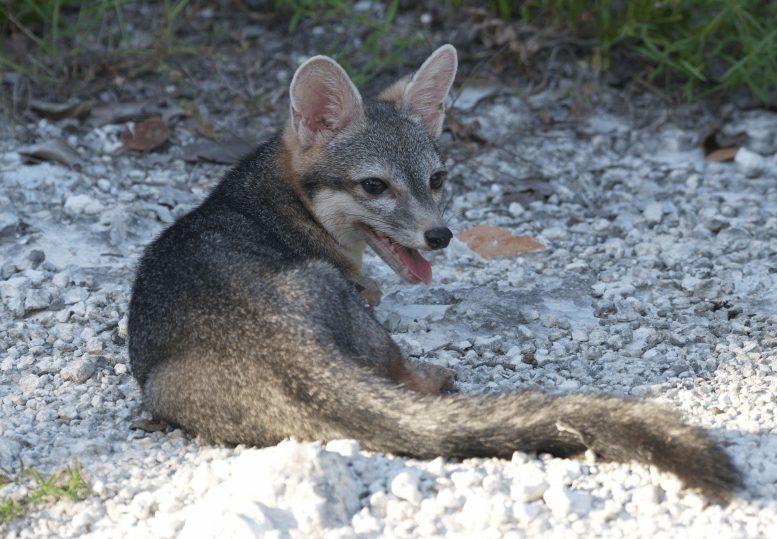
Researchers estimate the fox is only 60-80% the size of its mainland relative, the gray fox (Urocyon cinereoargenteus). Before this recent documentation, the only physical evidence of the animal came from subfossil remains, while the most recent unconfirmed sighting dated back to 2001.
Why the Cozumel Fox Faces Extinction Risk
Although it has inhabited the island for centuries, the Cozumel fox has never been formally described as a distinct taxonomic entity. Scientists consider the population critically endangered because the remaining habitat in southern Cozumel is increasingly threatened by land-use changes, development, invasive species, and natural disasters. As a result, researchers warn that the fox could be nearing extinction.
Travis Bayer of Pathos Wildlife highlighted how easily rare species can disappear without attracting attention. “One of the most important takeaways from this research is that species can quietly disappear without the world even realizing they are gone. We often think extinction is something dramatic and obvious, but in reality, it can happen gradually and silently, especially for rare species living in remote or understudied habitats.”
“The rediscovery of the fox is not a conservation success story yet, but it represents a second chance,” Bayer added.
Conservation Priorities for Saving the Cozumel Fox
The researchers say the newly documented photographic evidence underscores the need for immediate conservation efforts. “The biggest challenge facing the Cozumel fox is that we still know almost nothing about it, including its remaining population size, distribution, or ecology,” noted Bayer. “That uncertainty alone is dangerous, because it makes effective conservation extremely difficult.”
The team outlined several priority actions, including targeted field surveys to estimate the fox’s population size and range, genetic research to better understand its evolutionary history, and measures to protect the remaining suitable habitat while reducing conflicts between people and wildlife.
“Ultimately, we hope this work helps move the Cozumel fox from a little-known, uncertain presence on the island to a better-understood key part of Cozumel’s ecosystems. We also hope it demonstrates that conservation is often most urgent when certainty is lowest and that uncertainty itself can be a call to action,” concluded Bayer.
Reference: “First photographic evidence of an insular dwarf fox (Urocyon sp.) on the island of Cozumel, Mexico” by Travis D. Bayer, Maggie A. McGreal and A. Rafael Chacón D., 4 May 2026, Neotropical Biology and Conservation.
DOI: 10.3897/neotropical.21.e187967
Never miss a breakthrough: Join the SciTechDaily newsletter.
Follow us on Google and Google News.
1 Comment
I would like to be hired with helping these animals, insects, etc not to become extinct. I want to help repopulate our Dominion of animals, birds, fish, insects, etc. I would like to be paid for my work and time. Could you help me to get in communication with those who can help hire me locally and world wide? Thank You, Erika Lynn Laine cellphone: 412-267-5115 email: [email protected] home address: 436 Franklin Ave Apt 2A1 Pittsburgh, PA 15221 USA