
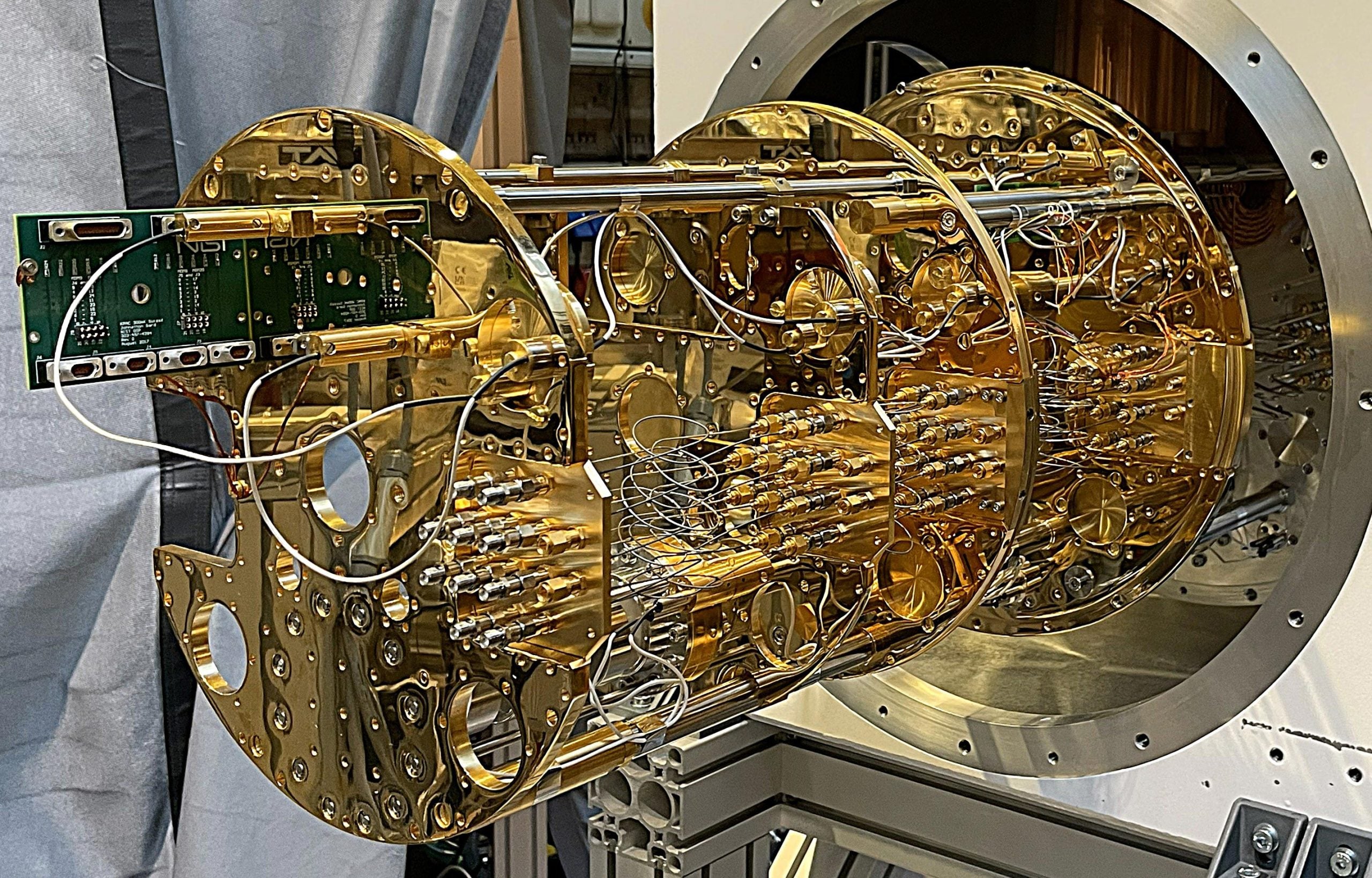
Europe’s first TES spectrometer is transforming X-ray research with up to 1,000 times greater sensitivity, making once impossible experiments finally possible.
Europe’s first and only TES spectrometer at a synchrotron light source is now operating at BESSY II, marking a major advance for X-ray research. Developed through a collaboration between HZB, the MPI-CEC (Mühlheim-an-der-Ruhr, Germany), and NIST (Boulder CO, USA), the new instrument can detect X-ray photons with an efficiency that is 100 to 1,000 times greater than conventional wavelength dispersive X-ray emission spectrometers.
Its exceptional sensitivity will allow researchers to investigate the electronic properties of atomically thin materials, nanostructures, and extremely dilute atomic and molecular samples. The team is now inviting scientists to submit research proposals that take advantage of the new capability.
A Major Boost for X-Ray Spectroscopy
Synchrotron facilities such as BESSY II generate exceptionally bright X-ray beams that scientists use to study the structure and properties of many different materials. Some of the most powerful techniques, including X-ray emission spectroscopy (XES) and Resonant Inelastic X-ray Scattering (RIXS), analyze the X-ray photons emitted by a sample after it is exposed to the beam.
These methods provide valuable information about a material’s electronic structure, but they require large numbers of emitted photons to produce meaningful data. As a result, XES and RIXS have traditionally been limited to bulk materials and samples with relatively high concentrations.
Up to 1,000 Times More Efficient
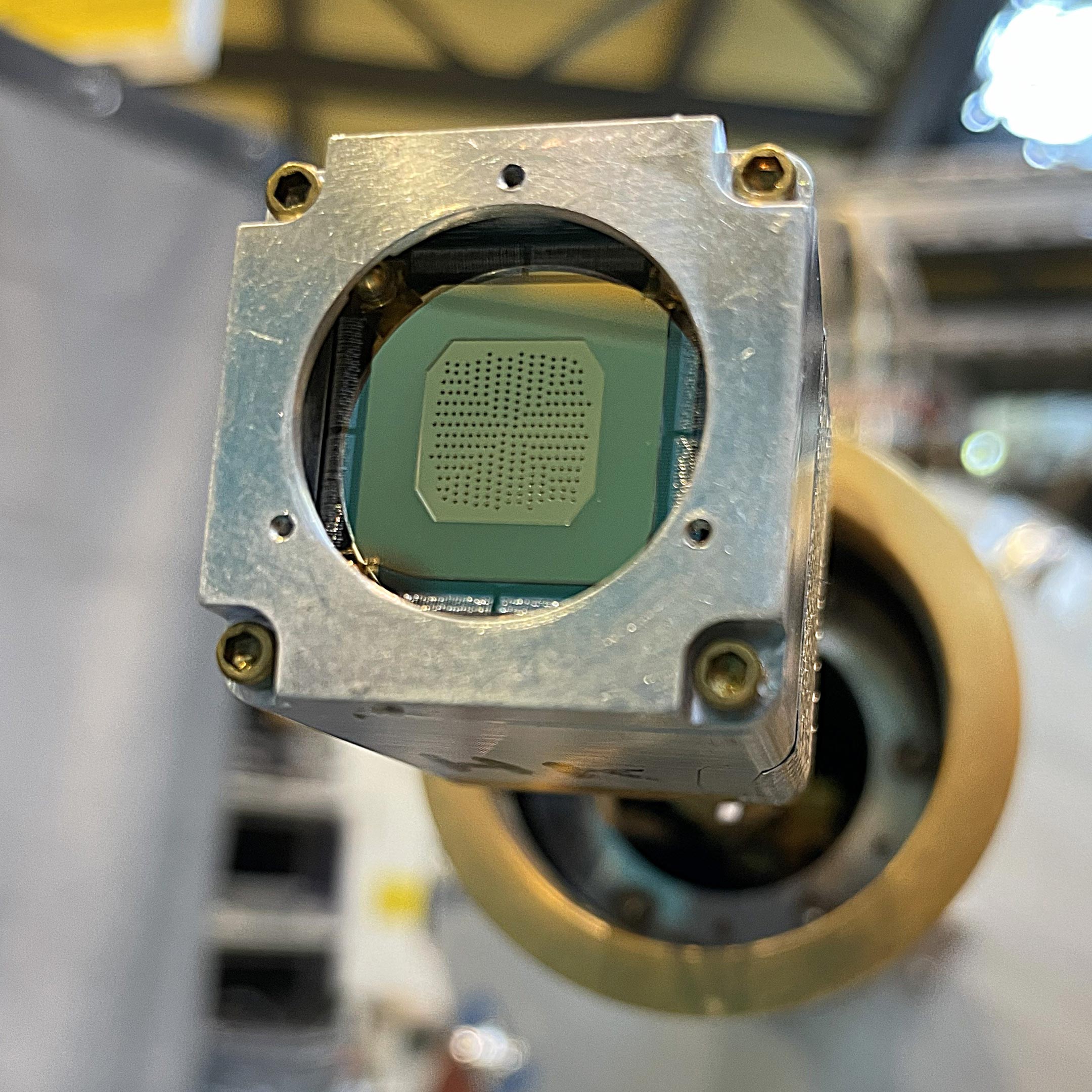
“The superconducting Transition Edge Sensor (TES) array photon detector that we have now put into operation at BESSY II is around 100 to 1000 times more efficient to detect photons than conventional XES and RIXS spectrometers,” says Régis Decker, HZB, responsible scientist of the new instrument.
That dramatic improvement makes it possible to examine samples that were previously too small or too dilute for these techniques.
Revealing Quantum Materials and Molecular Systems
According to Decker, the new spectrometer will enable studies across a wide range of scientific fields.
“This can provide new insights into molecular chemistry or molecular biology, but also into the quantum properties of systems in reduced dimensions such as atomic monolayers, nanostructures, and impurities. The TES spectrometer complements methods such as ARPES, which scans the electronic band structures of such systems,” says Régis Decker.
The increased sensitivity also speeds up many experiments. Measurements that once required hours can now, in some cases, be completed within minutes.
How the TES Spectrometer Works
The instrument contains an array of 248 superconducting sensors that operate at an extremely low temperature of just 25 milli-Kelvin. Those conditions are achieved using a He4-He3 dilution refrigerator, a cooling technology similar to the systems used in quantum computers.
When X-rays strike a sample, the material emits photons of its own. Each emitted photon is captured by one of the superconducting sensors, briefly raising its temperature enough to disrupt its superconducting state. That tiny change increases the sensor’s electrical resistance, which is measured using a circuit based on Superconducting Quantum Interference Devices (SQUIDs). This process allows the energy of each photon to be measured with remarkable precision.
Advanced Sample Handling and Future Upgrades
The spectrometer is connected to a custom ultra-high vacuum sample chamber that allows researchers to transfer, prepare, and analyze samples while precisely controlling temperatures from 10 K to room temperature.
The complete system is installed at the BESSY II UE52-SGM beamline, which provides full polarisation control. Future enhancements will expand sample preparation capabilities and enable experiments in magnetic fields for X-ray Magnetic Circular Dichroism in absorption (XMCD) and emission (RIXS-MCD).
Europe’s Only Synchrotron TES Spectrometer
TES spectrometers were originally created for astrophysics, where they were designed to detect extremely weak photon signals from distant objects.
Before the installation at BESSY II, only five TES spectrometers were operating at X-ray facilities worldwide, with four located in the United States and one in Japan. BESSY II now hosts the only synchrotron TES spectrometer in Europe.
“We are looking forward to receiving exciting research proposals from our user community,” says Decker.
Reference: “A superconducting transition edge sensor array for synchrotron soft x-ray emission spectroscopies of low-dimensional and impurity-level concentration systems” by Régis Decker, Kelsey M. Morgan, Sergey Peredkov, Charles J. Titus, Galen C. O’Neil, Alexander Dillmann, Dmitry Tikhonov, Utkarsh Prakash, Axel Knop-Gericke, Joseph W. Fowler, Jonathan W. Dean, Nathan Nakamura, Raoul Blume, Detre Techner, Minmin Chen, Zechao Jin, Christian Weniger, Thomas Blume, Torsten Kachel, Nathan J. Ortiz, Douglas A. Bennett, John A. B. Mates, Daniel R. Schmidt, Jozsef Imrek, Joel C. Weber, Johnathon D. Gard, Leila Vale, Abigail L. Wessels, Bastian Klemke, Sebastian Gerischer, Mattis Fondell, Sebastian Eckert, Joel N. Ullom, Daniel S. Swetz, Serena DeBeer and Alexander Föhlisch, 10 June 2026, Review of Scientific Instruments.
DOI: 10.1063/5.0332443
Never miss a breakthrough: Join the SciTechDaily newsletter.
Follow us on Google and Google News.