

Materials that are incredibly thin, only a few atoms thick, exhibit unique properties that make them appealing for energy storage, catalysis, and water purification. Researchers at Linköping University, Sweden, have now developed a method that enables the synthesis of hundreds of new 2D materials. Their study has been published in the journal Science.
Since the discovery of graphene, the field of research in extremely thin materials, so-called 2D materials, has increased exponentially. The reason is that 2D materials have a large surface area in relation to their volume or weight. This gives rise to a range of physical phenomena and distinctive properties, such as good conductivity, high strength or heat resistance, making 2D materials of interest both within fundamental research and applications.

“In a film that’s only a millimeter thin, there can be millions of layers of the material. Between the layers, there can be a lot of chemical reactions and thanks to this, 2D materials can be used for energy storage or for generating fuels, for example,” says Johanna Rosén, professor in Materials physics at Linköping University.
The MXenes Family and New Theoretical Models
The largest family of 2D materials is called MXenes. MXenes are created from a three-dimensional parent material called a MAX phase. It consists of three different elements: M is a transition metal, A is an (A-group) element, and X is carbon or nitrogen. By removing the A element with acids (exfoliation), a two-dimensional material is created. Until now, MXenes has been the only material family created in this way.
The Linköping researchers have introduced a theoretical method for predicting other three-dimensional materials that may be suitable for conversion into 2D materials. They have also proved that the theoretical model is consistent with reality.
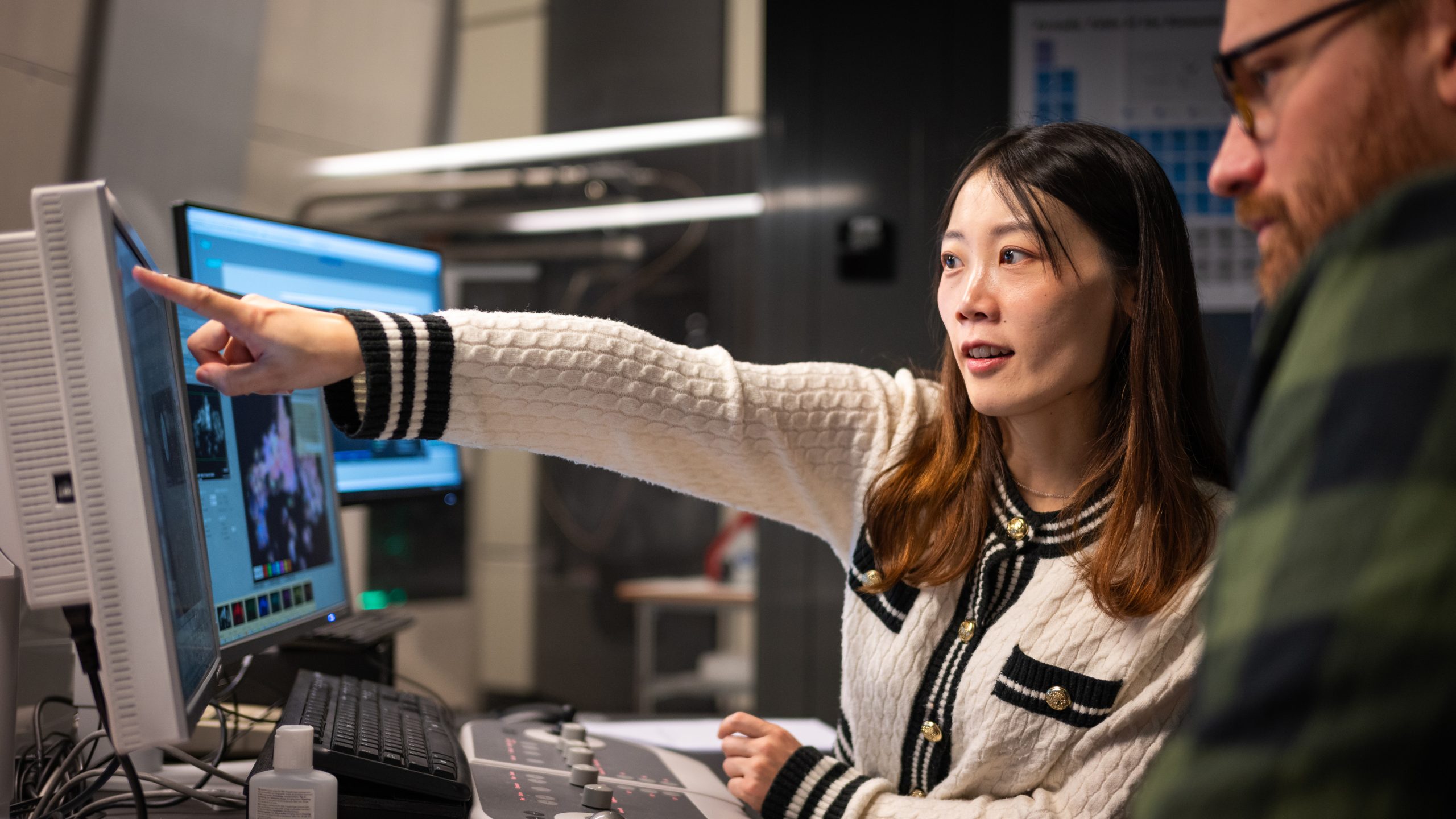
To succeed, the researchers used a three-step process. In the first step, they developed a theoretical model to predict which parent materials would be suitable. Using large-scale calculations at the National Supercomputer Centre, the researchers were able to identify 119 promising 3D materials from a database and a selection consisting of 66,643 materials.
The next step was to try to create the material in the lab.
“Out of 119 possible materials, we studied which ones had the chemical stability required and which materials were the best candidates. First, we had to synthesize the 3D material, which was a challenge in itself. Finally, we had a high-quality sample where we could exfoliate and etch away specific atom layers using hydrofluoric acid,” says Jie Zhou, assistant professor at the Department of Physics, Chemistry, and Biology.
The researchers removed yttrium (Y) from the parent material YRu2Si2, which resulted in the formation of two-dimensional Ru2SixOy.
Future Implications and Applications
But to confirm success in the lab, verification is necessary – step three. The researchers used the scanning transmission electron microscope Arwen at Linköping University. It can examine materials and their structures down at the atomic level. In Arwen, it is also possible to investigate which atoms a material is made up of using spectroscopy.
“We were able to confirm that our theoretical model worked well, and that the resulting material consisted of the correct atoms. After exfoliation, images of the material resembled the pages of a book. It’s amazing that the theory could be put into practice, thereby expanding the concept of chemical exfoliation to more materials families than MXenes,” says Jonas Björk, associate professor at the division of Materials design.
The researchers’ discovery means that many more 2D materials with unique properties are within reach. These, in turn, can lay the foundation for a plethora of technological applications. The next step for the researchers is to explore more potential precursor materials and scale up the experiments. Johanna Rosén believes that future applications are almost endless.
“In general, 2D materials have shown great potential for an enormous number of applications. You can imagine capturing carbon dioxide or purifying water, for example. Now it’s about scaling up the synthesis and doing it in a sustainable way,” says Johanna Rosén.
Reference: “Two-dimensional materials by large-scale computations and chemical exfoliation of layered solids” by Jonas Björk, Jie Zhou, Per O. Å. Persson and Johanna Rosen, 14 March 2024, Science.
DOI: 10.1126/science.adj6556
Funding: Knut och Alice Wallenbergs Stiftelse, Wallenberg Initiative Materials Science for Sustainability, Göran Gustafssons Stiftelse för Naturvetenskaplig och Medicinsk Forskning, Stiftelsen för Strategisk Forskning, European union, Vetenskapsrådet, the Swedish Government Strategic Research Area in Materials Science on Advanced Functional Materials, AFM, at Linköping University
Never miss a breakthrough: Join the SciTechDaily newsletter.
Follow us on Google and Google News.
3 Comments
Be the first to COMMENT?, it’s a game changer! readily and at finger tips:yours sincerely.
Pivotal for sustainable nanobiocatalysis of smart materials in transdimensional programmed printing for self -replicating memorystoring geneticys.Bravo!
Only a millimeter thick? Surely you mean nanometer or Ångström if e are talking only a few atoms thick?
This must be a factual error in the article.