
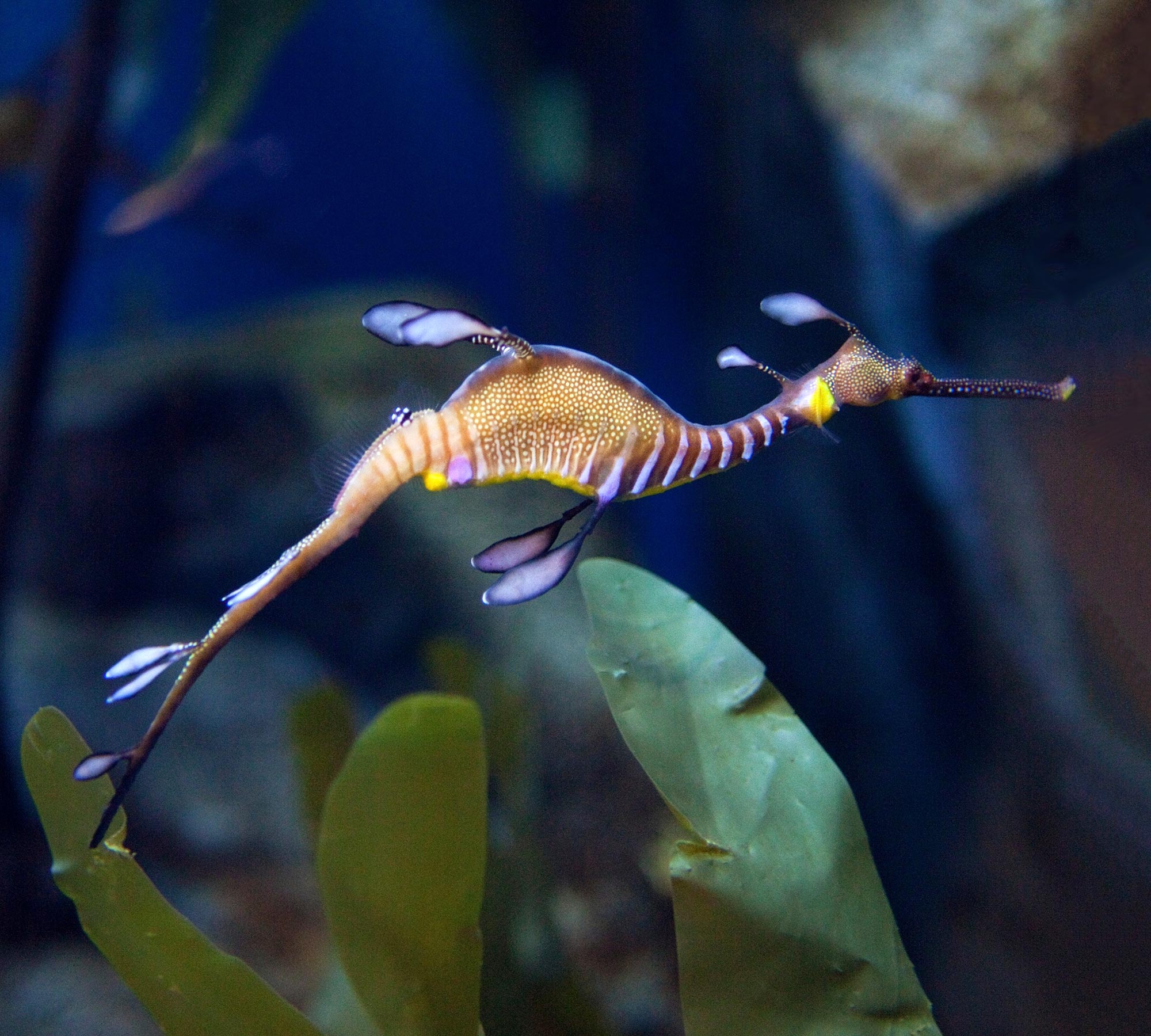
Seadragons (Phyllopetryx taeniolatus) live off the coast in western and southern Australia. An international team involving evolutionary biologist Axel Meyer from the University of Konstanz has now found the genetic basis for some external characteristics of the seadragon, like its lack of teeth and its distinct leaf-like appendages. The team also localized the sex-determination gene in the seadragon genome. The study was published on August 18, 2021, in Science Advances.
Experts in Camouflage
Seadragons belong to the family Syngnathidae along with seahorses and pipefishes. Their name refers to the dragon-like shape of their bodies and the spectacular coloring of their special leaf-like skin appendages. They are considered experts in camouflage because of their ability to mimic the appearance of seaweed. Like the other members of the Syngnathidae family, seadragons exhibit special adaptations and behaviors: They have a tube-shaped, toothless mouths, they lack the ventral and pelvic fins and scales typical for fish, but they instead have a bony shell covering their entire bodies.
Dried seahorses are used in traditional Chinese medicine, which has led to many species being highly endangered. They do not swim horizontally, but instead glide slowly through coral reefs and shallow coastal waters, almost vertically – like a horse – with their heads bent downwards. Their prehensile tail can be used to hold on to things. Like other seahorse species, the seadragon males are responsible for protecting the bright pink eggs attached to the outside of their bodies until they hatch.
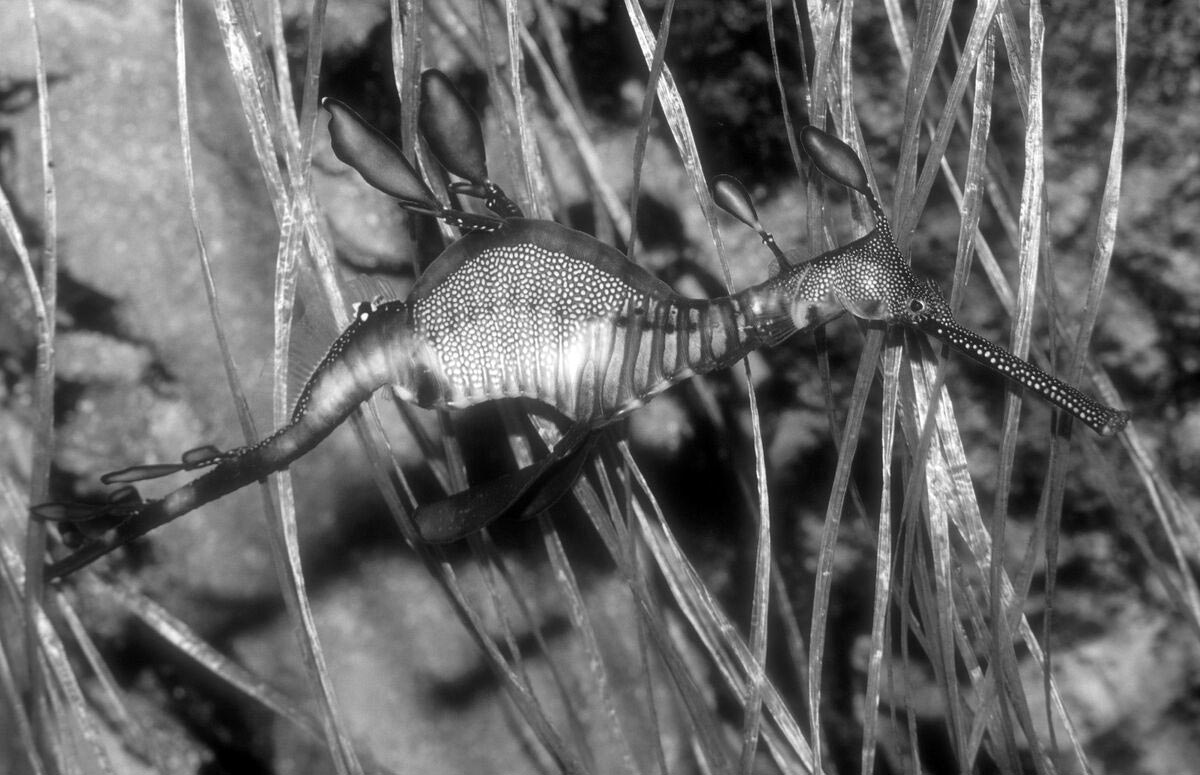
While sequencing the genome and examining the genetic basis for other external characteristics of seadragons, researchers from five teams from China, Singapore, Japan and Germany focussed their efforts on sex-determination, toothlessness and newly-evolved skin appendages in seadragons. The research team, led by Professor Qiang Lin from the Chinese Academy of Sciences in Guangzhou, showed that a series of genes is responsible for this evolutionary development that usually control fin development. The leaf-like skin appendages of the seadragons are thus highly altered fin rays.
Like seahorses, seadragons are also toothless. They use their long snouts to suck in their food, small crustaceans, and swallow them whole. The genome analysis shows that, in the seahorse relatives, too, several genes are missing that contribute to the development of teeth in other fishes as well as in humans. The research team tested the hypothesis about the corresponding scpp5 gene by switching off this gene in zebra fish, a well-researched model organism with pharyngeal teeth. As expected, the mutated fish displayed reduced teeth. The function of the missing gene responsible for tooth loss was thus proven in molecular-biological CRISPR-Cas experiments.
Males Care for Fertilized Eggs
It is also typical that male members of the seahorse family care for fertilized eggs until they hatch. Seahorse males have developed brood pouches, but males of the older seadragon species still carry the sticky eggs visibly on their tails. The females lay the eggs onto this special location on the males’ bodies, and they are then carried around by the male seadragons and thus protected from predators. It is generally more common that male fish care for fertilized eggs rather than females, although this particular form has only evolved in members of the seahorse family.
In this context, the researchers looked for sex-determination mechanisms that were previously unknown in seadragons. On the whole, it is difficult to localize sex-determination in fish, since, for the most part, they do not have special sex chromosomes, like the X and Y chromosomes in mammals. The team found the molecular basis for sex-determination in seadragons to be in the Mullerian hormone, as had previously also been documented for seahorses.
The sequencing of the seadragon genome was completed as part of an additional project in the context of a long-term collaboration between the research teams in Guangzhou and Konstanz. The first publication – on first the seahorse genome – was published by both teams in 2016 in Nature, with a second one with 21 new seahorse genomes appeared this year in Nature Communications. Axel Meyer: “Our research into the genome seeks to derive the corresponding phenotype or “essence” of these animals. We are striving to understand what an animal looks like based on its sequence of genomes and our understanding of the genes’ function. Seadragons are fish that do not look like typical fish at all. They are a particularly fascinating and beautiful species.”
Reference: “Seadragon genome analysis provides insights into its phenotype and sex determination locus” by Meng Qu, Yali Liu, Yanhong Zhang, Shiming Wan, Vydianathan Ravi, Geng Qin, Han Jiang, Xin Wang, Huixian Zhang, Bo Zhang, Zexia Gao, Ann Huysseune, Zhixin Zhang, Hao Zhang, Zelin Chen, Haiyan Yu, Yongli Wu, Lu Tang, Chunyan Li, Jia Zhong, Liming Ma, Fengling Wang, Hongkun Zheng, Jianping Yin, Paul Eckhard Witten, Axel Meyer, Byrappa Venkatesh and Qiang Lin, 18 August 2021, Science Advances.
DOI: 10.1126/sciadv.abg5196
Key facts:
- Study on the genetic basis for the phenotype of the seadragon and the genetic mechanism behind sex-determination
- Research collaboration of five teams from China, Singapore, Japan and Germany, including evolutionary biologist Professor Axel Meyer
Never miss a breakthrough: Join the SciTechDaily newsletter.
Follow us on Google and Google News.