
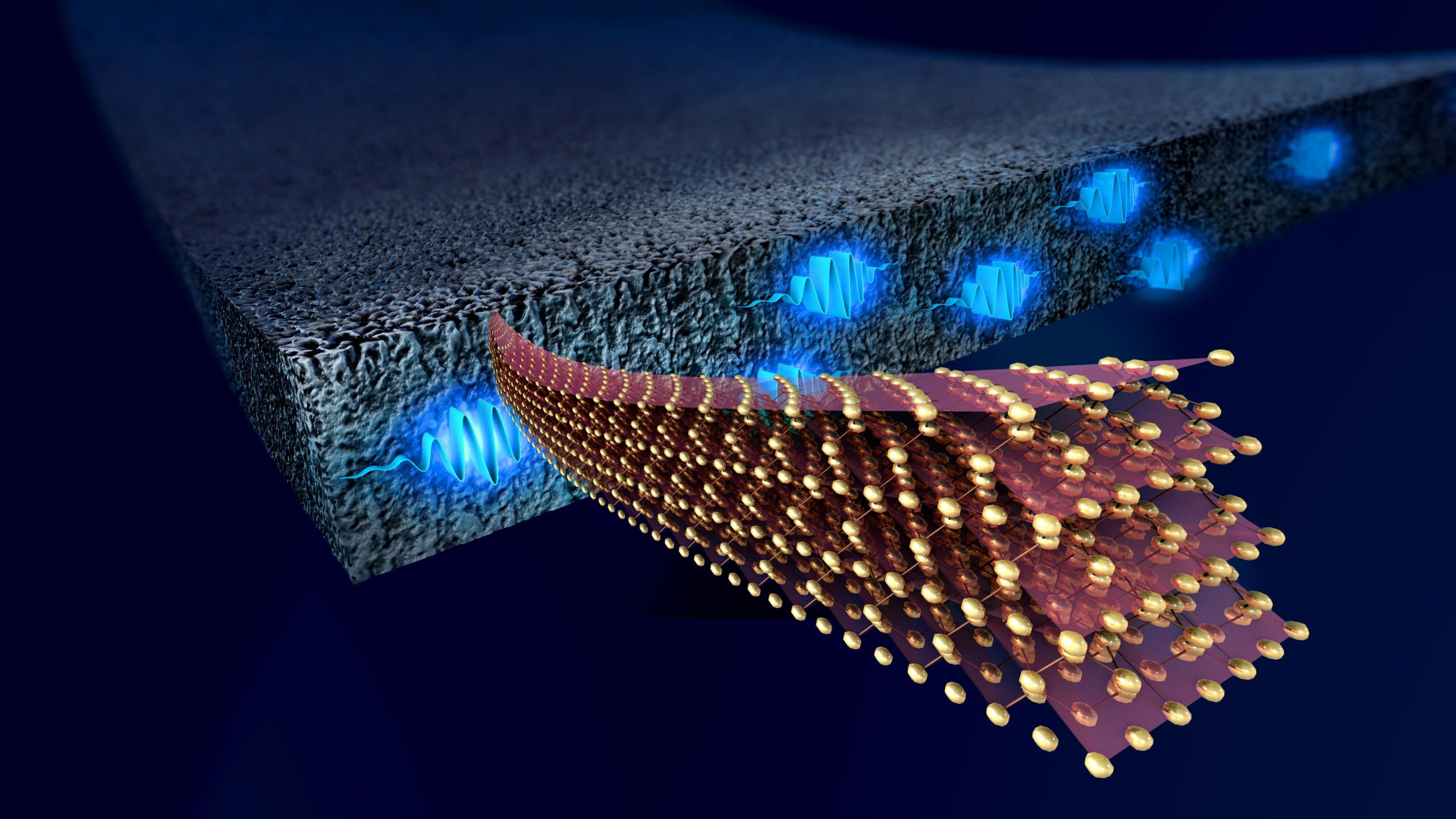
Scientists have unlocked a new understanding of mesoporous silicon, a nanostructured version of the well-known semiconductor. Unlike standard silicon, its countless tiny pores give it unique electrical and thermal properties, opening up potential applications in biosensors, thermal insulation, photovoltaics, and even quantum computing.
Silicon is the most widely used semiconductor, but when its structure is carefully engineered at the nanoscale, its properties change dramatically. A research team at HZB has developed a specialized etching technique to create mesoporous silicon—thin layers filled with countless tiny pores. By studying its electrical and thermal conductivity, they have, for the first time, uncovered the fundamental mechanism behind charge transport in this material.
These findings open up exciting possibilities for mesoporous silicon in a range of advanced technologies, including photovoltaics, thermal management, and nanoelectronics. Notably, its ability to significantly reduce heat transfer makes it a promising candidate for thermally insulating qubits in quantum computers, where maintaining extremely low temperatures is critical for stable operation.
Mesoporous Silicon: A Game-Changer for Future Technologies
Mesoporous silicon is a type of crystalline silicon that contains a network of randomly arranged, nanometer-sized pores. This unique structure gives it a massive internal surface area and makes it biocompatible, opening the door to a variety of applications, including biosensors, battery anodes, and capacitors. Additionally, its extremely low thermal conductivity makes it a promising candidate for use as a thermal insulator.
Understanding Transport Properties in Silicon Nanostructures
Despite being studied for decades, the way charge carriers move through mesoporous silicon — and the role of lattice vibrations (phonons) in this process — has remained poorly understood. “However, in order to develop the material in a targeted manner, a precise understanding of the transport properties and processes is required,” explains Priv.-Doz. Dr. Klaus Habicht, head of the Dynamics and Transport in Quantum Materials (QM-ADT) department at HZB.
Habicht and his team have now made significant progress in this area. Using a specialized etching technique developed at HZB, they created a series of silicon nanostructures and analyzed their electrical conductivity and thermopower across different temperatures.
Electrons in Wavelike States Dominate the Transport
“By analyzing the data, we were able to unambiguously identify the fundamental charge transport process,” says Dr. Tommy Hofmann, first author of the study. The key finding: “It is not the electrons, localized by disorder, that hop from one localized state to the next that dominate charge transport, but those in extended, wave-like states.” In this case, the conductivity decreases with increasing disorder. The activation energy required to move charge carriers over a disorder-dependent ‘mobility edge’ increases.
In contrast to a hopping process, lattice vibrations do not play a role in charge transport. This was particularly evident from measurements of the Seebeck effect, which probe the electrical voltage across a sample when it is exposed to a temperature difference along a defined direction.
“This is the first time that we have provided a reliable and novel explanation for the microscopic charge carrier transport in disordered, nanostructured silicon,” says Dr. Tommy Hofmann.
Mesoporous Silicon: A Thermal Insulator for Qubits
These results are highly relevant to practical applications, as mesoporous silicon could be ideal for silicon-based qubits. These qubits operate at cryogenic temperatures, typically below 1 Kelvin, and require very good thermal insulation to prevent heat from the surrounding environment from being absorbed and erasing the information stored in the qubits. “To use a metaphor, you could think of mesoporous silicon as a type of insulating foam used in building construction,” says Habicht.
The use of mesoporous silicon may also be suitable for semiconductor applications that have so far failed due to the high thermal conductivity of crystalline or polycrystalline silicon. “The disorder can be used in a targeted way,” says Habicht. Semiconductors with purely randomly distributed mesopores would be an exciting new class of materials for technical applications ranging from photovoltaics, thermal management, and nanoelectronics to qubits for quantum computers.
Reference: “Electrons, Localization but no Hopping: Disorder as Key for Understanding Charge Transport in Mesoporous Silicon” by Tommy Hofmann, Haider Haseeb, Danny Kojda, Natalia Gostkowska-Lekner and Klaus Habicht, 24 February 2025, Small Structures.
DOI: 10.1002/sstr.202400437
Never miss a breakthrough: Join the SciTechDaily newsletter.
Follow us on Google and Google News.
1 Comment
We should say goodbye to our jobs.