
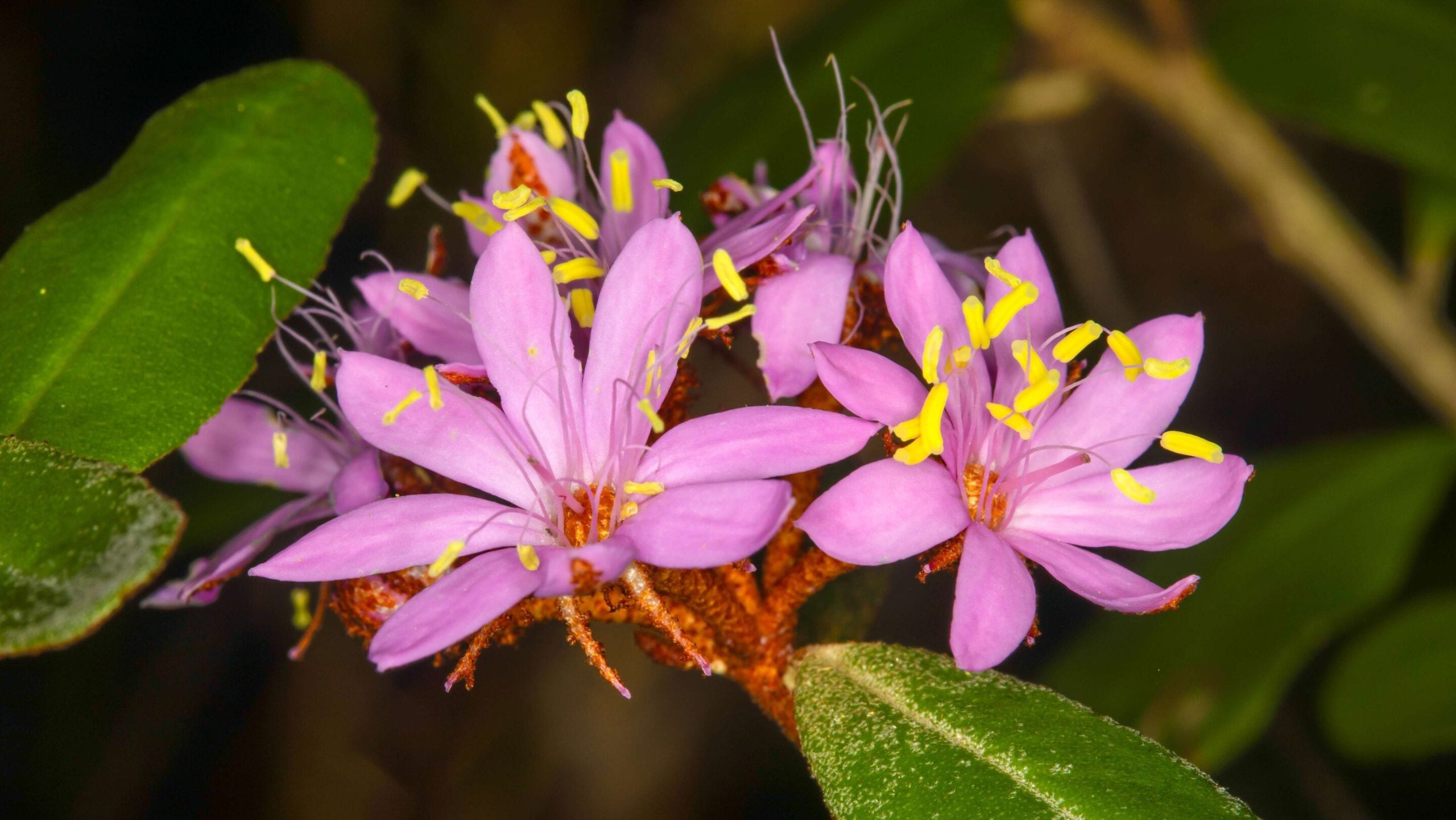
A plant misidentified for more than a century has been named as a distinct and threatened species in northeastern NSW.
For more than a century, a bright pink flowering shrub in northeastern NSW was hiding in plain sight. Botanists thought it belonged to the known species Phebalium nottii, but closer inspection has now revealed that the plant was something else entirely.
Botanists at the University of New England (UNE) have formally described it as Phebalium banyabba, a species found only in a limited part of northeastern NSW. The work corrects a long-running scientific misidentification and gives conservationists a clearer picture of what needs protection.
The trail began when Paul Sheringham, a rare plant expert with the Department of Climate Change, Energy, the Environment and Water, collected a plant north of Grafton, NSW, that was believed to be Phebalium nottii. At first, it seemed like another record of a familiar species. But to botanists at the UNE N.C.W. Beadle Herbarium, the specimen did not quite fit.
A familiar plant proves different
The possible mismatch mattered because plant identification is the foundation of conservation. If a rare species is mistaken for a more familiar one, its population size, threats, and legal protection can all be misunderstood.
“Phebalium banyabba forms a lovely shrub less than two meters tall and is covered with stunning pink and rusty flowers in late winter through spring,” said Emeritus Professor Jeremy Bruhl, who described the new species together with Dr. Ian Telford.
The evidence came from both physical traits and DNA. Molecular work by then PhD student Dr Sangay Dema confirmed that the samples were distinct, while close examination showed features that separated the plant from related species.
“The specimen featured densely hairy calyces with distinctive dendroidal hairs, larger calyx lobes, and larger seeds compared to related species,” said Dr Telford.
Fieldwork revealed limited numbers
Once Phebalium banyabba appeared to be a separate species, the next question was how many plants existed and where they survived. The N.C.W. Beadle Herbarium worked with Mr Sheringham to search for additional populations and assess the pressures facing the plant in the wild.
“The species has only been found in two locations, with fewer than 1,000 individual plants found in the wild,” said Mr Sheringham.
“We found 466 plants in one location and 502 mature plants in a second. These low numbers are likely due to threats such as the species’ restricted distribution, too frequent fire, drought, cattle grazing, and the species’ dependence on seed regeneration rather than resprouting after fire.”
Those details are important because the plant appears to rely on seed regeneration rather than regrowing from its base after fire. That makes the timing and frequency of fire especially significant. If fires occur too often, plants may not have enough time to mature and replenish the seed bank.
Naming supports conservation action
The name Phebalium banyabba honors the Bandjalang First Nations people’s name for the region where the plant is found. Formal scientific publication also makes the species visible to conservation law, supporting its listing as a Threatened Species under NSW legislation.
“Collaborations such as this can contribute to scientific knowledge, threatened plant and biodiversity conservation, and inform government programs such as Saving our Species,” said Professor Bruhl.
Conservation work has already moved beyond description. Emeritus Professor Bruhl and horticultural staff at the Australian National Botanic Gardens (ANBG) have propagated P. banyabba to learn how it grows under cultivation.
The species is now part of the ANBG’s living collection. There are also plans to introduce it to the horticultural trade, a step that could reduce pressure on wild populations by lowering the incentive for illegal collection.
The discovery may not be the last surprise in this group of plants. A broader revision of the Phebalium nottii complex is now underway at the N.C.W. Beadle Herbarium.
Reference: “Phebalium banyabba (Rutaceae: Zanthoxyloideae), an endangered, narrowly endemic new species from north-eastern New South Wales” by Ian R.H. Telford, Paul R. Sheringham, Sangay Dema and Jeremy J. Bruhl, 31 March 2026, Telopea.
DOI: 10.7751/telopea21637
Never miss a breakthrough: Join the SciTechDaily newsletter.
Follow us on Google and Google News.