

Close Menu
    Facebook X (Twitter) Instagram
    SciTechDaily
    • Biology
    • Chemistry
    • Earth
    • Health
    • Physics
    • Science
    • Space
    • Technology
    Facebook X (Twitter) Pinterest YouTube RSS
    SciTechDaily
    Home»Health»The Surprising Cellular Benefit of the Pigment Behind Red Hair
    Health

    The Surprising Cellular Benefit of the Pigment Behind Red Hair

    By PNAS NexusJuly 12, 2026No Comments3 Mins Read
    Facebook Twitter Pinterest Telegram LinkedIn WhatsApp Email Reddit
    Share
    Facebook Twitter LinkedIn Pinterest Telegram Email Reddit
    Child Redhead Boy
    An orange-red pigment found in feathers, hair, and skin may do more than create color. Experiments in zebra finches suggest that producing pheomelanin helps cells dispose of excess cysteine, limiting oxidative damage and revealing a possible evolutionary advantage. Credit: Shutterstock

    Orange pigment may help protect cells by turning excess cysteine into inert pigment.

    The same pigment that gives red hair and orange feathers their color may also help cells manage a chemical problem. Pheomelanin, an orange to red pigment found in human red hair, fair skin, and some bird feathers, is made using the amino acid cysteine. New research suggests that producing this pigment may help protect cells by drawing down excess cysteine before it contributes to cellular damage.

    Pheomelanin has long presented an evolutionary puzzle. Earlier studies have linked the pigment to a higher risk of melanoma, raising the question of why genetic variants that encourage pheomelanin production have persisted over time.

    To investigate a possible benefit, Ismael Galván and colleagues studied 65 adult zebra finches divided into treatment and control groups. In the treatment group, male zebra finches were given dietary cysteine along with ML349, a drug that blocks pheomelanin synthesis.
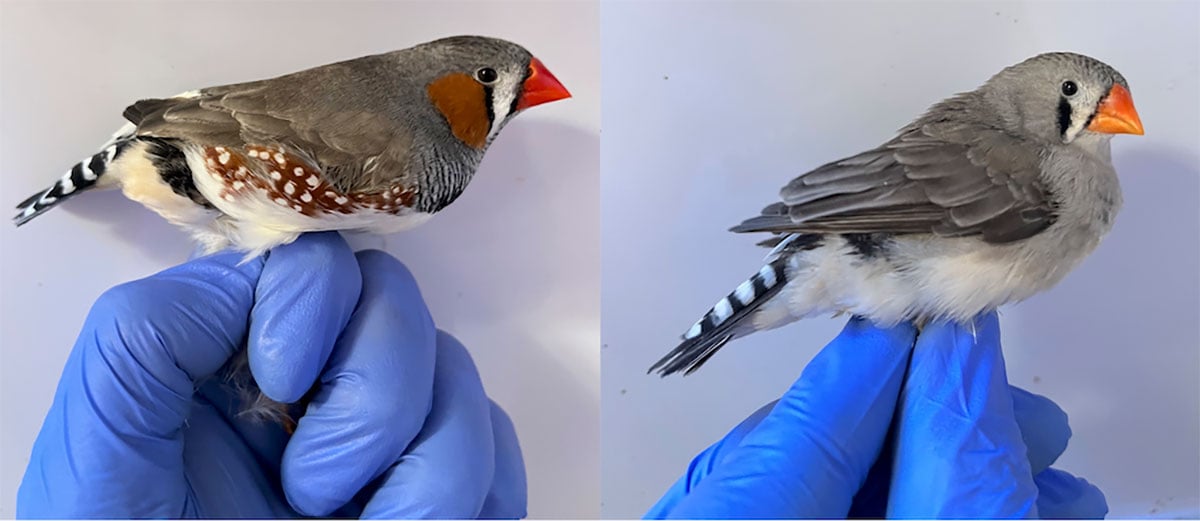
    Male (Left) and Female (Right) Zebra Finches
    Male (left) and female (right) zebra finches. The orange feathers displayed by the male are colored by the pigment pheomelanin, which is also present in human skin and red hair. Pheomelanin is associated with an increased risk of melanoma, but also exerts a beneficial physiological function consisting in the avoidance of toxicity that an excess of the amino acid cysteine in the diet may cause. Female zebra finches, which do not produce pheomelanin like males, experience cellular damage when exposed to high dietary levels of cysteine. Credit: Ismael Galván

    Pigment helps manage cysteine

    The results suggest that pheomelanin production may help cells keep cysteine levels in balance. Male birds that received both cysteine and ML349 showed more serious oxidative damage in blood plasma than males that received cysteine alone, after the authors accounted for the overall expression of the antioxidant regulator produced by melanocytes.

    The pattern was also seen in females, which do not produce pheomelanin. Female birds given cysteine alone tended to show more oxidative damage than female controls.

    According to the authors, pheomelanin synthesis may help maintain cysteine homeostasis by converting excess cysteine into inert pigment. That protective role could help explain why pheomelanin-promoting genetic variants remain in populations, even though they are also associated with increased melanoma risk.

    Reference: “MC1R depalmitoylation inhibition reveals a physiological role for pheomelanin” by Ismael Galván, Marina García-Guerra and Marta Araujo-Roque, 6 January 2026, PNAS Nexus.
    DOI: 10.1093/pnasnexus/pgaf391

    This study received funding by Ministerio de Ciencia e Innovación (MCIN/AEI/10.13039/501100011033) grant PID2020-114632GB-100 to I.G.

    Never miss a breakthrough: Join the SciTechDaily newsletter.
    Follow us on Google and Google News.

    Biochemistry Cell Biology Evolution Melanoma Pigmentation
    Share. Facebook Twitter Pinterest LinkedIn Email Reddit

    Related Articles

    Human ‘Jekyll and Hyde’ Immune Cell Discovered by Scientists

    Cancer Cells Can Become Invisible to the Immune System – Here’s How

    Unlocking the Secrets of Organ and Limb Regeneration From a Tiny Salamander’s Genetics

    Breakthrough in Understanding Evolution – Mitochondrial Division Conserved Across Species

    Strange New Organelle That Helps Prevent Cancer Discovered in Our Cells

    How Did Cells Originally Form Billions of Years Ago? Scientists Identify Molecule That May Be Key to Emergence of Life on Earth.

    Chemists Discover Unexpected Synergy Between Two Cancer Drugs

    Chemists Reveal New Theory For How Life On Earth May Have Begun

    Scientists Identify Genes Associated with Progression of Melanoma

    Leave A Reply Cancel Reply

    • Facebook
    • Twitter
    • Pinterest
    • YouTube

    Don't Miss a Discovery

    Subscribe for the Latest in Science & Tech!

    Trending News

    Black Hole Shredded a Massive Star in the Most Powerful Stellar Explosion Ever Seen

    Building the Brain Requires Millions of Dangerous DNA Breaks

    Endless Supply of Cancer-Fighting Immune Cells Unlocked by USC Scientists

    XRISM Reveals Galaxy-Shaping Winds Erupting From a Supermassive Black Hole

    New Molecule Restores the Brain’s Natural Defenses Against Alzheimer’s

    Could Creatine Boost More Than Muscles? It May Also Help Depression

    Scientists Discover a Natural Molecule That Could Help Prevent Vision Loss

    Scientists Thought Royal Jelly Made Queen Bees. They Were Wrong

    Follow SciTechDaily
    • Facebook
    • Twitter
    • YouTube
    • Pinterest
    • Newsletter
    • RSS
    SciTech News
    • Biology News
    • Chemistry News
    • Earth News
    • Health News
    • Physics News
    • Science News
    • Space News
    • Technology News
    Recent Posts
    • The Surprising Cellular Benefit of the Pigment Behind Red Hair
    • The Hidden Health Risk of Sitting for Hours Without a Break
    • Coffee May Protect the Liver in More Ways Than Scientists Realized
    • New Smart Material Can Control Heat Like a Computer Chip
    • AI Just Uncovered a Hidden Secret Inside Water
    Copyright © 1998 - 2026 SciTechDaily. All Rights Reserved.
    • Science News
    • About
    • Contact
    • Editorial Board
    • Privacy Policy
    • Terms of Use

    Type above and press Enter to search. Press Esc to cancel.