
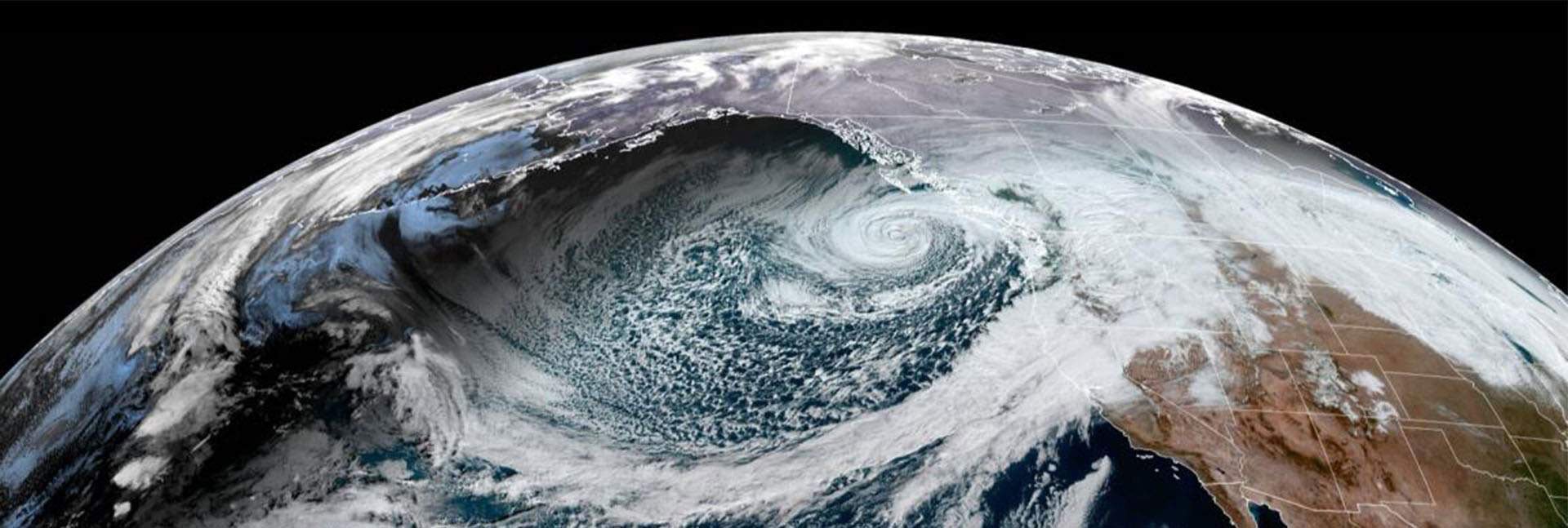
North Pacific winter storm paths are moving toward the North Pole faster than scientists expected.
In Alaska, glaciers are losing about 60 billion tons of ice each year. Farther south, across California and Nevada, heat and dryness records are falling, leaving landscapes more prone to wildfire. These changes may seem separate, but both are tied to a major shift over the North Pacific Ocean.
Winter storm tracks, the usual paths followed by powerful weather systems, are moving northward. These storms act like atmospheric conveyor belts, carrying heat and moisture from warmer parts of the planet toward the pole. As their paths shift closer to the Arctic, Alaska receives more of that heat and moisture, while the southwestern United States loses some of the natural atmospheric flushing that helps moderate temperatures.
Storm shift outpaces models
Research published in Nature by Dr. Rei Chemke of the Weizmann Institute of Science’s Earth and Planetary Sciences Department and Dr. Janni Yuval of Google Research finds that this northward movement is happening faster than climate models have projected.

To test whether the shift was part of ordinary climate swings or a sign of human-driven warming, the researchers used a new metric based on sea-level pressure, a measurement that has been collected consistently for decades. That long record gave them a way to separate background variability from a lasting climate signal. Their analysis indicates that the storm track shift is not natural variability, but a clear result of climate change.
Models may understate risk
The result fits with several earlier studies by Chemke suggesting that storm tracks are changing quickly and that climate models may not fully capture those changes. That matters because storm tracks help shape where heat, moisture, drought, and storms concentrate, especially across western North America.
“Our preparedness for future climatic change relies on the ability of models to make accurate predictions,” Chemke says. “The fact that models fail to capture the effect of climate change on the recent northward shift of storm tracks – and its consequences for western North America – suggests that changes in this region may be even more dramatic than we currently expect.”
Reference: “Climate change shifts the North Pacific storm track polewards” by Rei Chemke and Janni Yuval, 7 January 2026, Nature.
DOI: 10.1038/s41586-025-09895-y
This work is supported by the Israeli Science Foundation Grant 407/25.
Never miss a breakthrough: Join the SciTechDaily newsletter.
Follow us on Google and Google News.
10 Comments
“Their analysis indicates that the storm track shift is not natural variability, but a clear result of climate change.”
Is the unstated assumption that weather should only exhibit random changes and not long-term trends? If so, then how does one explain the several ‘Ice House’ and ‘Hot House’ climates that geologists have identified? Perhaps more to the point, if weather isn’t supposed to have long-term trends, how does one explain explain interglacials, such as the one we are currently experiencing? Underlying this is the idea that climate can only change because of anthropogenic influences. They actually state that the motivation for the ‘research’ was “To test whether the shift was part of ordinary [random] climate swings or a sign of human-driven warming, …” One should be skeptical of research that is motivated to find evidence to support an a priori hypothesis, rather than gathering data to use with inductive reasoning to try to understand why things happen. Motivation can be a subtle but powerful influencer.
“The fact that models fail to capture the effect of climate change on the recent northward shift of storm tracks … suggests that changes in this region may be even more dramatic than we currently expect.” In other words, the models are wrong. Actually, we have known for some time that the models run warm and do a poor job of predicting regional precipitation.
Without specifying a temporal interval to distinguish ‘natural’ from anthro’, almost anything can be proven. If one calculates the slope of a small section of a sine-wave, almost any trend is possible between the minimum and maximum on the y-axis, depending entirely on the starting and ending point of the time, and the frequency of the sinusoidal function.
“In Alaska, glaciers are losing about 60 billion tons of ice each year.”
That is an impressively large number. However, there is no context. Is that a net loss? What percentage of the total ice does that represent? Can that rate be maintained as the glaciers retreat to colder, higher elevations away from the ocean?
“Our preparedness for future climatic change relies on the ability of models to make accurate predictions,”
Can ANY of the models predict when and where the 113-year-old global temperature record will be broken? Is there any reasonable explanation that they will ever be able to do so?
Great comments. Unstated premises are always the first place to assess how much “science” is really involved.
We have proven we are more than okay with destroying our environment. Not going to change that or the minds of skeptical armchair pseudo intellectual commentators. The distinction of human vs natural is moot. Reality is our planet is rapidly warming, either you give a flying F and will try to limit your actions from speeding up the effects, or you put on your red hat and burn some tires in your yard … Either you care about the long term viability of our planet to support life or you are happy envisioning your descendants starving to death along with all the other very thirsty species. We will get exactly what we deserve.
Dave…Atmospheric CO2 has increased by 50%. How much has global average temperature increased since 1988 when NASA’s James Hansen testified before Congress? How much has it increased since 1995?
I don’t think you will find this reality of rapid warming you assert is there.
I’m not OK with destroying our environment. Why do you assume that I am? Your unsupported insults are not adding anything to the debate. I disagree with your claim that the distinction between “human vs natural is moot.” It may actually be easier to do something about warming (assuming that there really is a need) if it is natural, than if it is produced by humans because, IF it is produced by humans it requires changing the behavior of humans when doing so is against their short-term best interests. Many of the problems, like over-fishing, degradation of top-soil, and contamination of the ecosphere with microplastics, are a direct result of trying to feed 8 billion fecund humans. The environmental problems are a direct result of humans being too efficient at reproducing. You arrogantly act as though you are smarter than everyone who sees the problems differently, and that you can solve the problems in an unspecified manner that involves self-sacrificing moral behavior. However, you offer no specifics on how that is to be accomplished without a significant fraction of the world’s population starving. Your unexamined assumption is that humans are responsible for the changing climate, ergo, we can do something about it. I think that you are suffering from the Dunning-Kruger Effect.
Instead of insulting me, tell me how you distinguish warming caused by the natural Interglacials that started before humans had the technological ability to extract and use fossil fuels, and warming that you attribute to us.
Bad outcome, good science.
@Clyde: You seem to question climate science in general, mostly because you confuse short term weather variation with long term climate trends. That man made global warming is happening at an unprecedented (and therefore more harming) rate is not in question among scientists, c.f. how 99 % of climate science publication supports that.
[Personally I was convinced by a simple test in 2003, where already then I could load CO2 and global temperature data and do a longitudinal spreadsheet fit at sufficient 3 sigma evidence – CO2 increase leading the warming. Which is why we know it isn’t natural, including glacial cycles which are now impossible to happen again according to models. I don’t understand why people go through the motions to try to poison the well of rock solid and useful science*, when it is so easily checked for yourself…. It isn’t about smartness or arrogance, it is about a smidgen of self protecting elbow grease. *Not all of it of course, see the article, it is still testable science, but rock solid observations of man made warning.]
That extreme weather events can now be causally tied to man made global warming is a new and different development than the basic science and so called attribution models should not be confused with that. But FWIW I live in Europe where we saw thousands of premature heat deaths in young and old according to comparative statistics, and the attribution models tell us it is because man made global warming. So I am not amused by people trying to say this isn’t the observed fact when, in fact, it is.
PS. I had to check a “113-year-old global temperature record” I’ve never heard about, and for good reason: It was a local heat record in US, and is debatable at that. The global average surface temperatures have, however, been systematically tracked since the 1880s. Again, this is about climate, not local weather.
@Mike: This is science, check with an encyclopedia on climate science.
@K.: The 50 % increase is since the start of the industrial revolution. It has surged from a stable pre-industrial baseline of roughly 280 parts per million (ppm) to over 430 ppm. Its growth rate has tripled since the 1960s.
Meanwhile the net long-term global average temperature increase is approximately 1.4°C (2.5°F) above the pre-industrial baseline (1850–1900). The increase it as a rate that is estimated to be 1000s of times the natural fluctuation rates.
Locally here in Scandinavia it has resulted in a double average warming. The traditional Nordic Winter has disappeared, the snow cover season in central and southern Scandinavia has shortened by several weeks over the past few decades. The “slushification” of winter is problematic, and so is the mid-winter floodings that we are not used to. The summers have become unstable, with droughts interspersed with flash floods, and degradation of forests, agriculture, lake and sea waters (from algal blooms and loss of sea ice, for example).
Now we are drawing up costly plans to move away from the southern coasts that are disappearing under the rising seas. So again, I am not amused by people who trying to say this isn’t the observed fact when, in fact, it is.
I know very well what the difference is between climate and weather. You are making an unsupported assumption about what I don’t know to support a false narrative. I can’t post graphs here, so just tell me how you can make a claim of “unprecedented” when comparing the present climate with the temperature spike that represents the Paleocene-Eocene Thermal Maximum?
Speaking of 99%, your might find the support for that claim a little weak also after reading this: https://wattsupwiththat.com/2026/07/14/climate-consensus-research-is-the-worst-most-invalid-research-ever-published-in-journals/ By the way, I am a scientist. That is precisely why I am critical of most of the dogma. The quality of the science is generally poor. And it is NEVER about voting.
“… I could load CO2 and global temperature data and do a longitudinal spreadsheet fit at sufficient 3 sigma evidence – CO2 increase leading the warming.” If a particular data point supports your hypothesis, but it is not representative of all data, it is usually referred to as anecdotal. The Law Dome C ice core data does not support your claim. It demonstrated the exact opposite of your claim.
“… including glacial cycles which are now impossible to happen again according to models.” Those same models are acknowledged to run warm, even by the modelers. Worse, the precipitation predictions are often contradictory. Your assumption about the reliability of models is not warranted by the evidence. I am not trying to “poison the well. I’m pointing out when the unstated, and therefore unexamined, assumptions are not true. As to why, I or anyone wouldn’t jump on the bandwagon and accept poorly supported hypotheses, have you read T C Chamberlain’s “Method of Multiple Working Hypotheses”? That may give you a clue.
Amused or not, “premature deaths” are a weak argument because in most cases, as with COVID, there are co-comorbidities that contribute to the outcome. From what I can tell, Europeans, particularly from more northerly countries, aren’t used to temperatures that someone in Phoenix (AZ) would shrug off as just another warm summer day. The conjecture of “premature deaths” probably has a very large associated uncertainty. Fundamentally, Europeans have not built homes adapted to warmer weather, nor have they modified their lifestyles to account for temperatures they are not used to. I acknowledge that Earth is warming. Where we disagree is the cause.
You assert “That extreme weather events can now be causally tied to man made global warming is a new and different development …” I don’t accept that unsupported assertion. One of the strongest arguments for your position is the Delta 13C ratio. However, the fact that every phase change and chemical reaction involving carbon will result in isotopic fractionation raises serious questions about the conclusion of the change in the atmospheric isotopic ratios.
Not surprisingly, you misunderstand. The claim, based on the observation that “A rising tide raises all boats,” predicts that all temperatures should increase if the world is warming. The problem seems to be that the low temperatures are typically rising faster than the Tmax temperatures. Thus, the average Tmin, and the Tave are clearly increasing, but as I pointed out the global Tmax has not changed in 113 years. Your complaint that it is a local temperature is really a non sequitur. ALL record temperatures will be local! As to the reliability, there are issues with all claimed temperatures. However, it was the higher and later temperature in Libya that was the removed from the records. The point being, that in the last 113 years no accepted global temperature has been greater. Are you suggesting that temperatures measured in the 1880s were as reliable as modern temperatures?
Once again, you have made an assumption that you have not explicitly stated. That is, you are engaging in circular reasoning when you cite the past CO2 concentration because you are assuming that a correlation proves causation. At best, what we are looking at are interrelated CO2 feedback loops, some of which result in warming and some of which result in cooling. The unanswered question is “What is the net effect?” There are also the possibilities that we are seeing a spurious correlation, OR that the net cause and effect are backwards.
You started and ended with making a point about the difference between climate and weather. Yet, you are only citing temperature changes since the Industrial Revolution, which came on the heels of the Little Ice Age. In essence, you are cherry picking what data to use to support your beliefs. Climate demands using ALL the available data since the glaciers stopped advancing 20,000 years ago.
Why are Scandinavians concerned about rising seas? It is my understanding that all glaciated terrain is experiencing isostatic rebound, resulting in an apparent lowering of sea level compared to land.
Torbjörn, are you not going to defend your initial claims against my critique of them? As we say in the USA, “This is where the rubber meets the road.” Your poorly supported claims, with the common alarmist vocabulary (you missed a chance to use “flash droughts), has been challenged by me. You haven’t even addressed direct questions, such as how the PETM compares to today, and why Scandinavians would be alarmed by global sea level rise when they are experiencing lowering sea levels from isostatic rebound after the ice load has been removed.
If it’s not cars, co2, methane it will surely be data centers. So long humans