
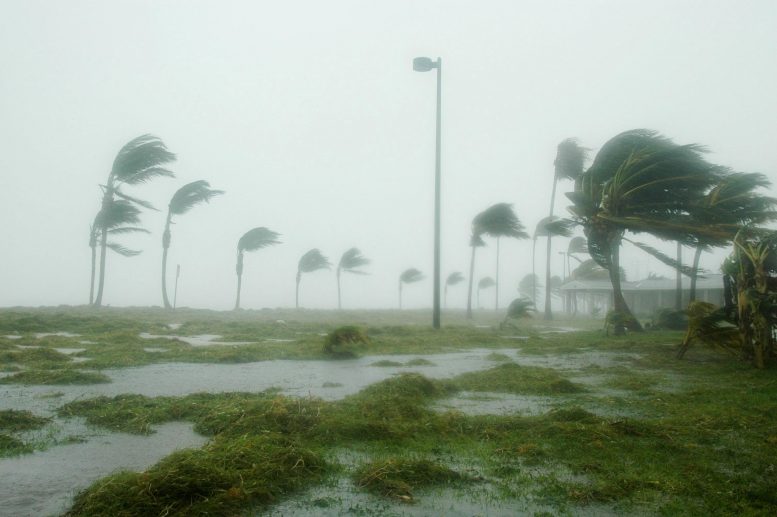
Global warming is dramatically increasing the risk of extreme hurricanes in the Caribbean, but meeting more ambitious climate change goals could up to halve the likelihood of such disasters in the region, according to new research.
The study, led by the University of Bristol, analyzed future projections of hurricane rainfall in the Caribbean and found it to be particularly vulnerable to climate change, resulting in extreme hurricane rainfall events being as much as five times more likely in a warmer world.
“Hurricane research has previously focused on the United States, so we wanted to look at the Caribbean region, which has fewer resources to recover. The findings are alarming and illustrate the urgent need to tackle global warming to reduce the likelihood of extreme rainfall events and their catastrophic consequences, particularly for poorer countries which take many years to recover,” said lead author Emily Vosper, Research Student at the School of Computer Science, at the University of Bristol.
The researchers generated thousands of synthetic hurricanes under three climate scenarios: present day conditions compared to the Paris Agreement goals of 1.5 degrees Celsius (2.7 degrees Fahrenheit) and 2°C (3.6°F) warming above pre-industrial levels. The main objective of the Paris Agreement, a global framework to tackle climate change, is to hold the global average temperature increase to well below 2°C above pre-industrial levels and endeavor to limit the temperature increase to 1.5°C.
Focusing their analysis on the Caribbean region, the study generated rainfall statistics by applying a physics-based model to the synthetic hurricanes. The model takes into account several factors including the land features and large-scale winds, and has been shown to give realistic results compared to observations of real-life hurricanes.
The study, published in Environmental Research Letters, found that extreme hurricane rainfall events affecting the Caribbean, those which typically happen once every 100 years under the current climate, occur more often under the Paris Agreement scenarios. But a 1.5°C warmer world would see significantly fewer intense Caribbean hurricanes, reducing occurrence by as much as half in the Eastern regions, compared to a 2°C warmer world.
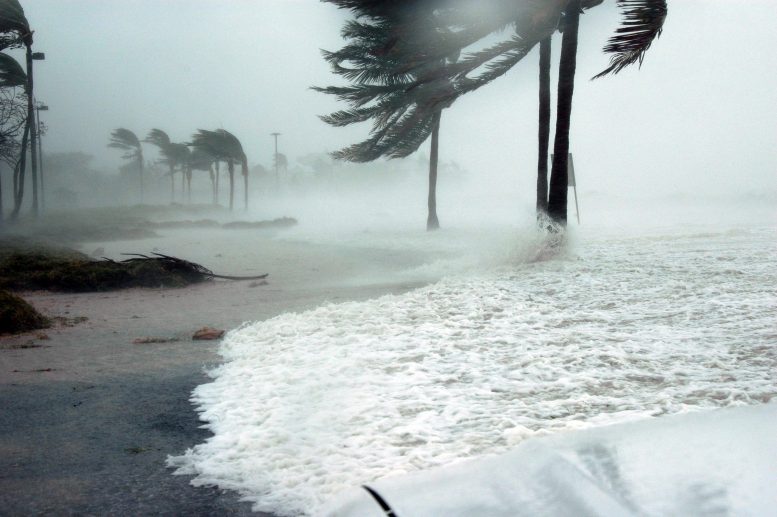
Hurricane Maria brought as much as a quarter of normal annual rainfall to some regions of Puerto Rico when it made landfall in 2017 and storms of this magnitude are roughly once in a 100-year events. The results show that in a 2°C warmer world, an event of similar size to Maria would be more than twice (2.3 times) as likely, occurring once every 43 years. Similarly, a 100-year storm affecting the Bahamas would be 4.5 times as likely under the 2°C Paris Agreement scenario compared to the present day. Under the more ambitious goal of 1.5°C warming, such extreme hurricane rainfall events affecting the Dominican Republic would occur roughly once every 57 years, which is half as likely compared to the 2°C warming scenario where they would occur once every 30 years.
Emily said: “We expected extreme hurricanes to be more prevalent in the 2°C global warming scenario, but the scale of the projected increases was surprising and should serve as a stark warning to countries across the globe underscoring the importance of keeping climate change under control.”
The projections reinforce the Intergovernmental Panel on Climate Change special report, which concludes that restricting global warming to 1.5°C would limit the risk of climate-related hazards, such as torrential rainfall, drought, and temperature extremes.
Emily said: “Our findings show that the impacts of a 2◦C warming above pre-industrial levels are set to disproportionately affect the Caribbean. By focusing efforts to stabilize global warming to the more ambitious 1.5◦C goal, we could dramatically reduce the likelihood of extreme hurricane rainfall events in the area, particularly in the Eastern Caribbean region.”
It takes at least six years for even the richest of the Caribbean countries to rebuild after a major hurricane hits, stalling economic growth. Building resilient infrastructure throughout the islands is not feasible due to financial and time constraints. The study recommends its findings could be used to inform a multi-hazard, multi-scale approach which identifies the most at-risk areas so resilience funding and strategies can be more effectively targeted.
Emily said: “Resources to mitigate damage are limited, so our findings could help highlight the hotspots in greatest danger and need. An integrated climate risk approach is needed to fully understand the threat of future hurricanes to Caribbean populations.
“Further studies could therefore incorporate factors that directly affect the health and well-being of local populations – such as storm surge, flood, and landslide modeling – into the rainfall results to quantify such threats and feed into adaptation and resilience planning.
“Reducing the likelihood of extreme hurricanes should be the overriding priority. Our research clearly illustrates how vital it is to keep striving to meet the lower global warming temperature target, and the collective responsibility all countries, cities, communities, governments, and individuals share to make that happen.”
Reference: “Extreme hurricane rainfall affecting Caribbean mitigated by the Paris Agreement goals” by Emily Vosper, Dann Mitchell, and Kerry Emanuel in Environmental Research Letters.
DOI: 10.1088/1748-9326/ab9794
Never miss a breakthrough: Join the SciTechDaily newsletter.
Follow us on Google and Google News.
1 Comment
“…, we assess how the impacts of hurricanes MAY change under the Paris Climate goals.” How about a validated quantitative probability instead of an ambiguous possibility?