
China Health Threats Likely to Increase Due to Heatwaves
Study reveals climate change will pose a deadly threat in China in the future as heatwaves become more severe and frequent.
Current health issues in China could be dwarfed by the future impacts of severe and frequent heatwaves caused by climate change, scientists are warning.
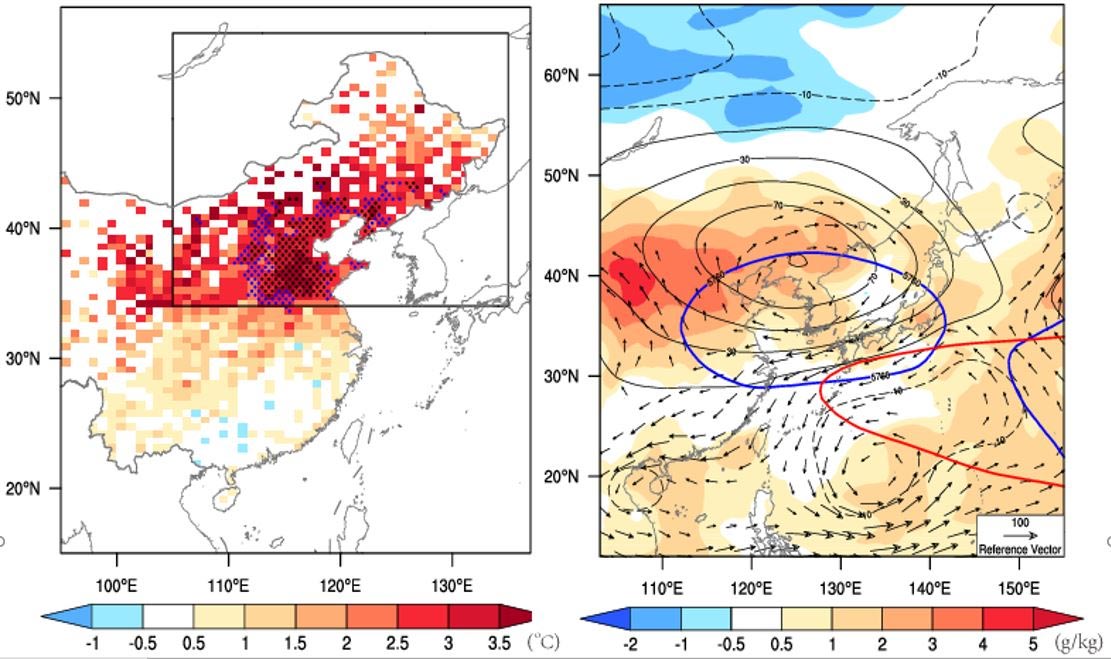
A study by the University of Reading, University of Edinburgh, the Met Office and several Chinese institutions, calculated that 30-day spells of deadly overnight heat, like the one that killed and hospitalized many people in north-east China in 2018, have already gone from being one-in-500-year events to one-in-60-year events since pre-industrial times.
They also found that extreme daytime heat, as well as extreme rainfall, is due to become more common in the country in the future as humans continue to emit greenhouse gases into the atmosphere.
Dr. Buwen Dong, co-author, and climate scientist at the University of Reading and NCAS, said: “People are already suffering from more frequent extreme heat in China, and this will only get more common in the future due to climate change.
“It is particularly concerning to see high night-time temperatures becoming a growing threat. This gives no respite to people struggling to cope with searing daytime heat and can lead to deadly heatstroke, particularly for vulnerable people. Better strategies for adapting and coping with rising temperatures are vital to save lives.”
“A hotter climate will have a severe impact on global health, with the kinds of extreme temperatures that hospitalized record numbers of people in China in 2018 likely to become more frequent in the future.” Professor Elizabeth Robinson
In two studies published by the American Meteorological Society, scientists looked at how common such hot conditions in north-east China and wet conditions in central western China have become, and will become in the future, due to human-induced climate change.
They looked at almost 50 million daily temperature records captured at 2,400 weather stations across China between 1961 and 2018, along with data from other sources.
The scientists also found that climate change has made rainfall more likely to occur in severe bursts in central western China. Using climate models, they calculated extreme downpours have become 1.5 times more likely since pre-industrial times, while the likelihood of persistent heavy rainfall has reduced by 47%.
Professor Elizabeth Robinson, an environmental economist at the University of Reading, who was not part of this study but addresses the vulnerability of people to climate change worldwide in the latest Lancet Countdown report, said: “The current health emergency in China is sadly causing many deaths and this report shows how climate change could also cause serious health emergencies in the region in the future.
“A hotter climate will have a severe impact on global health, with the kinds of extreme temperatures that hospitalized record numbers of people in China in 2018 likely to become more frequent in the future. Outdoor workers, older and young people, and those with pre-existing health conditions are likely to be most at risk.”
Example of night-time heatwave event in China
In the summer of 2018, northeast China and surrounding regions of Asia were affected by an unprecedented long and intense nighttime heatwave. Nighttime minimum temperatures in China remained as high as 29°C (84°F), and above 26°C (79°F)across a large area. Daytime maximum temperatures rose as high as 39.2°C (102.6°F), as high temperature alerts were issued in China for 33 consecutive days between 14 July and 15 August.
This led to record numbers of heat-related hospital admissions in Shenyang on 31 July, as well as affecting agriculture and increasing strain on power systems and water supplies. Fish farms producing sea cucumbers in the Liaoning Province reported an economic loss of 6.87 billion Yuan (£760 million, or US$ 1 billion).
Although no fatality records are available for China, at least 138 people were reported to have died from heat-related causes in Japan and 42 in South Korea.
Example of intense rainfall event in China
In June and July 2018, parts of the Sichuan, Gansu, and Shaanxi provinces in China were affected by frequent intense downpours. Between 18 June and 15 July, rainfall was 38% higher than the average for 1961-2010. The day with the heaviest rain was the fifth wettest in the wet season on record.
This caused floods and landslides and caused houses to collapse, affecting 2.9 million people and resulting in a reported economic loss of more than 8.9 billion Yuan (£990 million or US$ 1.29 billion).
References:
“Anthropogenic influences on the persistent night-time heat wave in summer 2018 over North-East China” by Liwen Ren, Dongqian Wang, Ning An, Shuoyi Ding, Kai Yang, Rong Yu, Nicolas Freychet, Simon F. B. Tett, Buwen Dong and Fraser C. Lott, Bulletin of the American Meteorological Society.
DOI: 10.1175/BAMS-D-19-0152.1
PDF
“Anthropogenic influence on 2018 summer persistent heavy and daily extreme rainfall in central western China” by Wenxia Zhang, Wei Li, Lianhua Zhu, Yuanyuan Ma, Lin Yun Yang, Fraser C. Lott, Chunxiang Li, Siyan Dong, Simon F. B. Tett, Buwen Dong and Ying Sun, Bulletin of the American Meteorological Society.
DOI: 10.1175/BAMS-D-19-0147.1
PDF
Never miss a breakthrough: Join the SciTechDaily newsletter.
Follow us on Google and Google News.