
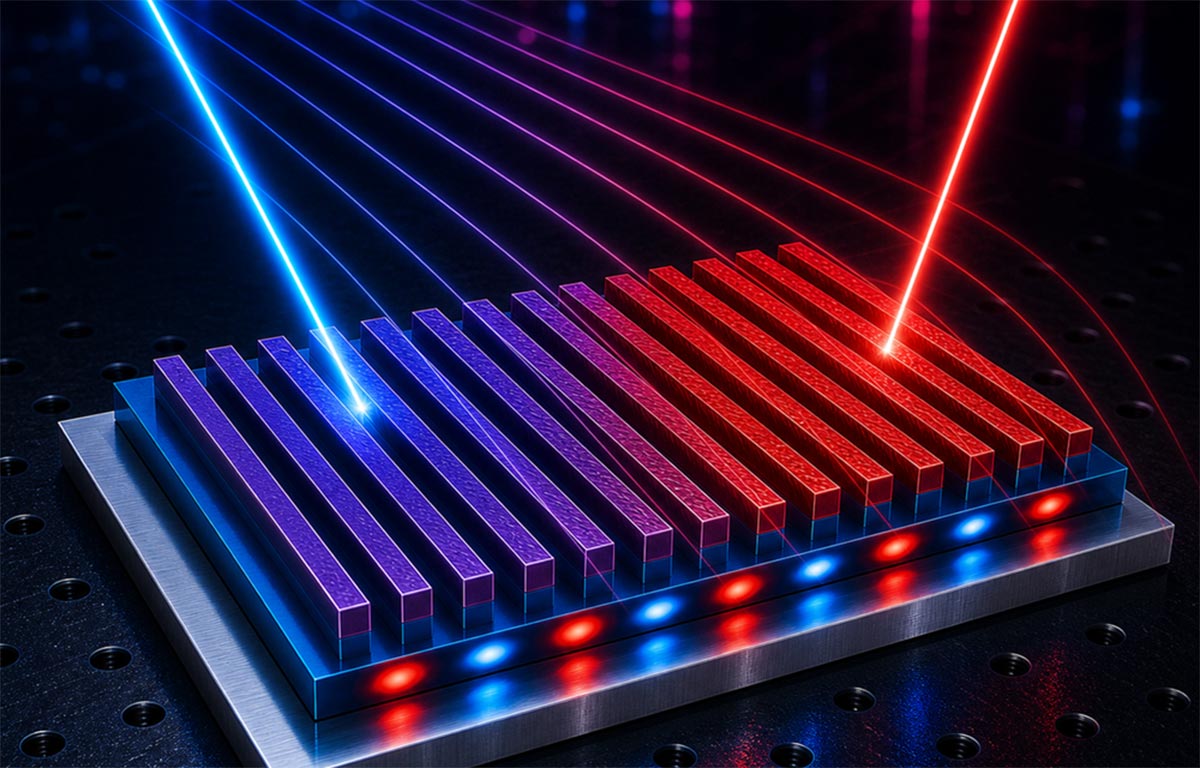
Scientists have created a programmable material that gives engineers unprecedented control over heat, with potential applications ranging from energy systems to next-generation photonic memory.
Heat normally follows strict rules. A material that efficiently absorbs heat from a particular direction and wavelength will also emit heat the same way. This fundamental principle, known as reciprocity, has long prevented scientists from independently controlling how heat is absorbed and released.
Breaking that link could unlock an entirely new class of technologies. If materials could absorb heat from one direction while emitting it in another, engineers could steer thermal energy with unprecedented precision, leading to advances in thermal management, energy conversion, infrared sensing, and thermal communication.
Smart Material Can Steer and Store Heat
To make that possible, an international research team led by Professor Koichi Okamoto and Dr. Shunsuke Murai of Osaka Metropolitan University’s Graduate School of Engineering turned to magneto-optical materials. These materials change the way they interact with light when exposed to a magnetic field.
The researchers paired a magneto-optical material with a phase change material known as GST to create a device that can control the direction of thermal radiation. The device can also switch this behavior on or off and retain its selected state even after power is removed, allowing heat to be programmed much like data stored in a microchip.
“We made heat radiation behave in a ‘smarter’ way,” Dr. Murai explained. “Achieving these capabilities in a working model could enable a new generation of efficient infrared emitters, thermal-energy devices, sensors, and photonic memory technologies.”
A Major Improvement Over Earlier Designs
Tests showed that the device responded differently depending on the direction of incoming light, even when the light struck it almost straight on. This represents a significant advance over previous designs, which only worked when light arrived at very steep angles where both heat absorption and heat emission became much less efficient.
The new system also solved another major limitation. Earlier devices produced inconsistent switching behavior and lost their programmed state as soon as power was removed, making them difficult to reconfigure. By contrast, the new device provides more reliable switching while preserving its stored state without continuous power.
Toward Programmable Thermal Devices
The researchers envision a future where heat can be manipulated with the same level of precision that electronics use to control electricity.
“Our ultimate goal is to develop compact devices that can actively control heat radiation, much like electronic circuits control the flow of electricity,” Professor Okamoto said. “Such devices could be used in smarter infrared sensors, more efficient energy systems, and new types of photonic memory that store information using light and heat instead of electrical charges.”
Reference: “Reconfigurable Giant Nonreciprocity at Near-Normal Incidence via Phase-Change Magneto-Optical Metagratings” by Ye Ming Qing, Yi Shen, Jun Wu, Shunsuke Murai, Zhaogang Dong and Koichi Okamoto, 25 June 2026, Laser & Photonics Reviews.
DOI: 10.1002/lpor.71438
Never miss a breakthrough: Join the SciTechDaily newsletter.
Follow us on Google and Google News.
1 Comment
looking specifically at the GfE (Gravity from Entropy) paper, not the heat material.
logic is simple If a paper sets out to solve gravity, but in the process breaks or modifies Relativity, it fails its own test.
The author didn’t state she was set up to test or break Relativity—she was trying to link entropy to gravity. But the moment the math forced her to modify Einstein’s equations and add extra arbitrary fields just to make her entropy density work, the foundation cracked.
If a theoretical model can’t hold General Relativity intact as an absolute baseline without altering the rules halfway through, the whole experiment falls apart right there. Case closed, into the trash bin it goes with the rest of them.