
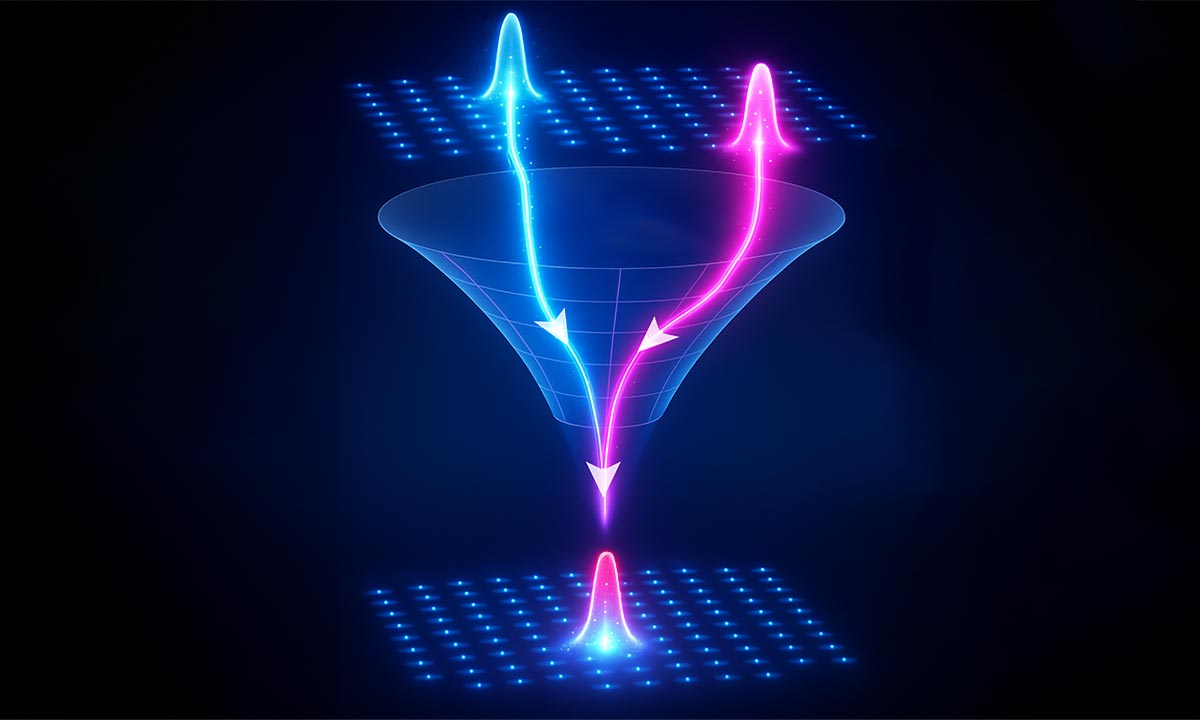
USC engineers have demonstrated a new kind of optical device that lets light organize its own route using the principles of thermodynamics.
Instead of relying on switches or digital control, the light finds its own path through the system. This approach could transform data transmission, computing, and communications by making optical technologies more natural and efficient.
Breakthrough in Optical Thermodynamics
Researchers at the Ming Hsieh Department of Electrical and Computer Engineering have achieved a major advance in photonics with the creation of the first optical device based on the emerging concept of optical thermodynamics.
Their study, published in Nature Photonics, presents a completely new method for directing light within nonlinear systems (systems that operate without switches, external control, or digital input). In this setup, light doesn’t need to be steered or adjusted—it naturally travels through the device, following the basic laws of thermodynamics.
From Valves to Routers to Light
Routing is a common principle across many fields of engineering. In mechanical systems, a manifold valve controls which outlet a fluid flows through. In electronics, routers and network switches manage the flow of digital data, ensuring information from multiple inputs reaches the right destination. But directing light works differently and is far more difficult. Traditional optical routers depend on intricate arrays of switches and electronic circuits to control pathways, which makes the process complex and slows performance.
The photonics researchers at the USC Viterbi School of Engineering have discovered an entirely new approach. They describe it as being like a marble maze that organizes itself. Normally, you would have to lift barriers and guide the marble step by step to reach the right hole. In the USC team’s design, the maze is structured so that wherever you drop the marble, it automatically rolls to its correct endpoint—no manual guidance required. In the same way, light in this device finds the right path on its own, driven purely by thermodynamic behavior.
Potential Industry Impact
This innovation could have significant effects beyond basic research. As computing and data systems approach the physical limits of electronic speed and efficiency, many companies (including chip developers like NVIDIA and others) are turning to optical interconnects as a faster, more energy-efficient alternative. By introducing a natural, self-organizing way to control light, the principles of optical thermodynamics could help advance this next generation of optical technology. The framework may also influence broader areas such as telecommunications, high-performance computing, and secure data transfer, opening the door to devices that are both more powerful and less complex.
How it Works: Chaos Tamed by Thermodynamics
Nonlinear multimode optical systems are often dismissed as chaotic and unpredictable. Their intricate interplay of modes has made them among the hardest systems to simulate—let alone design for practical use. Yet, precisely because they are not constrained by the rules of linear optics, they harbor rich and unexplored physical phenomena.
Recognizing that light in these systems undergoes a process akin to reaching thermal equilibrium—similar to how gases reach equilibrium through molecular collisions—the USC researchers developed a comprehensive theory of “optical thermodynamics.” This framework captures how light behaves in nonlinear lattices using analogues of familiar thermodynamic processes such as expansion, compression, and even phase transitions.
A Device that Routes Light by Itself
The team’s demonstration in Nature Photonics marks the first device designed with this new theory. Rather than actively steering the signal, the system is engineered so that the light routes itself.
The principle is directly inspired by thermodynamics. Just as a gas undergoing what’s known as a Joule-Thomson expansion redistributes its pressure and temperature before naturally reaching thermal equilibrium, light in the USC device experiences a two-step process: first an optical analogue of expansion, then thermal equilibrium. The result is a self-organized flow of photons into the designated output channel—without any need for external switches.
Opening a New Frontier
By effectively turning chaos into predictability, optical thermodynamics opens the door to the creation of a new class of photonic devices that harness, rather than fight against, the complexity of nonlinear systems. “Beyond routing, this framework could also enable entirely new approaches to light management, with implications for information processing, communications, and the exploration of fundamental physics,” said the study’s lead author, Hediyeh M. Dinani, a PhD student in the Optics and Photonics Group lab at USC Viterbi.
The Steven and Kathryn Sample Chair in Engineering, and Professor of Electrical and Computer Engineering at USC Viterbi Demetrios Christodoulides added, “What was once viewed as an intractable challenge in optics has been reframed as a natural physical process—one that may redefine how engineers approach the control of light and other electromagnetic signals.”
Reference: “Universal routing of light via optical thermodynamics” by Hediyeh M. Dinani, Georgios G. Pyrialakos, Abraham M. Berman Bradley, Monika Monika, Huizhong Ren, Mahmoud A. Selim, Ulf Peschel, Demetrios N. Christodoulides and Mercedeh Khajavikhan, 25 September 2025, Nature Photonics.
DOI: 10.1038/s41566-025-01756-4
Never miss a breakthrough: Join the SciTechDaily newsletter.
Follow us on Google and Google News.
2 Comments
DCB Memo 2510201251_Source 1. Summary of Reinterpretation []
Source 1.
https://scitechdaily.com/self-organizing-light-could-transform-computing-and-communications/
1.
Self-organizing light could revolutionize computing and communications.
_Self-guiding light could lead the next revolution in computing and communications.
_USC engineers have demonstrated a new type of optical device that uses thermodynamic principles to allow light to organize its own path.
_Instead of relying on switches or digital controls, light finds its own path within the system. This approach could make optical technology more natural and efficient, revolutionizing data transmission, computing, and communications.
【Photons have a boson value (1). Boson particles are integers 1.sample1.3 of oss.nsum(*).
_1. [A photon is a boson with spin 1. Like other bosons, it does not follow the Pauli exclusion principle and can exist in multiple identical quantum states. Bosons have quantum spins with integer values, and photons, as gauge bosons that mediate electromagnetic interactions, have spin 1.
_2. [A boson’s quantum spin has integer values (0, 1, 2, …). This property distinguishes bosons from fermions (particles with half-integer spin) by allowing them to follow Bose-Einstein statistics. For example, particles that mediate fundamental interactions, such as photons, W bosons, Z bosons, gluons, and Higgs bosons, are bosons.]
>>>>The boson particle photon
_3. [A photon is the particle that mediates the electromagnetic force in the Standard Model. The Standard Model is a theory that describes the fundamental particles of nature and their interactions, and the photon is one of the gauge bosons that mediates electromagnetic interactions.
According to this theory, the interaction and repulsion of two electrons occurs because photons are exchanged between them.
Photons are classified according to the type of electromagnetic radiation (energy and frequency).
Radio waves, microwaves, infrared, visible light, ultraviolet light, X-rays, gamma rays, etc. are all photons (light particles), each with its own unique wavelength, frequency, and energy.
These photons are classified according to their energy, and energy and frequency are proportional to each other.
sample1. msbase12.qpeoms.2square.vector
oms.vix.a’6,vixx.a(b1,g3,k3,o5,n6)
b0acfd|0000e0
000ac0|f00bde
0c0fab|000e0d
e00d0c|0b0fa0
f000e0|b0dac0
d0f000|cae0b0
0b000f|0ead0c
0deb00|ac000f
ced0ba|00f000
a0b00e|0dc0f0
0ace00|df000b
0f00d0|e0bc0a
sample2.qoms(standard)
0 0 0 0 0 0 0 0 1 1=2,0
0 0 0 0 0 0 1 1 0 0
0 0 0 0 0 0 1 1 0 0
0 0 0 0 0 1 0 0 1 0
0 0 0 1 1 0 0 0 0 0
0 1 0 1 0 0 0 0 0 0
0 0 1 0 0 1 0 0 0 0
0 1 0 0 1 0 0 0 0 0
2 0 0 0 0 0 0 0 0
0 0 1 0 0 0 0 0 0 1
sample3.pms (standard)
q0000000000
00q0000000
000q000000
0000000q000
000000000q
000000000000
0000000000q
00000000000
000000000q0
000000000q0
sample4.msoss(standard)
zxdxybzyz
zxdzxezxz
xxbyyxzz
zybzzfxzy
cadccbcdc
cdbdcbdbb
xzezxdyyx
zxezybzyy
bddbcbdca
】
1-1. Breakthrough Advances in Optical Thermodynamics
_Ming Xue Researchers in the Department of Electrical and Computer Engineering have developed optical A major advance in the field of photonics has been made by creating the first optical device based on a new concept called thermodynamics.
_This research, published in Nature Photonics, presents a completely new way to direct light within nonlinear systems (systems that operate without switches, external controls, or digital inputs). In this configuration, light requires no direction or regulation. Light naturally passes through the device, guided by the fundamental laws of thermodynamics.
1-3. From Valves to Routers to Lighting
_Routing is a common principle across many engineering disciplines. In mechanical systems, manifold valves control the flow of fluids to their respective outlets.
In electronic systems, routers and network switches manage the flow of digital data, ensuring that information from multiple inputs reaches the correct destination.
_However, directing light works differently and is much more challenging. Conventional optical routers use complex arrays of switches and electronic circuits to control the path, complicating the process and reducing performance.
2.
_Photonics researchers at the USC Viterbi School of Engineering have discovered a completely new approach. They describe it as a self-moving marble maze.
Typically, you’d have to lift obstacles and guide the marbles step by step until they reach the correct hole.
According to the USC research team’s design, this maze automatically rolls to the correct endpoint no matter where you drop them, eliminating the need for manual guidance. Similarly, the light in this device finds its own path through thermodynamic behavior.
【Suppose you have marbles with a constant temperature and mass. If you pour a large number of these marbles through a funnel, they will naturally flow out one by one, gradually lowering their temperature and mass as if they were in equilibrium.】
>> Since the matter of the universe is composed of particles with the unique scalar vector properties of the Standard Model of Particles, there exists an equilibrium of temperature and mass, as if they were flowing through numerous funnels.
2-1. Potential Industrial Impact
This innovation could have significant ramifications beyond basic research.
As computing and data systems reach the physical limits of electronic speed and efficiency, many companies (including chip developers like NVIDIA) are turning to optical interconnects as a faster and more energy-efficient alternative.
By introducing a natural, self-organizing approach to light control, the principles of opto-thermodynamics can contribute to the development of next-generation optical technologies.
Furthermore, this framework could have implications for broader fields such as communications, high-performance computing, and secure data transmission, opening the door to more powerful yet less complex devices.
2-2. How It Works: Chaos Tamed by Thermodynamics
Nonlinear multimode optical systems are often overlooked due to their chaotic nature and unpredictability.
The complex interactions between modes make them among the most challenging systems to simulate, and designing them for practical applications is even more challenging.
However, because they are not bound by the laws of linear optics, they harbor a wealth of unexplored physical phenomena.
【The universe has already transformed the material world into a nonlinear 2d3d4d…optical thermodynamic system. Hmm.
>>msbase Ordinary matter is a positive thermodynamic system with the vibrational state of electromagnetic light.
>>msoss Dark matter is a negative thermodynamic structure with the vibrational state of gravitational waves. Uh-huh.
2-3.
_Recognizing that light reaches thermal equilibrium in these systems through a process similar to the process by which gases reach equilibrium through molecular collisions, USC researchers developed a comprehensive theory of “optical thermodynamics.”
_This theory captures how light behaves in nonlinear lattices by leveraging analogies to familiar thermodynamic processes like expansion, compression, and even phase transitions.
3. Self-Transmitting Light Devices
_The demonstration presented by the team in Nature Photonics is the first device designed based on this new theory. Rather than actively controlling the signal, this system is designed to allow light to determine its own path.
[Light is an optical thermodynamic qpeoms.qpms.dark_energy.]
>>>Like heat energy gathering in a funnel, two types of light energy, varying in intensity and decreasing in intensity, converge at a singular point, qqcell. Huh?
>>>The main properties of light are straight-line propagation, reflection, refraction, dispersion, and scattering. Furthermore, it possesses wave-like properties such as interference, diffraction, and polarization, as well as particle-like properties (wave-particle duality). Within msbase, it possesses both wave-like properties as an electromagnetic wave and quantum-like properties as a particle.
>>>The photon in this singularity possesses energy as a qpms particle, and this energy is quantized by numerous thermal equilibrium msbase.n. The product of the frequency of (𝐸=ℎ𝜈) and Planck’s constant is expressed as 𝐸=ℎ𝜈.
>>This energy can be transferred in the form of “thermal energy” in processes such as the photoelectric effect, which occurs when a photon is absorbed by a material, increasing the kinetic energy of atoms or molecules, thus raising their temperature.
>>>If msbase.n-1. (𝐸=ℎ𝜈) has been used, the temperature decreases, which is a decrease in electron mass (*) defined by the banc effect, where msbase.size decreases.
>>>Therefore, the characteristic distinction between high and low temperatures at the singularity of qpms.photon.nqvix.qqcell is banc.n-1. 𝐸=ℎ𝜈. Oh, my.
】
thanks for this