
Close Menu
    Facebook X (Twitter) Instagram
    SciTechDaily
    • Biology
    • Chemistry
    • Earth
    • Health
    • Physics
    • Science
    • Space
    • Technology
    Facebook X (Twitter) Pinterest YouTube RSS
    SciTechDaily
    Home»Technology»A Fiber Frozen at -196°C Unlocks a New Way To Store Light
    Technology

    A Fiber Frozen at -196°C Unlocks a New Way To Store Light

    By Max Planck Institute for the Science of LightJuly 26, 2026No Comments4 Mins Read
    Facebook Twitter Pinterest Telegram LinkedIn WhatsApp Email Reddit
    Share
    Facebook Twitter LinkedIn Pinterest Telegram Email Reddit
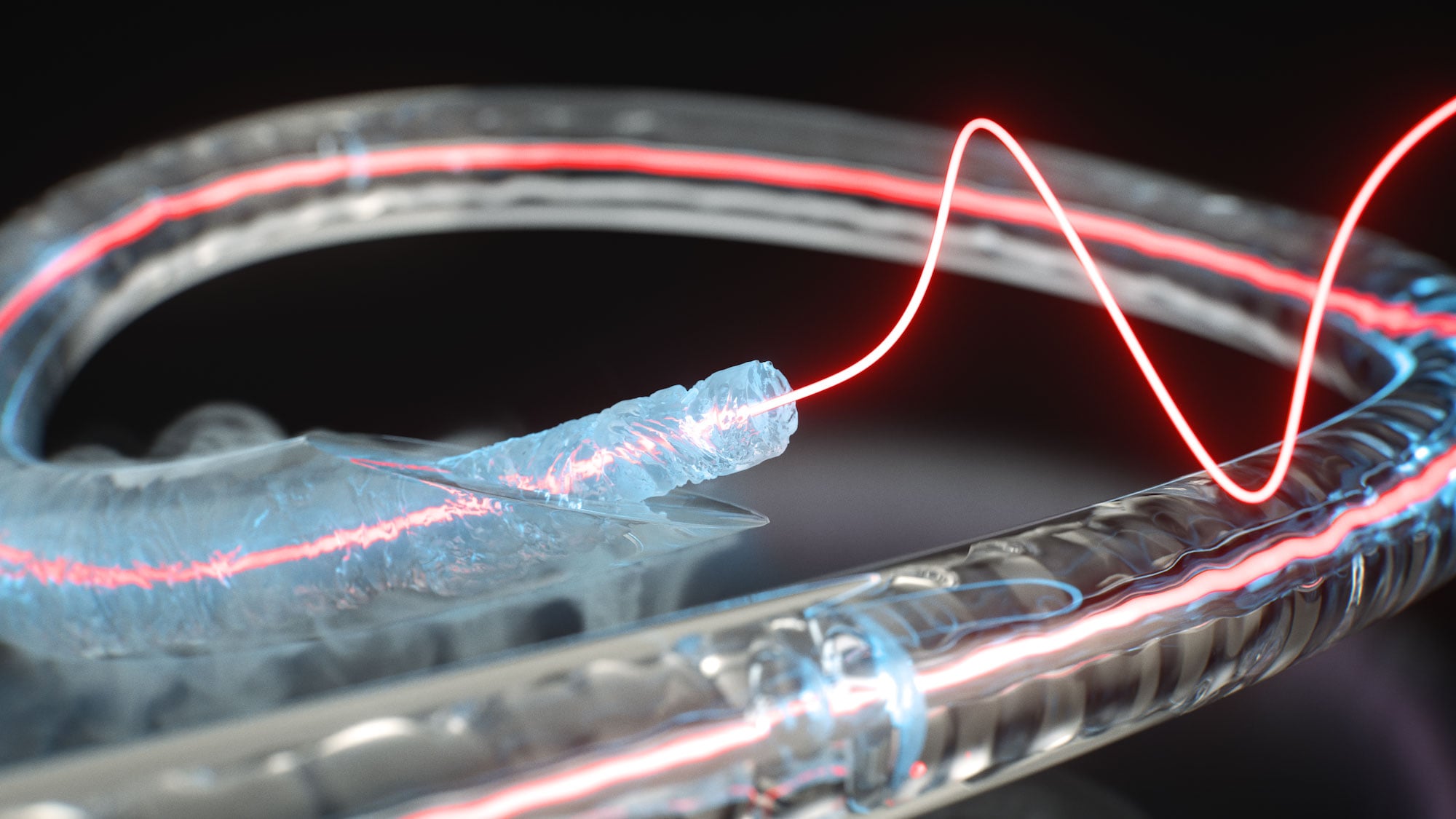
    Artist Impression of a Frozen Optical Fiber Core in a Glass Capillary
    Artist impression of a frozen optical fiber core in a glass capillary, which guides and couples light and sound waves efficiently. Credit: Philipp Denghel

    A frozen-core optical fiber has revealed a powerful new way to control interactions between light and sound.

    Molten lava hardens into rock as it cools, much as the surface of a lake freezes during a cold winter. In both cases, a liquid becomes a solid, changing physical properties such as density and refractive index, which influence how sound and light travel through the material.

    A related process is used to manufacture optical fiber by heating glass preforms until they soften enough to be drawn into thin strands. Light travels through the fiber core, carrying information rapidly across long distances and making these fibers essential to telecommunications.

    Specialized designs have also been created for fiber lasers, endoscopes and sensors. Hollow core fibers, for example, can hold gases or liquids, measure temperature patterns or function as miniature chemistry laboratories.

    Frozen liquid still guides light

    Researchers from the Max Planck Institute of the Science of Light (MPL) in Erlangen, Leibniz University Hannover (LUH) and the Leibniz Institute for Photonic Technologies (IPHT) in Jena created a new kind of optical fiber by placing liquid core optical fibers (LiCOF) in nitrogen at -196 °C. The extreme cooling changed the core from a liquid into a solid.

    Birgit Stiller, Andreas Geilen, Simon Seiderer, and Luan Sliwa
    Team of first authors with project leader Prof. Birgit Stiller (2nd from left): Dr. Andreas Geilen, Simon Seiderer, Luan Sliwa (from left to right). Credit: MPL

    “The key point is, that the frozen section of the LiCOF retains its ability to guide light. Not only that, but both the liquid and the frozen section of the fiber also guide hypersonic sound waves,” says Simon Seiderer, one of the three lead authors of the article and a researcher in the “Quantum Optoacoustics” research group of Prof. Dr. Birgit Stiller, who leads the project.

    The new fiber produces an unusually strong interaction between light and sound through a process called Brillouin-Mandelstam scattering. Although this effect also occurs in conventional optical fibers, freezing the LiCOF creates a dense and highly confined environment that increases optoacoustic coupling by more than 1000 times compared with standard fibers.

    The researchers used this interaction to demonstrate optoacoustic memory, an important component for photonic neuromorphic computing in fibers. Because light travels much faster than sound, information can be transferred from a rapid light wave to a slower sound wave for temporary storage and then converted back into light.

    The strong coupling inside the frozen LiCOF could sharply reduce the energy required by photonic computing systems.

    Mario Chemnitz, Birgit Stiller, and Markus A. Schmidt
    Project leaders of the collaborative project: Jun.-Prof. Mario Chemnitz, Prof. Birgit Stiller, Prof. Markus A. Schmidt (from left to right). Credit: MPL

    One fiber opens several applications

    The work built on an established collaboration with Prof. Markus Schmidt and Prof. Mario Chemnitz at IPHT Jena, who helped pioneer research involving liquid core optical fibers. Freezing the LiCOF core added another step that enabled stronger nonlinear effects.

    “By freezing the liquid core, we have created an entirely new physical platform that provides extreme nonlinearities while being easy to handle,” says Stiller.

    “While demonstrating a highly efficient optoacoustic memory is a fantastic first step, this level of light-sound coupling not only opens up exciting new possibilities for neuromorphic computing, but also for quantum information processing, microwave photonics and high-precision sensing.”

    Reference: “Giant Brillouin gain in frozen CS₂ capillaries” by Simon Seiderer, Andreas Geilen, Luan N. Sliwa, Linqiao Gan, Xue Qi, Mario Chemnitz, Markus A. Schmidt and Birgit Stiller, 19 July 2026, Optica.
    DOI: 10.1364/OPTICA.600056

    Funding: European Research Council (101170362); Deutsche Forschungsgemeinschaft (STI-792/7-1, STI-792/1-1, SCHM-2655/3-2, SCHM-2655/23-1); Max Planck Society (Independent Research Group Scheme); Carl Zeiss Foundation (Nexus Program P2021-05-025).

    Never miss a breakthrough: Join the SciTechDaily newsletter.
    Follow us on Google and Google News.

    Acoustics Max Planck Institute Optoelectronics Photonics Photons
    Share. Facebook Twitter Pinterest LinkedIn Email Reddit

    Related Articles

    Photonic Chip Unlocks Ultra-Broadband Optical Signal Boosting

    Breakthrough in High-Performance Fractal Nanowire Photon Detectors

    Revolutionizing Light: The Breakthrough Frequency Comb Transforming Photonics

    Neural Networks Made of Light: Photon Power Drives the Next AI Revolution

    Revolutionizing Photonics: Lithium Tantalate Powers Next-Gen Optical Circuits

    AI Efficiency Breakthrough: How Sound Waves Are Revolutionizing Optical Neural Networks

    Revolutionizing Photonics: Researchers Achieve Unprecedented Upconversion Efficiency

    Physicists Unlock the Secrets of Light-Induced Ferroelectricity in Quantum Materials

    A Game-Changer for Space Telescopes: Membrane Mirrors Revolutionize Astronomy

    Leave A Reply Cancel Reply

    • Facebook
    • Twitter
    • Pinterest
    • YouTube

    Don't Miss a Discovery

    Subscribe for the Latest in Science & Tech!

    Trending News

    Long COVID Brain Scans Reveal Damage to Dopamine Neurons

    Scientists Warn a Silent Oxygen Crisis Is Spreading Through Earth’s Waters

    James Webb Telescope Discovers Hidden Giant Planet in Famous Star System

    Scientists Build the First 3D Cloak That Makes Objects Invisible To Heat

    Common Food Additive Linked To Gut Inflammation

    Black Hole Collisions May Follow a Surprisingly Simple Rule

    The Eye Has a Hidden Cleanup System and Scientists Just Discovered It

    The Truth About Vikings Is More Complicated Than Museums Admit

    Follow SciTechDaily
    • Facebook
    • Twitter
    • YouTube
    • Pinterest
    • Newsletter
    • RSS
    SciTech News
    • Biology News
    • Chemistry News
    • Earth News
    • Health News
    • Physics News
    • Science News
    • Space News
    • Technology News
    Recent Posts
    • A Fiber Frozen at -196°C Unlocks a New Way To Store Light
    • Scientists Solve a Decades-Old Mystery Inside Atomic Nuclei
    • Alien Signals May Be Hiding in a Radio Band SETI Has Barely Explored
    • Scientists Crack the Code for Making “Impossible” Nanocrystals
    • Earth’s Hidden Thermostat Has Regulated Climate for 60 Million Years
    Copyright © 1998 - 2026 SciTechDaily. All Rights Reserved.
    • Science News
    • About
    • Contact
    • Editorial Board
    • Privacy Policy
    • Terms of Use

    Type above and press Enter to search. Press Esc to cancel.