
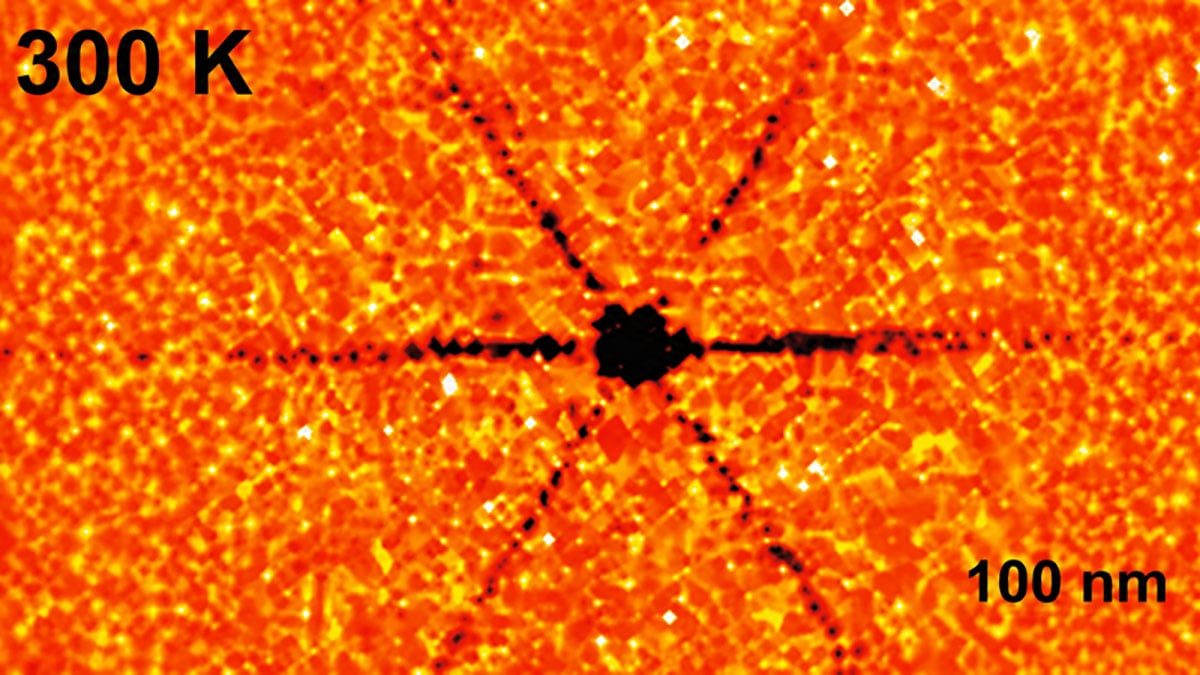
The discovery could improve thermal management in electronics and support advances in quantum and next-generation computing technologies.
Heat usually spreads outward through a solid, making it difficult to control once it begins moving. Until now, a wavelike form of heat transport called phonon focusing had been observed only at extremely low, or cryogenic, temperatures, sharply limiting its study and possible applications.
Researchers at the UCLA Samueli School of Engineering have now shown that phonons, quantum vibrations that carry heat through a material, can travel along concentrated, ray-like paths at room temperature. Rather than dispersing evenly in every direction, the heat followed routes determined by the underlying crystal structure, suggesting a new way to direct thermal energy in future electronics and quantum technologies.
The work, published in Nature Physics, was led by Yongjie Hu, a professor of mechanical and aerospace engineering at UCLA Samueli. His group observed room-temperature phonon focusing in boron arsenide, a crystalline semiconductor known for its high thermal conductivity.
Instead of waiting for unwanted heat to spread and then trying to remove it, boron arsenide could potentially steer that energy along carefully chosen routes with nanoscale precision, similar to how optical fibers direct light.
Heat forms rays inside the crystal
The researchers developed a nanoscale temperature mapping method to make the effect visible. Ordinary materials produced circular temperature patterns, showing the familiar process in which heat diffuses outward.
Boron arsenide behaved differently. Its temperature patterns formed distinct rays, revealing that heat was traveling preferentially along specific directions within the crystal.
Crystal orientation redirects heat flow
The pattern changed in predictable ways when the orientation of the crystal changed. Different planes within boron arsenide produced sixfold, eightfold, and fourfold arrangements of focused heat.
This quantum phonon behavior persisted across distances of one micrometer and could potentially extend for tens of micrometers. That range is large enough to be relevant for many electronic, photonic, and quantum devices.
“This is a fundamental observation that enables us to think about thermal management in a new way,” said Hu, the study’s corresponding author and a member of the California NanoSystems Institute at UCLA. “By enabling heat to be guided, focused and redistributed with nanoscale precision at room temperature, the discovery establishes a foundation for quantum thermal engineering.”
Guided heat could ease overheating
The ability to control heat at atomic scales could help address overheating in AI hardware, microelectronics, aerospace systems and other devices where rising temperatures restrict performance, reliability and scalability.
Hu said the finding may also allow researchers to adjust interactions between phonons, electrons and other carriers of energy. Such control could benefit future quantum information and sensing technologies.
Weak scattering preserves wave behavior
Earlier demonstrations of phonon focusing largely required temperatures only a few degrees above absolute zero. Under those conditions, phonons can travel long distances without frequently colliding or scattering.
At room temperature, phonons generally scatter much more often and rapidly lose their wave coherence, causing heat to spread through conventional diffusion.
The new findings build on Hu’s earlier work involving the experimental discovery of boron arsenide in 2018. His group has since demonstrated high-performance thermal interfaces and gallium nitride devices that incorporate boron arsenide for cooling, underscoring the material’s potential for future semiconductor technologies.
Boron arsenide experiences unusually weak phonon scattering, allowing wavelike heat transport to survive even at room temperature.
The measured heat patterns agreed with theoretical predictions, confirming that phonons can travel unusually far before scattering — the essential condition that makes this room temperature wave behavior possible.
Reference: “Phonon focusing at room temperature” by Man Li, Huan Wu, Zihao Qin, Chuanjin Su, Huu Duy Nguyen and Yongjie Hu, 23 July 2026, Nature Physics.
DOI: 10.1038/s41567-026-03335-y
Never miss a breakthrough: Join the SciTechDaily newsletter.
Follow us on Google and Google News.
2 Comments
Quantum vibrations that carry heat through a material, can travel along concentrated, ray-like paths at room temperature.
VERY GOOD.
Please ask researchers to think deeply:
Why does quantum vibrate?
Is vibration one of the periodic manifestations of motion?
Does spin have periodicity?
Is the ideal fluid still an ideal fluid after undergoing topological phase transition, forming spin and interaction?
These themes reflect a deep-seated institutional resistance to questioning the ontological premises that underlie all of contemporary fundamental physics—premises that have never been empirically verified.
—— Excerpted from https://zhuanlan.zhihu.com/p/2062808500313626237.
It’s wild to realize that Fourier’s Law ($q = -k \nabla T$), which governed heat engineering for two centuries, was essentially an empirical approximation born out of 1822 flat-space assumptions.Back then, the scientific establishment forced physics into a rigid box: treating space as a passive void and heat as a chaotic, random bleed. But seeing “second sound” quantum heat waves observed at room temperature completely shatters that flat-space view—aligning right with what we’ve mapped out in the Torsion Hill framework.Heat isn’t forced to degrade into random thermal noise when a material’s internal structural clearance ($V_{\text{SC}}$) allows momentum to be conserved. Instead of scattering randomly into the surrounding spatial continuum ($+\pi$), the energy moves as a coherent, non-dispersive wave pulse through a low-shear pathway ($\nabla T \to 0$).It’s another great proof that when you look past 19th-century approximations and account for Torsion Hill field geometry, nature routes energy far more efficiently than old equations ever predicted!