
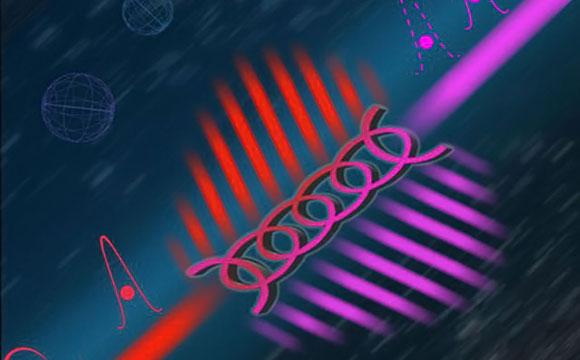
By slicing up and entangle each photon pair into multiple dimensions, researchers from UCLA have demonstrated a new way to harness light particles.
A team of researchers led by UCLA electrical engineers has demonstrated a new way to harness light particles, or photons, that are connected to each other and act in unison no matter how far apart they are — a phenomenon known as quantum entanglement.
In previous studies, photons have typically been entangled by one dimension of their quantum properties — usually the direction of their polarization.
In the new study, researchers demonstrated that they could slice up and entangle each photon pair into multiple dimensions using quantum properties such as the photons’ energy and spin. This method, called hyperentanglement, allows each photon pair to carry much more data than was possible with previous methods.
Quantum entanglement could allow users to send data through a network and know immediately whether that data had made it to its destination without being intercepted or altered. With hyperentanglement, users could send much denser packets of information using the same networks.
The research, published in Nature Photonics, was led by Zhenda Xie, a research scientist in the lab of Chee Wei Wong, a UCLA associate professor of electrical engineering who was the research project’s principal investigator. Researchers from MIT, Columbia University, the University of Maryland and the National Institute of Standards and Technology were also part of the team.
Albert Einstein famously described quantum entanglement as “spooky action at a distance” because it seems so improbable that what happens to one particle in an entangled pair also happens instantly to the other particle, even over great distances. The phenomenon exceeds the speed of light.
In the new study, researchers sent hyperentangled photons in a shape known as a biphoton frequency comb, essentially breaking up entangled photons into smaller parts.
In secure data transfer, photons sent over fiber optic networks can be encrypted through entanglement. With each dimension of entanglement, the amount of information carried on a photon pair is doubled, so a photon pair entangled by five dimensions can carry 32 times as much data as a pair entangled by only one. The result greatly extends from wavelength multiplexing, the method for carrying many videos over a single optical fiber.
“We show that an optical frequency comb can be generated at single photon level,” Xie said. “Essentially, we’re leveraging wavelength division multiplexing concepts at the quantum level.”
Potential applications for the research include secure communication and information processing, in particular for high-capacity data transfer with minimal error. This could be useful for medical servers, government data communications, financial markets, and military communication channels, as well as quantum cloud communications and distributed quantum computing.
“We are fortunate to verify a decades-old theoretical prediction by Professor Jeff Shapiro of MIT, that quantum entanglement can be observed in a comb-like state,” Wong said. “With the help of state-of-the-art high-speed single photon detectors at NIST and support from Dr. Franco Wong, Dr. Xie was able to verify the high-dimensional and multi-degrees-of-freedom entanglement of photons. These observations demonstrate a new fundamentally secure approach for dense information processing and communications.”
Co-authors on the paper are Sajan Shrestha, XinAn Xu, and Junlin Liang, prior students and postdoctoral scientists at Columbia with Wong; Tian Zhong, professors Jeffrey Shapiro and Franco N.C. Wong of MIT; Yan-Xiao Gong of Southeast University in Nanjing, China; and Joshua Bienfang and Alessandro Restelli, affiliated with both the University of Maryland and the NIST.
The work was funded by the Defense Advanced Research Projects Agency.
Reference: “Harnessing high-dimensional hyperentanglement through a biphoton frequency comb” by Zhenda Xie, Tian Zhong, Sajan Shrestha, XinAn Xu, Junlin Liang, Yan-Xiao Gong, Joshua C. Bienfang, Alessandro Restelli, Jeffrey H. Shapiro, Franco N. C. Wong and Chee Wei Wong, 29 June 2015, Nature Photonics.
DOI: 10.1038/nphoton.2015.110
Never miss a breakthrough: Join the SciTechDaily newsletter.
Follow us on Google and Google News.