
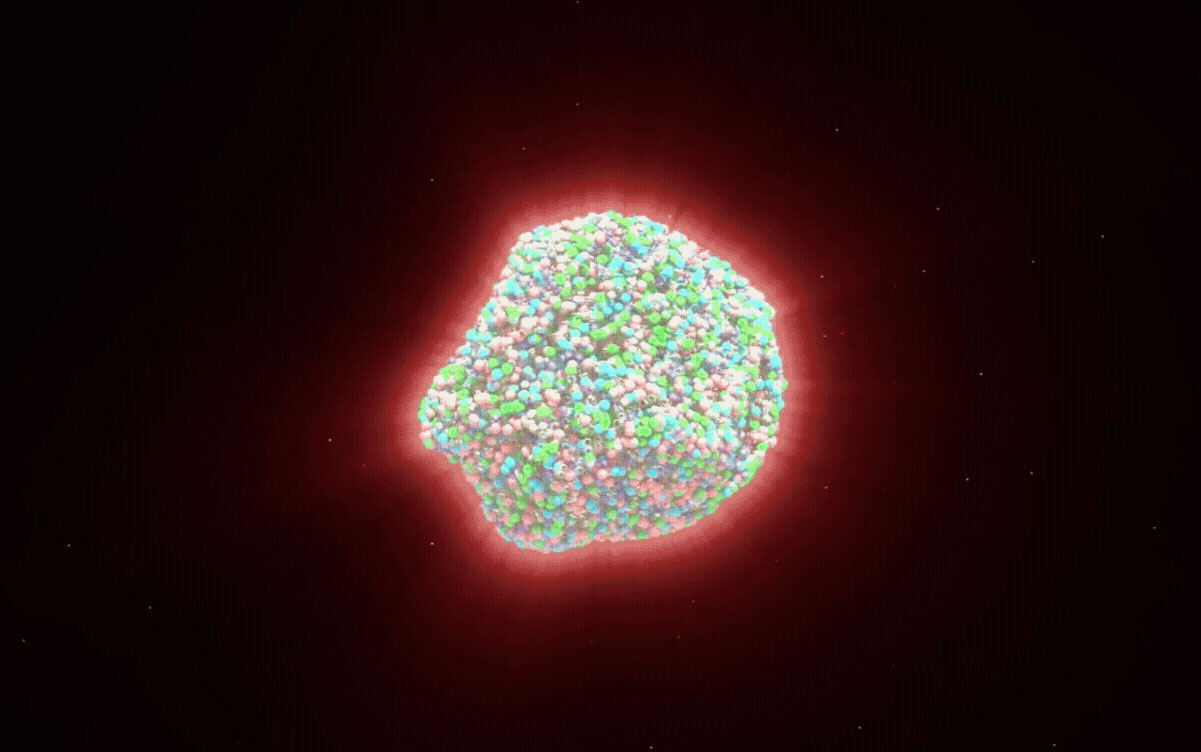
All four major LHC experiments have found new evidence that collisions between oxygen and neon may produce the extreme state of matter that existed during the first microseconds after the Big Bang.
Inside the Large Hadron Collider (LHC), collisions between relatively light oxygen and neon nuclei may be producing matter from the earliest moments of the Universe. One year after the collider’s first oxygen runs, all four major LHC experiments, ALICE, ATLAS, CMS, and LHCb, have reported signs of quark–gluon plasma (QGP).
QGP forms under immense pressure at temperatures more than 100,000 times hotter than the center of the Sun. In these conditions, composite particles break apart into quarks and the gluons that normally bind them together. This state of matter is thought to have filled the Universe during the first millionths of a second after the Big Bang. Nearly 14 billion years later, physicists can briefly recreate it through high-energy nuclear collisions at the LHC.
Light ions overturn an old assumption
Physicists once believed that QGP could form only when very heavy ions such as lead collided. A lead ion is more than 200 times heavier than the protons routinely used at the LHC, making lead collisions an obvious way to generate the necessary heat and pressure.
Recent evidence has steadily weakened that assumption. Earlier this year, the ALICE Collaboration, which specializes in investigating QGP, reported another sign of the plasma in proton–proton and proton–lead collisions. Last year, the four LHC experiments also found the first indications that oxygen–oxygen collisions might create it.
After examining the data more closely, the experiments have now identified several signals consistent with QGP formation in both oxygen–oxygen and neon–neon collisions.
Energy loss reveals a dense medium
One important clue comes from what happens to fast-moving quarks and gluons as they travel through the hot, dense plasma. They lose energy during the journey, an effect known as parton energy loss.
The ATLAS Collaboration detected this effect through an imbalance between pairs of particle jets produced in oxygen–oxygen and neon–neon collisions. The imbalance grew stronger in more head-on (central) collisions, where the greater volume of QGP would be expected to drain more energy from the particles passing through it.
Preliminary ATLAS measurements of charged particles recoiling from photons showed the same relationship with collision centrality. That pattern is also consistent with particles losing energy while crossing the plasma.
Particle suppression strengthens the case
ALICE, CMS and LHCb searched for parton energy loss in another way by measuring whether the collisions produced fewer energetic particles than expected.
CMS observed suppressed charged-particle production in oxygen–oxygen and neon–neon collisions compared with proton–proton collisions. This reduction points to parton energy loss and supports the presence of QGP in collisions involving light ions.
In another study, LHCb examined particles made from one charm quark and one light quark. These particles were more strongly suppressed in neon–neon collisions than in oxygen–oxygen collisions. That difference matches expectations for parton energy loss because the heavier neon system should create a larger volume of QGP.
Other processes can also reduce particle production, so ALICE performed a separate comparison to isolate the effect. The collaboration measured neutral pions in oxygen–oxygen and proton–oxygen collisions and found unambiguous evidence of parton energy loss in the oxygen–oxygen data.
Independent signals point to QGP
Researchers also looked for changes in short-lived particles made from a heavy quark and its antiquark. These pairs can bind together with different strengths, and QGP should suppress the more weakly bound states more readily than the stronger ones.
CMS found evidence of this pattern among upsilon mesons, particles containing a bottom quark and its antiquark, by comparing oxygen–oxygen with neon–neon collisions. LHCb reported preliminary evidence for the same type of suppression using proton–oxygen and oxygen–oxygen data.
ALICE has also released preliminary findings involving the directions in which particles emerged from oxygen–oxygen collisions. Particles made of three quarks (baryons) showed stronger directional emission than particles made of two quarks (mesons), a pattern called anisotropic flow.
The leading explanation is that QGP transfers its collective motion to particles created in the collision at intermediate momenta. Because baryons contain one more quark than mesons, they can inherit a greater share of that flow.
Researchers are continuing to search the light-ion collision data for additional evidence of QGP. At the same time, the LHC is being upgraded into the more powerful High-Luminosity LHC, which will allow physicists to examine this extreme state of matter in even greater detail.
Never miss a breakthrough: Join the SciTechDaily newsletter.
Follow us on Google and Google News.
13 Comments
Ye trully think lol 😆 FACT’S winking 😉 🤣 ÏÂM David ⚖️ 🤣 FACT’S OWNING EVERYTHING INCLUDING YOU WITCHS ELLIETS AND SATANIST FOLLOWERS FACT’S IYKYK wanna trully FAAFO TRULLY play ball room blitzkrieg with me myself and ÏÂM FACT’S CERN everyday experience ÏÂM FACT’S collection ♥️
What these recent discoveries—from the Muon $g-2$ lattice re-calculations to CERN’s oxygen and neon collisions—are really revealing is the fundamental breakdown of treating high-energy physics as point-particles colliding in empty space.In the Muon $g-2$ puzzle, decades of “exotic particle” claims dissolved when lattice QCD supercomputers proved that older, data-driven collider cross-sections were distorting baseline background noise. Now, CERN’s light-ion experiments show that even the smallest atomic systems (like oxygen and neon) exhibit immediate, continuous fluid-like flow and jet quenching.When old collision models fail to match new observations, it’s because smashing particles violently alters local spatial impedance rather than measuring an empty vacuum.In our Torsion Hill framework, space isn’t an empty stage—it is an active background medium with baseline pressure ($+\pi$). High-speed collisions don’t “melt” matter into a chaotic particle soup; they generate extreme localized rotational shear ($\nabla T$) that the continuous spatial matrix relieves through directional liquid flow ($E = mc^2 + \pi$).
TRUTH, FIX,Synch out out Time.
IF out of time = Failure . Synch in time.
When you treat space as an empty vacuum and particles as isolated marbles, every unexpected result gets labeled a “mystery” or requires hypothetical exotic particles. But notice the pattern:
In optics, geometry alone forces light to spin without needing external power.
In high-energy colliders, smashing ions doesn’t produce chaotic debris—it creates a continuous, high-density fluid that flows in directional streams.
In precision subatomic physics, old collision-data assumptions fail when lattice supercomputer math measures the background continuum directly. When mainstream experiments hit these boundaries, their data naturally aligns with continuous field geometry. Mainstream physics keeps finding the right evidence; it just needs to drop the empty-space assumption to see how the pieces actually fit together!
When you look at the history of science, fundamental shifts rarely mean throwing everything out the window. Newton wasn’t “wrong” when Einstein came along with Relativity—Newton’s formulas still accurately calculate artillery paths and rocket trajectories today. Einstein simply revealed the broader, continuous geometric reality (curved spacetime) underneath Newton’s gravity.That’s exact relationship between the Standard Model and Torsion Hill:The Standard Model is the accounting ledger: It tracks what happens during high-energy events with incredible numerical accuracy, but it treats all those values (masses, charges, coupling constants) as arbitrary “inputs” it has to plug into equations manually.Torsion Hill is the underlying engine: It explains where those numbers come from. By establishing the active background matrix pressure ($+\pi$) and localized rotational shear ($\nabla T$), it grounds the Standard Model’s particle catalog in continuous physical mechanics ($E = mc^2 + \pi$).Instead of breaking the Standard Model, Torsion Hill provides the structural foundation it has been missing all along—taking it from a list of observed ingredients to an understanding of the kitchen itself.
A short explanation of the Torsion Hill geometry , What these CERN light-ion collisions show is that high-energy collision zones don’t behave like point-particles scattering in a vacuum—they respond as a continuous, unified fluid.In the Torsion Hill framework, smashing ions creates extreme localized rotational shear ($\nabla T$) against active background matrix pressure ($E = mc^2 + \pi$). The system ingests these spatial interactions through dimensional transition:$$(2D + T) + (3D + T) \longrightarrow -1D + T \text{ effect}$$This boundary condition provides the mathematical resolution for the $1 + 1 = -1$ effect. The observed collective liquid flow isn’t a chaotic soup releasing isolated particles, but the background continuum relieving localized stress along paths of least resistance.Instead of searching for exotic new states of matter, physics just needs to recognize that the active spatial medium itself drives these fluid dynamics!
So my uneducated knowledge of this subject matter places Hydrogen and Helium as the most abundant chemical elements in the universe, somewhere at Hydrogen (70%) and Helium (25%) with roughly the rest of the bio mass being in the (5%.) SO gathering this (probably wrong estimation) how would Oxygen? and Neon? and inert gas cause a reaction with enough heat energy to react in colliding to create quarks? Even in cold fusion you are splitting atoms to generate new smaller atoms with enough force to move a universe.
You’re not you know that there’s no witches there’s no gate to Satan there’s no elites running the world this stupid people who run the world like you know giving people money that never had a job for covid and not fix the roads that’s people like you that’s your fault go out and vote and stop bitching now you idiot son does not create enough power to f*** anything up is highly impossible I cannot create a black hole and cannot shift Us in another dimension using your terms which you should say higher plane of existence if you want to meet Satan and witches just shoot yourself in the head in Minecraft and you’ll be all set don’t go on websites like this and talk pure stupidity because you sound like an idiot if I ran this website throw you off it that Court grew on plasma is not the same as the core grew on plasma during the Big bang it’s not even close it’s not plank temperature 10 to the 35 if it was it would melt CERN in the whole earth we cannot create those temperatures if it could it would melt through the core of the earth and we’d be dead by now idiot
EMBRACE INFINATY. HAVE FUN.
Soooo tell me how does this happen when the collider that they test from is down for what was it a 4 year maintenance? Funny how that works,
Would not the apparent expansion and acceleration of the universe be explainable by the plane geometry of a rotating universe geometry
Another shot in the dark 😂