
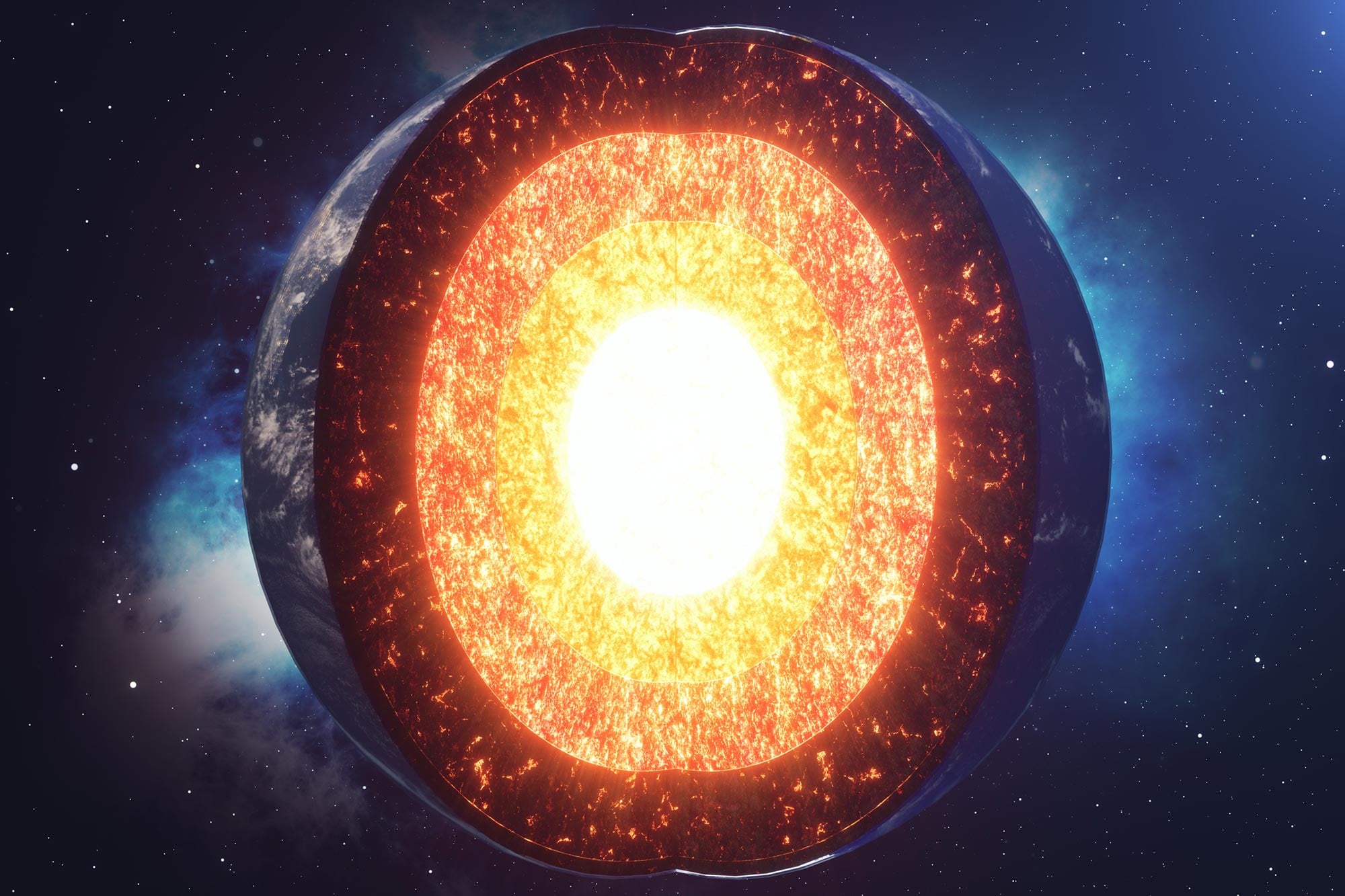
Experiments under extreme conditions suggest that iron hydride can enter a superionic state, allowing hydrogen to move through a solid iron lattice.
Far beneath Earth’s surface, the inner core is squeezed and heated to conditions so extreme that some of its ingredients may behave in an unexpected way. Experiments from researchers at Science Tokyo suggest that iron hydride can enter a superionic state, in which the iron structure stays solid while hydrogen moves through it. The results offer new clues about the composition and behavior of Earth’s deepest interior.
Earth’s inner core consists mostly of iron mixed with a small proportion of lighter elements. Under the immense pressures and temperatures found there, alloys containing elements such as hydrogen, oxygen, and carbon are predicted to become superionic. In this unusual state of matter, iron atoms remain close to fixed positions in the crystal lattice while lighter atoms move through that structure almost like a liquid.
That mobility could also soften the alloy against shearing, a property with potential geophysical importance because it may help account for the unusually slow speed of seismic shear waves through the inner core. Until now, however, evidence for this explanation had come primarily from molecular dynamics simulations rather than direct experiments.
Experiments provide the missing evidence
Researchers at the Institute of Science Tokyo (Science Tokyo) in Japan have now found strong experimental signs that face-centered cubic (fcc) iron hydride (FeHX), an iron–light-element alloy, becomes superionic under the high-pressure and high-temperature conditions relevant to Earth’s inner core.
The work was published in Nature Geoscience. Doctoral students Yoshihiro Nagaya and Yusuke Okazaki led the study with Professor Kenji Ohta of Science Tokyo’s Department of Earth and Planetary Sciences.
“Because the superionic state of iron–light-element alloys exists only under ultrahigh-pressure and ultrahigh-temperature conditions, it had never previously been observed experimentally. FeHX is expected to adopt either a hexagonal close-packed or an fcc structure under inner-core conditions, depending on the hydrogen content,” says Ohta.
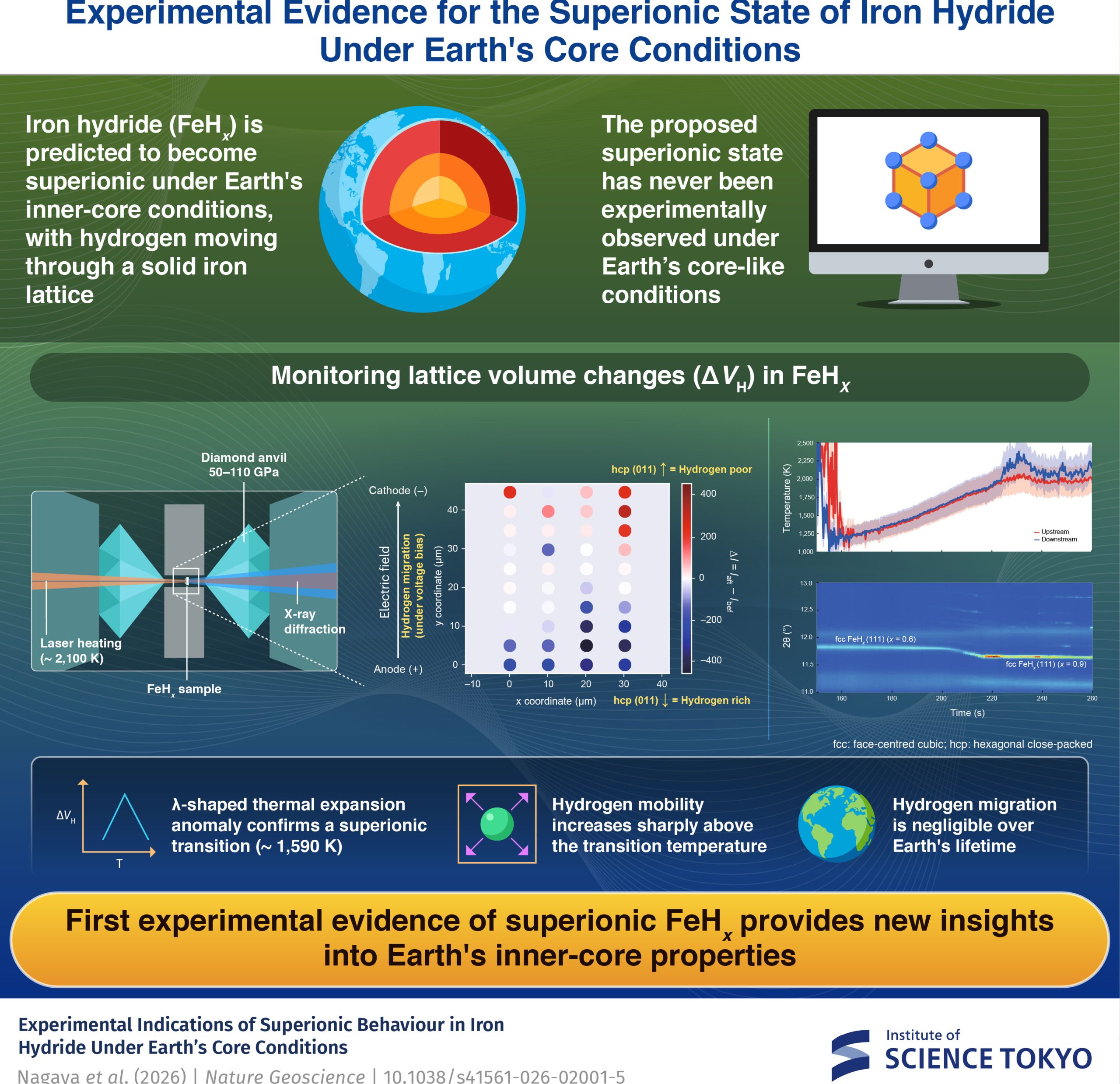
To watch how the material changed, the researchers used time-resolved synchrotron X-ray diffraction (XRD) to follow its crystal lattice as pressure and temperature increased. Tiny samples of fcc FeHX were compressed inside a diamond-anvil cell to between 50 and 110 gigapascals, then heated by lasers to temperatures exceeding 2,000 Kelvin. Measurements of the changing crystal lattice allowed the researchers to calculate how its volume responded as hydrogen entered the iron structure.
Heating revealed the superionic transition
Near 1,590 Kelvin, the researchers detected a distinctive λ-shaped anomaly in the thermal expansion coefficient, a feature associated with phase transitions and previously seen in other superionic materials. Tracking that feature across different pressures allowed them to map the boundary between the ordinary solid and superionic forms of FeHX. When the researchers extended that boundary to pressures expected in Earth’s inner core, the predicted transition temperature remained well below estimated inner-core temperatures, indicating that FeHX could be superionic there.
A second set of time-resolved XRD experiments tested whether hydrogen actually became mobile. Under high-temperature and high-pressure conditions, the researchers applied a constant voltage across the samples and observed a sudden change in the hydrogen content of FeHX. After quickly cooling the material back to room temperature, they found that hydrogen had redistributed along one direction, evidence that it had become highly mobile during the superionic state. From the sample geometry and applied bias, they estimated hydrogen mobility at roughly 1 µm2J⁻1s⁻1, corresponding to a diffusion coefficient of approximately 103 µm2s⁻1.
Mobile hydrogen would remain trapped
Despite the sharp increase in hydrogen mobility during the superionic transition, its movement under actual inner-core conditions would still be extraordinarily limited. The researchers estimated that migration driven by Earth’s geomagnetic field would shift hydrogen by only about 0.1 µm over 10,000 years.
At that pace, hydrogen would require more than 100 times the age of Earth to cross a distance comparable to the inner core’s roughly 1,200 km radius. The result suggests that hydrogen incorporated into the planet during its formation could remain trapped inside the core over geological timescales.
The experiments may help researchers better understand processes within Earth’s core and improve models describing how the core formed and changed through time.
“These findings are expected to contribute to elucidating seismic-wave velocity anomalies in Earth’s inner core and the evolution of Earth’s interior,” says Ohta.
Reference: “Experimental indications of superionic behaviour in iron hydride under Earth’s core conditions” by Yoshihiro Nagaya, Yusuke Okazaki, Haruhiko Dekura and Kenji Ohta, 9 June 2026, Nature Geoscience.
DOI: 10.1038/s41561-026-02001-5
Never miss a breakthrough: Join the SciTechDaily newsletter.
Follow us on Google and Google News.