
Researchers can now put numerical error limits on quantum simulations, showing how much confidence to place in their results.
As quantum simulators become powerful enough to tackle problems beyond the reach of conventional computers, a difficult question follows: how can researchers know whether their answers are accurate? When classical calculations are still possible, the two approaches can be compared directly. Once quantum systems move beyond that point, however, scientists need another way to verify the results.
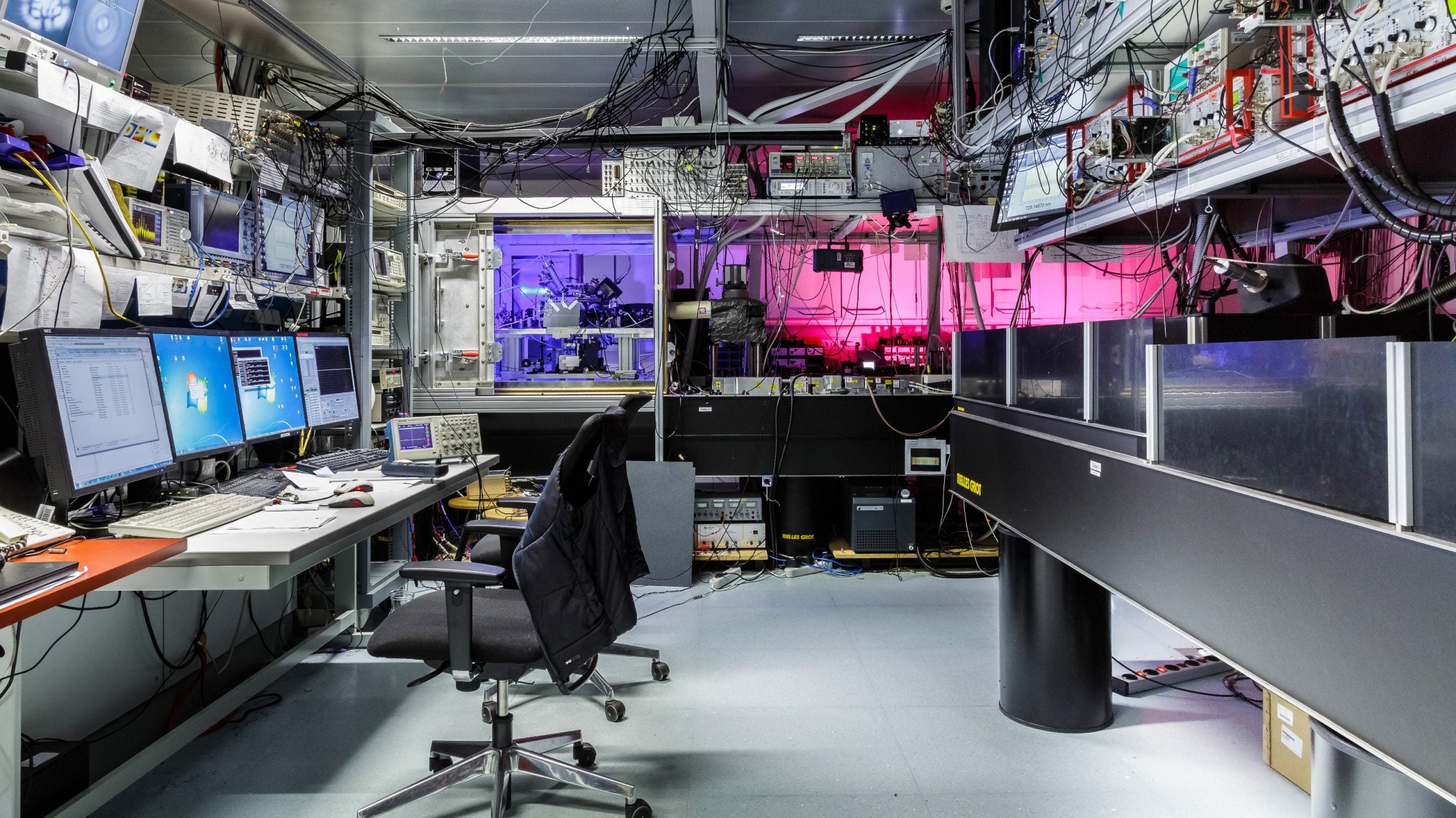
Researchers led by Tristan Kraft of the Technical University of Munich and Peter Zoller of the University of Innsbruck and the Institute for Quantum Optics and Quantum Information at the Austrian Academy of Sciences, together with Barbara Kraus of the Technical University of Munich, have demonstrated a method for experimentally characterizing a quantum simulator and turning its uncertainties into numerical error limits. A team led by Manoj Joshi and Christian Roos tested the approach with an ion-trap quantum simulator containing as many as 51 ions.
Real devices introduce unavoidable uncertainty
Quantum simulators are physical systems designed to reproduce the behavior of other quantum systems. They are especially useful for studying complicated many-particle systems whose calculations can quickly become too demanding for classical computers.
“But no real experiment is perfect,” says Tristan Kraft. “Interactions may turn out differently than expected, the system is influenced by its environment, and measurements are also subject to uncertainties.”
Rather than assuming that a simulator behaves exactly as intended, the researchers use experimental measurements to determine how it actually operates.
“From this data, we determine the relevant interactions as well as key influences from fluctuations and noise. We then calculate how the uncertainties in this model affect the simulation results,” explains Tristan Kraft. “The quantum simulator thus provides not just a single value, but a result with error margins that quantify its accuracy.”
Error limits scaled to 51 ions
The researchers first tested the method with a system of ten ions, small enough that its behavior could still be calculated using a conventional computer. They compared the resulting model and its predicted error bounds against independent measurements, providing a way to check whether the method worked as intended.
They then extended the approach to a chain of 51 ions, showing that the same strategy can be used for substantially larger quantum systems.
The next target is two-dimensional quantum systems. “This is particularly important because classical calculations for such systems become significantly more difficult as the number of particles increases,” explains quantum computing pioneer Peter Zoller. “This also makes independent verification of the results increasingly complex, making the question of experimentally determined error limits all the more important.”
Verifiable accuracy could redefine quantum advantage
The researchers are now adapting the method for the newest generation of two-dimensional quantum simulators, which provide greater precision and can handle larger numbers of particles.
In the longer term, the approach could offer a way to measure quantum advantage quantitatively. Rather than judging a quantum simulator only by whether it is faster or larger than a classical computer, researchers could also compare how reliably each system solves the same problem.
“After all, when a classical computer and a quantum simulator tackle the same problem, it’s not just a matter of which one delivers a result faster. What’s also crucial is which one can solve the problem with a smaller, verifiable margin of error,” says Peter Zoller.
That could shift how quantum simulation is evaluated in the future. Performance may depend not only on system size or calculation speed, but also on whether a difficult problem can be solved with an accuracy that can be independently quantified.
Reference: “Bounded-Error Quantum Simulation via Hamiltonian and Lindbladian Learning” by Tristan Kraft, Manoj K. Joshi, William T. Lam, Tobias Olsacher, Florian Kranzl, Johannes Franke, Lata Kh Joshi, Rainer Blatt, Augusto Smerzi, Daniel Stilck França, Benoît Vermersch, Barbara Kraus, Christian F. Roos and Peter Zoller, 13 August 2026, Physical Review X.
DOI: 10.1103/s96t-n8tx
Funding from the Austrian Science Fund (FWF), the German Ministry of Research, Technology and Space, the European Union, and BMW among others.
Never miss a breakthrough: Join the SciTechDaily newsletter.
Follow us on Google and Google News.
2 Comments
Can We Trust the Results?
VERY GOOD.
If the public understands that nature organizes itself through topological spin in an ideal fluid space, they will not be fooled and deceived by the absurdity and pseudoscience in mainstream physics. Quantum mechanics is algebra, the universe is not algebra, formulas, or numbers. The universe is the superposition, deflection, and entanglement of geometric shapes, is the interaction and balance between topological vortices and their fractal structures. Science and physics are striding towards the era of topology, and quantum and its half dead cat should have stepped down from the altar and entered history long ago.
Researchers attempting to verify quantum computing outputs face a fundamental challenge: verifying large-scale quantum circuits using classical simulation becomes computationally intractable.
However, modern quantum error mitigation often over-complicates the problem by treating environmental noise as a purely stochastic, memoryless process. This forces systems to burn massive computational overhead on active error-correcting codes (such as surface codes). In real physical architectures, a significant portion of what is measured as background decoherence is actually stationary, low-frequency environmental coupling—a deterministic baseline.
By performing comprehensive noise tomography to map the system’s idle Hamiltonian prior to state transfer, the environmental coupling profile becomes a known parameter rather than an uncontrolled variable. Instead of relying on post-hoc classical verification or heavy active correction routines, the operational fidelity can be preserved by subtracting the known system-bath interaction directly through differential phase processing and open-loop calibration.
Treating the background environment as a measurable, structured baseline allows quantum processors to isolate the true quantum signal cleanly, drastically reducing the overhead required to achieve fault-tolerant computation.