
Close Menu
    Facebook X (Twitter) Instagram
    SciTechDaily
    • Biology
    • Chemistry
    • Earth
    • Health
    • Physics
    • Science
    • Space
    • Technology
    Facebook X (Twitter) Pinterest YouTube RSS
    SciTechDaily
    Home»Biology»MicroCHIPS Wireless Drug Implant Releases Timed Dosed Injections
    Biology

    MicroCHIPS Wireless Drug Implant Releases Timed Dosed Injections

    By SciTechDailyFebruary 18, 2012No Comments2 Mins Read
    Facebook Twitter Pinterest Telegram LinkedIn WhatsApp Email Reddit
    Share
    Facebook Twitter LinkedIn Pinterest Telegram Email Reddit
    microCHIPS-delivery-drug-implant
    Credit: MicroCHIPS

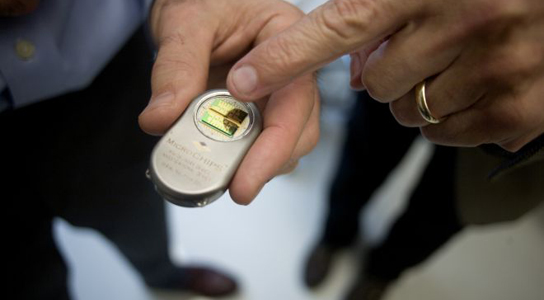
    Researchers have announced that a wirelessly-programmed implant, which has been successfully tested in human trials, could save patients the pain of daily injections.

    The trials were run on seven Danish women with osteoporosis, and the implant successfully delivered daily doses of the drug Teriparatide, which stimulates bone formation. Over the course of one month, the implant was able to deliver up to 20 does at the same levels of safety and therapeutic benefits as regular injections. They published their findings in the journal Science Translational Medicines.
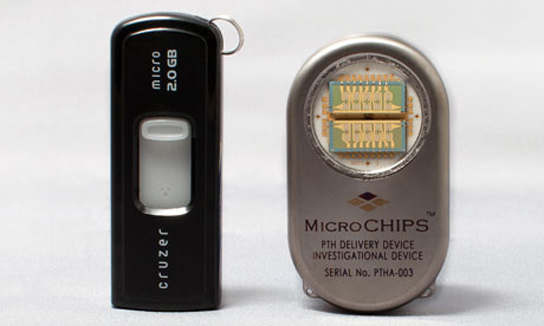
    Drug-delivery-microchip
    The wirelessly-programmed implant has the potential to spare patients the discomfort of daily injections. Credit: MicroCHIPS

    In the case of Teriparatide, only one-quarter of patients stick to the two-year daily injection regimen states Robert Farra, president of MicroCHIPS, based out of Waltham, Massachusetts, the company that was spin out of MIT to develop the implant.

    The implant measures 2 inches (5 centimeters) in length by 1.19 inches (3 centimeters) in width, and can be implanted in just under 30 minutes under a local anesthetic. The chip holds 20 pinprick-sized reservoirs, each containing about 600 nanoliters. In response to a timer or wireless command, the device applies a current to one of the apertures, causing the metal membrane to melt and re-solidify, like a fuse, which releases the drug.

    Passive drug-delivery implants are already available in the form of osmotic pumps and bio-erodible devices, which slowly break down in the body, but the ability to control the amount and timing of drug delivery will be beneficial to patients and doctors alike.

    The MicroCHIPS implant can house different drugs as well, which can be independently released when needed. It’s important that such devices function without any errors, which could endanger the lives of the patients they are trying to save. Regulatory testing will begin in 2014.

    Reference: “First-in-Human Testing of a Wirelessly Controlled Drug Delivery Microchip” by Robert Farra, Norman F. Sheppard, Jr., Laura McCabe, Robert M. Neer, James M. Anderson, John T. Santini, Jr., Michael J. Cima and Robert Langer, 22 February 2012, Science Translational Medicines.
    DOI: 10.1126/scitranslmed.3003276

    Never miss a breakthrough: Join the SciTechDaily newsletter.
    Follow us on Google and Google News.

    Drugs Implant Medical Medicine Microchip MicroCHIPS Popular Treatment Wireless
    Share. Facebook Twitter Pinterest LinkedIn Email Reddit

    Related Articles

    Why a Widely Used Drug Causes Birth Defects and Autism

    Insight on the Evolution of Cocaine Biosynthesis

    New Drug CD47 Could Potentially Shrink and Cure All Tumors

    Examining the Brain Receptors That Bind to Opioids

    PAPupuncture Offers Long-Lasting Pain Relief

    Understanding Antibiotics and Their Role in Killing Bacteria

    Canadian Researchers State That a 20-Minute Twice Weekly Workout Keeps You Healthy

    Cancer-Causing Mutations Disrupt Cells’ Ability to Differentiate

    Stem Cells Help Re-grow Healthy Heart Muscle After Heart Attack

    Leave A Reply Cancel Reply

    • Facebook
    • Twitter
    • Pinterest
    • YouTube

    Don't Miss a Discovery

    Subscribe for the Latest in Science & Tech!

    Trending News

    This Strange New Magnetism Could Change How Computers Work

    Scientists Decode a 12,000-Year-Old Mystery Hidden in Ancient Spear Points

    Rare Mutation May Shield the Brain From Alzheimer’s Damage

    James Webb Telescope Detects the Fingerprints of Catastrophic Planetary Collisions

    New Fat-Dissolving Shot Cuts Hidden Visceral Fat in Early Human Trials

    Scientists Discover “Pac-Man Enzyme” That Eats Plastic

    Study Finds Exercise May Be a Surprisingly Powerful Treatment for Pain

    New Research Reveals Dinosaurs May Have Eaten Seaweed

    Follow SciTechDaily
    • Facebook
    • Twitter
    • YouTube
    • Pinterest
    • Newsletter
    • RSS
    SciTech News
    • Biology News
    • Chemistry News
    • Earth News
    • Health News
    • Physics News
    • Science News
    • Space News
    • Technology News
    Recent Posts
    • Just 1,000 More Steps a Day Linked to Better Mental Health in Teens
    • Scientists Find a Surprising Blood Sugar Benefit to Eating With a Loved One
    • Why Too Much Cannabis Can Flip an Anxiety Switch in the Brain
    • Scientists Uncover Two Hidden Forms of Disorder in Next-Generation Semiconductors
    • Biofluorescence Discovered in Fire Salamanders for the First Time
    Copyright © 1998 - 2026 SciTechDaily. All Rights Reserved.
    • Science News
    • About
    • Contact
    • Editorial Board
    • Privacy Policy
    • Terms of Use

    Type above and press Enter to search. Press Esc to cancel.