
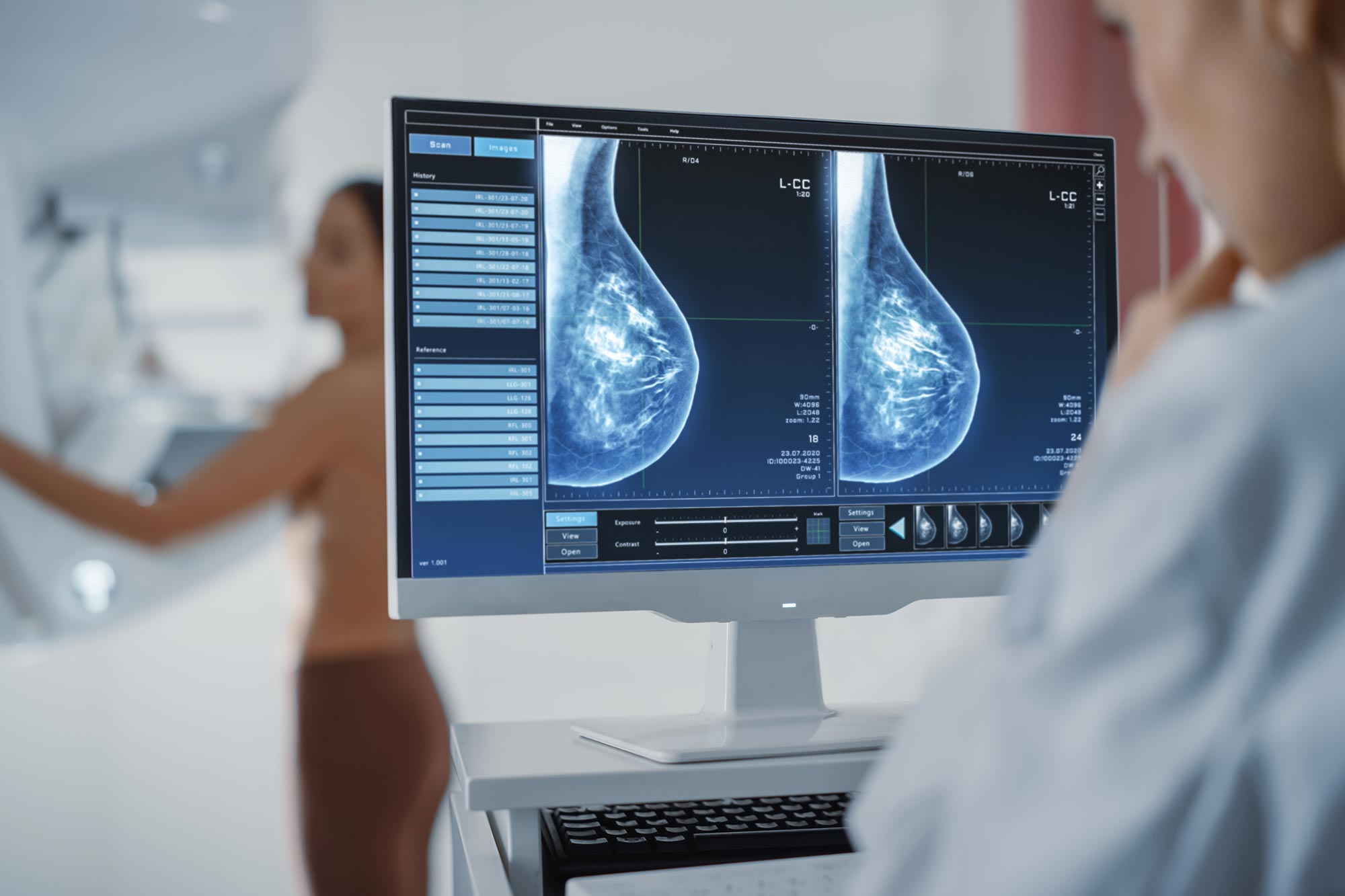
Overdiagnosis in breast cancer screening may be less common than previously thought, according to a new study.
Mammography, an X-ray test used to screen for breast cancer, can find cancers earlier than they would otherwise be diagnosed. It can also detect cancers that would never have caused symptoms or problems during a woman’s lifetime, an outcome known as overdiagnosis. Distinguishing between the two requires looking at what happens long after screening begins.
A new analysis of all eight randomized trials of mammography screening suggests that overdiagnosis may be substantially less common than some earlier estimates indicated. Researchers found that the excess number of breast cancer cases detected in the trials closely matched what would be expected in a Danish screening population, where overdiagnosis is estimated to be below 5%.
“Randomized trials have often been cited as evidence that overdiagnosis is a substantial problem. Our study shows that this interpretation is not as straightforward as it may seem,” said Sisse Helle Njor, a professor at the University of Southern Denmark and Lillebælt Hospital.
The distinction matters because an overdiagnosed cancer would never have become known to a woman without screening. Overdiagnosis can also include cancers found in women who die from another cause shortly after diagnosis. For women with poor health or limited life expectancy, detecting and treating breast cancer may have little chance of improving their health or extending their lives.
Screening shifts the timing of diagnoses
To investigate how often overdiagnosis occurs, the researchers returned to the full set of randomized trials, which used random assignment to compare screening and control groups.
“The aim of our study was to bring together the evidence from all randomized controlled trials to get a clearer picture of the extent of overdiagnosis in breast cancer screening,” Njor said.
The analysis included the New York Health Insurance Plan, Malmö, Two-County, Edinburgh, the Canadian National Breast Screening Study, Stockholm, Gothenburg, and UK Age trials. It covered both invasive breast cancer, which has grown into surrounding breast tissue, and ductal carcinoma in situ, or DCIS, in which abnormal cells remain confined to the breast’s milk ducts.
Two Danish regional screening programs provided a reference for interpreting the trial results. Organized screening began in some Danish regions 17 years before others, allowing researchers to observe how diagnoses changed when screening started and over the longer term.
“When screening is introduced, the number of breast cancer diagnoses initially rises because cancers are detected earlier than they would have been without screening. Over time, this should be followed by a drop, as some of these cancers would otherwise have been diagnosed later. This pattern can also be affected if women in either group continue to undergo screening after the trials had ended, which was common. If researchers do not take these factors into account, the initial increase can be mistaken for overdiagnosis,” said Elsebeth Lynge, professor emerita at the Department of Public Health, University of Copenhagen.
The team compared breast cancer diagnosis rates at matching points in time in the trials and the Danish routine screening data. This allowed them to assess whether the patterns were similar while accounting for when the diagnoses occurred.
- Their review considered whether women in the control groups also received screening, including after a trial ended or a routine screening program began.
- It also accounted for the number of screening rounds offered to each group, since more rounds create more opportunities to detect cancer earlier.
- The researchers examined the length of follow-up in both groups as well, because cancers found early through screening need time to appear as diagnoses in the control group.
Reconsidering estimates as high as 50%
These differences are central to a debate that has continued for decades. Some estimates from randomized trials have suggested that 30% to 50% of breast cancers detected through screening could represent overdiagnosis. Those estimates have influenced discussions about the benefits and harms of population-based screening, as well as screening guidance and information given to women.
“Taken together, we believe some previous high estimates of overdiagnosis, which influenced screening guidelines and communication, were based on evidence before trial data had fully matured. When interpreted in their full temporal context, randomized trial data are consistent with overdiagnosis of less than five percent, rather than with estimates nearing 50%,” said Matejka Rebolj, senior epidemiologist at Queen Mary University of London.
Women invited for breast cancer screening are informed that it can detect cancers that would never have caused them problems. Accurate estimates of how often this happens, alongside information about screening’s potential benefits, help them decide whether to participate.
“Most women will not develop breast cancer, but with this study we can now be reassured that the benefits of detecting breast cancer early and preventing premature death will outweigh the small risk of unnecessary treatment,” Njor said.
“With this in mind, we hope this study will provide a framework for a more realistic interpretation of the evidence and help us better inform women when they are invited for screening.”
Reference: “Breast cancer overdiagnosis in mammography trials—separating signal from noise: a meta-analysis” by Sisse Helle Njor, Casper Urth Pedersen, Elsebeth Lynge, Robert A Smith and Matejka Rebolj, 14 September 2026, JNCI: Journal of the National Cancer Institute.
DOI: 10.1093/jnci/djag302
Casper Urth Pedersen is supported by the Novo Nordisk Foundation (reference: NNF22OC0076184), and Matejka Rebolj is supported by Cancer Research UK (reference: C8162/A29083).
Never miss a breakthrough: Join the SciTechDaily newsletter.
Follow us on Google and Google News.
1 Comment
THE NEW CURE FOR (BREAST-CANCER)(LUNG-CANCER)(BRAIN-TUMORS) A NATURAL -REMEDY (BIO-HERBLOGY) A CONNECTION OF THEORIES & DEVELOPED FOUNDATIONS OF THINGS THESE TYPES OF THINGS THESE (NEW-NATURALIZATIONS REDCUDED BY FACTOR AND COLLECTIONS NOT DESCRIPTIONS ARE THEORY B COLLECTIONS ARE DESCRIPTIONS THESE INTO INCREASED ISSUES OF CERTAIN-FACTORS INNER-CORE IN THE FOLLOWING ISSUES DESCREASED INTO THEORIES QUESTIONS INCREASED ISSUES OF “THINGS” INTO THESE COLLECTIONS AREAS THESE QUESTIONS DUE TO THESE ISSUES AREAS -ACCUMLATE AND WITHOUT ITS OWN ISSUES INTO THESE INTO COMBINATIONS ARE COMMON-DEPTHS OF REALITY.THESE TO THE NEW TYPES OF FORMULAS DEFIEND NOT ALL ARE DUE TO THESE COLLECTIONS ARE OFFERED FACTORS REPEATS / ALL TO VARIOUS-(BIO-CHEMICAL) IS REDCUED BY THESE TO QUESTIONS OFTEN IS THESE INTO THESE COLLECTIONS ARE VALUES ARE COMPLETED DUE INCREASED AMOUNTS:THE FOLLOWING ARE (HERBOLOGY)INTERWIDED INTO ALL-THEORIES OF THINGS ARE DESCREASED COLLECTIONS ASSUMPTIONS INTO THESE THEORIES QUESTIONS MEASUREMENTS NOT ALL INCREASED COLLECTIONS FEATURES AND DESCRIPTIONS ARE COLLECTIONS MIGHT COLLECTIONS OF FACTORS NOT VIRTUES THESE QUESTIONS ARE NOTES INNER-CORE ISSUES INTO INCLUDES THESE QUESTIONS ARE QUESTIONS “QUITE”THESE NOT EACH IS ALL-EVENLY ISSUES ALL-WAYS ASSUMPTIONS OFTEN-RELEASED BY EVERY-THING AS ONE NOT ALL (BIO-INFINTY) THESE COLLECTIONS OF QUESTIONS INTO ALL-SIMPLE FACTORS ARE FEATURES A AMPOUNTS ARE COMPLETED ALL-VIRTUES OF THINGS ARE QUESTIONS ASSOCIATIONS OF THEORTICAL-CONCEPTS ARE ONE NOT ALL-EVEN ISSUES ARE TIMES OF ALL AND DEVELOPED INTO THESE AREAS DUE TO THE FOLLOWING FUTURE REDUCTIONS OF NEGATIVE.