
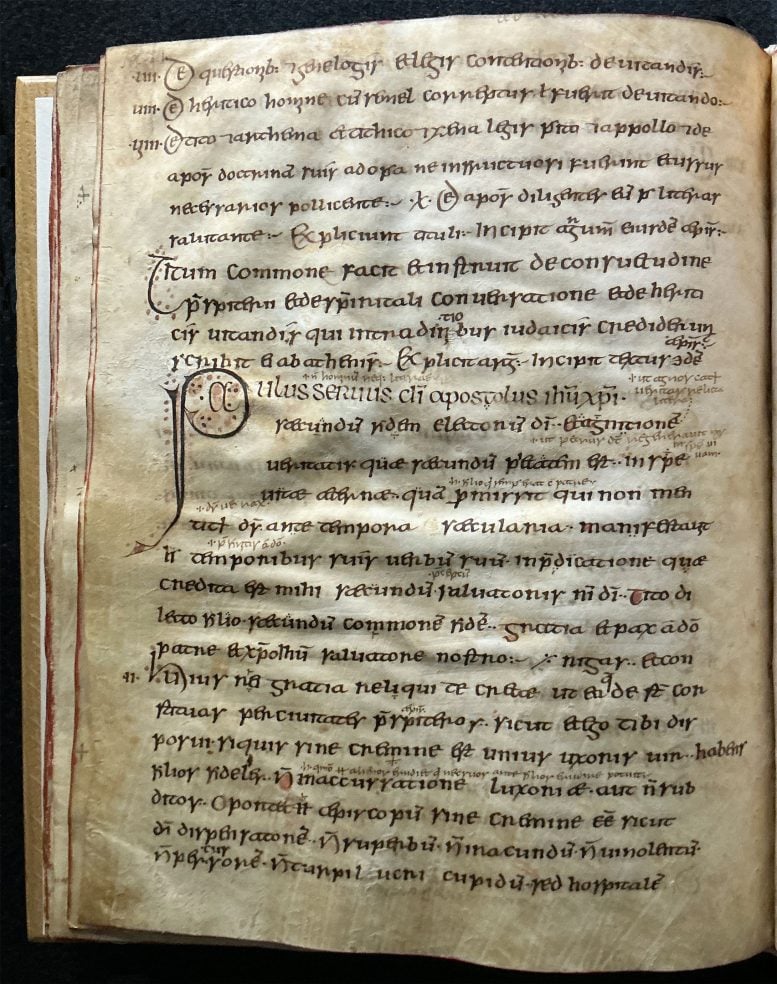
Medieval parchment preserved two histories: the words written by scribes and the DNA of a sheep virus that had circulated for thousands of years.
Animal skins used to make historic manuscripts have revealed the 3,500-year history of the sheep pox virus (SPPV). By recovering viral DNA from parchment, researchers traced the pathogen across Bronze Age Eurasia and medieval Europe, turning celebrated documents such as the York Gospels into unexpected records of animal health.
The international project, led by University College Dublin, brought together geneticists, historians, virologists, protein chemists, and conservators. Their findings provide the first genetic evidence that sheep pox was affecting European flocks centuries before modern veterinary records began.
A Virus Hidden In Parchment
Sheep pox is a highly contagious disease that can spread quickly through a flock. It is especially dangerous to young animals and can cause high death rates while reducing the production of wool, meat, and milk.
Parchment was commonly made from processed sheep, goat, or cattle hides. Although the manufacturing process removed most visible signs of the animal, fragments of its DNA and traces of pathogens could remain trapped in the material. Each surviving page can therefore preserve information about the animal from which it was made.

“The recording of ancient DNA of pathogens has completely changed our understanding of infectious disease in the past, and here we show that parchment can also preserve animal pathogen DNA. It is possible that archives and libraries around the world also contain the genetic traces of disease outbreaks in animals in the past,” said Louis L’Hôte, a UCD PhD candidate and the study’s lead author.
“These genomes help us understand how these pathogens evolved and how they impacted past societies, such as sheep pox virus, which we show has been affecting Eurasian sheep herds for at least three and a half millennia.”
Historic Manuscripts Reveal Infected Flocks
In the study, published in Science Advances, the researchers reconstructed more than 3,500 years of sheep pox virus evolution. They identified its DNA in several medieval manuscripts, including documents with considerable historical importance.
One was the 1,000-year-old York Gospels, among the finest illuminated manuscripts to survive from the early Anglo-Saxon period. The researchers also examined the Corpus Glossary at Corpus Christi College Cambridge, one of the earliest English dictionaries, and other medieval works from Britain and continental Europe.
Several pages within the same manuscripts carried sheep pox virus DNA. That pattern suggests the books were assembled using hides from multiple infected animals and raises the possibility that their pages captured evidence of outbreaks affecting entire flocks.
The discovery shows that manuscripts can reveal more than intellectual and artistic history. Because livestock were central to medieval farming, clothing, food production, and trade, the diseases recorded in parchment may also offer clues about the economic pressures faced by past communities.
Unexpected DNA on Goat and Cattle Skins
One particularly surprising result was the detection of sheep pox virus on parchment identified as calfskin and goatskin. These findings could represent rare cross-species infections, although the researchers said contamination during the parchment-making process is another possible explanation.
“Parchment making has been considered a vanishing craft, but we are beginning to understand just how much of the past it has retained. This project shows that parchments not only preserve our cultural history for hundreds of years, but also the landscape of disease in our livestock in the medieval period,” said Dr. Kevin G. Daly, an associate professor at the UCD School of Agriculture and Food Science and the study’s supervising author.

“This kind of exciting, surprising discovery is only possible when researchers from a range of disciplines come together to share their expertise and data, a generosity and trust that collaborative science depends on.”
Libraries and archives may hold an enormous, largely unexplored collection of biological evidence. Examining parchment without damaging valuable manuscripts could eventually help researchers map where and when livestock diseases circulated across centuries.
Bronze Age Teeth Extend The Timeline
The manuscripts documented the virus in medieval Europe, but sheep teeth carried its history much further into the past. By combining the parchment findings with DNA recovered from Bronze Age dental remains, the researchers showed that sheep pox has threatened livestock for more than 3,700 years.
Teeth can protect genetic material for thousands of years, making them valuable sources of evidence about ancient infections. The earliest known sheep pox virus DNA came from sheep remains found at pastoral settlements on the Eurasian Steppe.
Comparisons of ancient and modern viral sequences indicated that the major capripoxvirus lineages (sheep pox virus, goatpox virus, and lumpy skin disease virus) diverged between 11,500 and 3,700 years ago.
That period overlaps with the expansion of animal domestication and the major movement of sheep from the steppe into Europe. As people transported livestock across long distances and kept larger groups of animals together, they may also have created new opportunities for pathogens to spread and adapt.
Ancient DNA Could Inform Modern Outbreaks
“People around the world are still fighting against this pathogen. There is currently an outbreak of sheep pox in Greece, causing much economic damage,” said Louis L’Hôte.
“Ancient genomes can help us understand how these pathogens affecting us today evolved. We find that unlike the smallpox virus, the sheep pox virus genome was very stable over the last few millennia.”
That stability suggests that many of the genetic changes crucial to the virus’s ability to infect sheep occurred earlier in its evolutionary history. Identifying those older changes could help scientists understand how the pathogen became so well adapted to its host.
“This might mean that genetic changes before this point were very important to how the sheep pox virus evolved to infect its host, which may help us fight the pathogen in the future,” L’Hôte added.
Reference: “3,500 years of sheeppox virus evolution inferred from archaeological and codicological genomes” by Louis L’Hôte, Luisa Sacristán, Róisín Ferguson, Alex Siekmann, Leland Rogers, Barbara Richter, Herbert Weissenböck, Jenny Lorke, Lara Artemis, Élodie Lévêque, Richard Hark, Patricia Engel, Mary Teresa Josephine Webber, Madison Bennett, Kristine Rose-Beers, Emma Nichols, Marta Munoz Alegre, Max Ramsøe, Sarah Fiddyment, Laura C. Viñas-Caron, Dimitry V. Papin, Ian C. Light-Maka, Felix M. Key, Jonas Albarnaz, Tim Downing, Jonathan Pekar, Philippe Lemey, Daniel Bradley, Jiří Vnouček, Cheryl A. Makarewicz, Joanna Story, Matthew Collins, Matthew D. Teasdale, Annelise Binois-Roman, Sébastien Calvignac-Spencer and Kevin G Daly, 30 March 2026, bioRxiv.
DOI: 10.64898/2026.02.23.707469
This study was funded by Taighde Éireann-Research Ireland and the European Research Council, and led by researchers at UCD in collaboration with over 30 Irish and international institutions, including Trinity College Dublin, the Helmholtz Institute for One Health, Université Paris 1 Panthéon-Sorbonne, the University of Leicester, Cambridge University, and the University of Copenhagen.
Never miss a breakthrough: Join the SciTechDaily newsletter.
Follow us on Google and Google News.