

A new study reveals that modern ideas about the Black Death’s rapid spread across Asia stem from a centuries-old misunderstanding of a medieval Arabic tale.
Experts have traced long-standing myths about the Black Death’s rapid movement across Asia to a single fourteenth-century source. For centuries, depictions of the plague spreading swiftly along the Silk Route have been based on a misunderstanding of a rhyming Arabic tale rather than factual records.
This work, a “maqāma” (a form of Arabic storytelling that often features a wandering trickster), was written by the poet and historian Ibn al-Wardi in 1348/9 in Aleppo. Over time, readers mistook it for a literal account of how the disease traveled across the continent.
Modern research suggests that the pathogen behind the Black Death most likely emerged in Central Asia. Some geneticists, influenced by Ibn al-Wardi’s story, have proposed that it moved from Kyrgyzstan to the Black and Mediterranean Seas in less than ten years, sparking the catastrophic outbreaks that struck Western Eurasia and North Africa in the late 1340s. This interpretation, known as the “Quick Transit Theory,” stems largely from reading Ibn al-Wardi’s maqāma as a historical source rather than as a literary creation.
Questioning the “Quick Transit” Theory
This notion that a lineage of this bacterium moved over 3,000 miles overland within a few years and established itself sufficiently to cause the devastating Black Death of the Middle East and Europe from 1347 to 1350 is severely called into question in the new study.
In his tale, Ibn al-Wardi personifies plague as a roving trickster who, in the course of 15 years, decimates one region after the next, starting from unknown regions outside of China, to China, across India, central Asia, Persia, and finally entering the Black Sea and Mediterranean to wreak havoc on Egypt and the Levant. But it was taken as the truth because he also quoted selections of this tale in his historical work.
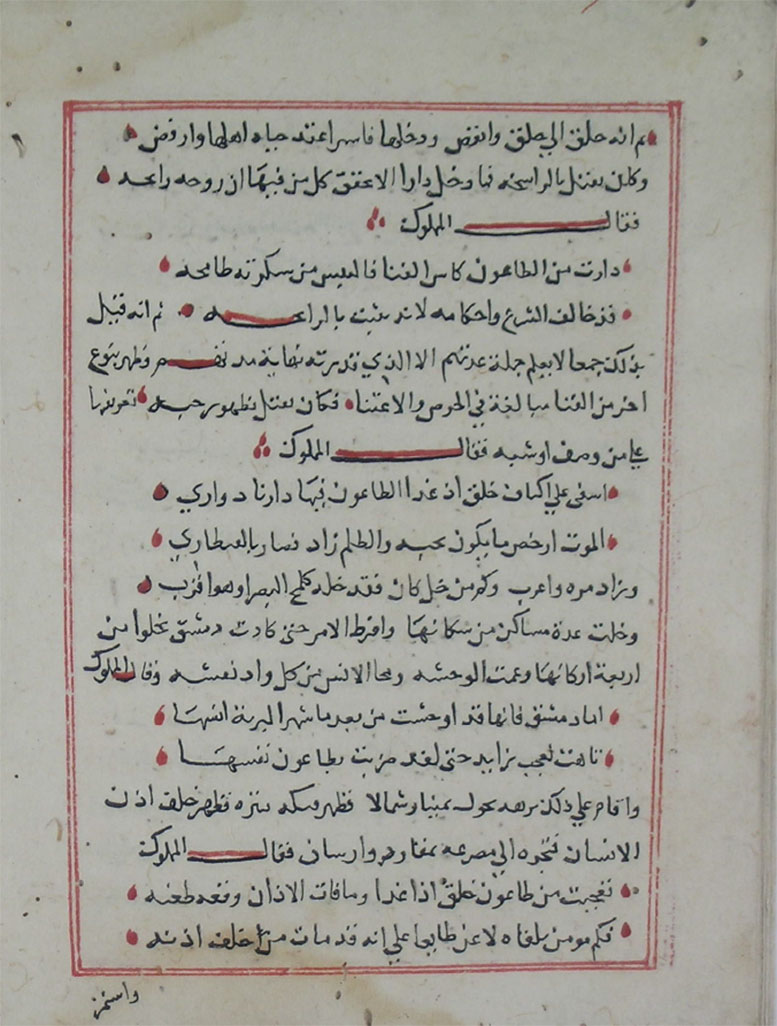
The study, by Muhammed Omar, a PhD candidate in Arab and Islamic Studies, and Nahyan Fancy, a historian of Islamic medicine from the University of Exeter, shows how this story began to be taken as fact by 15th century Arab historians and subsequent European historians.
Professor Fancy said: “All roads to the factually incorrect description of the spread of the plague lead back to this one text. It’s like it is in the center of a spider’s web of the myths about how the Black Death moved across the region.
“The entire trans-Asian movement of plague and its arrival in Egypt prior to Syria has always been and continues to be based upon Ibn al-Wardī’s singular Risāla, which is unsubstantiated by other contemporary chronicles and even maqāmas. The text was written just to highlight the fact the plague traveled, and tricked people. It should not be taken literally.”
The Maqāma Tradition
The maqāma form was invented in the late 10th century, but really took off from the 12th century onwards. Fourteenth-century Mamluk literati particularly prized this form of writing, and several of their maqāmas, including those on plague, are to be found in manuscripts in libraries across the world. Maqāmas were designed to be read aloud completely in one session.
Ibn al-Wardī’s Risāla was one of at least three maqāmas about plague composed in 1348-9. The study shows how this writing has huge potential to show how communities at the time coped with the catastrophic events.
This frees historians up to examine the significance of earlier plague outbreaks (such as the 1258 outbreak in Damascus, or the 1232–3 outbreak in Kaifeng), their impact on those societies, and how experiences in those outbreaks and their memories were recalled and revisited by later scholars.
Professor Fancy said: “These writings can help us understand how creativity may have been a way to exercise some control and served as a coping mechanism at this time of widespread death, similar to the way people developed new culinary skills or artistic skills during the Covid-19 pandemic.
“These maqāmas may not give us accurate information about the how the Black Death spread. But the texts are phenomenal because they help us see how people at the time were living with this awful crisis.”
Reference: “Mamluk Maqāmas on the Black Death” by Muhammed Omar and Nahyan Fancy, 31 October 2025, Journal of Arabic and Islamic Studies.
DOI: 10.5617/jais.12790
Never miss a breakthrough: Join the SciTechDaily newsletter.
Follow us on Google and Google News.
11 Comments
You trust a study by Muhammad
Did you really display your bigotry on the internet for everyone to see? Some things are best left in your head.
Let me guess, your a talking donkey, men spending the weekend in a big fish kind of guy.
A retelling of Covid 19 with the history of this as it’s predecessor?
People have been forced into fear so many times, it’s a cage they struggle to get out of when the worst is over. Proven to be effective for many circumstances and many political reasons.
So disappointed as I thought this was going to dig into the real “plague poem” Ring Around The Rosy ! I was eager to hear how and why someone would describe that timeless and extremely accurate account of the Black Death as “fooling” historians . Instead it’s a article about something nobody except historians ever heard of and I would think a real historian would have actually studied the thing at some point over 700 years . Kinda dumb article.
One of the stupidest things I’ve ever read. The real plague is Islam.
As is the above comment.
No reason Yersininia pestis carrying fleas couldn’t have spread 3000 miles in a few years. And no refutation in the article. Covid travels in the time a jet travels the world. Plague travels as fast as a caravan.
Yes, plague travels as fast as a caravan. So if the folks in the caravan start coming down with plague, the plague stops travelling.
The incubation period for the Black Death is typically 2-8 days, and more rarely 1-10 days. It would be quite rare for *no-one* in a sizable caravan to exhibit symptoms for 10 days, but even assuming that, how far do you think 10 days travel by caravan is?
What sad comments you have provided.
True, good point, but the fleas simply start riding along with the next caravan. Also how do camels respond to the bacteria?