
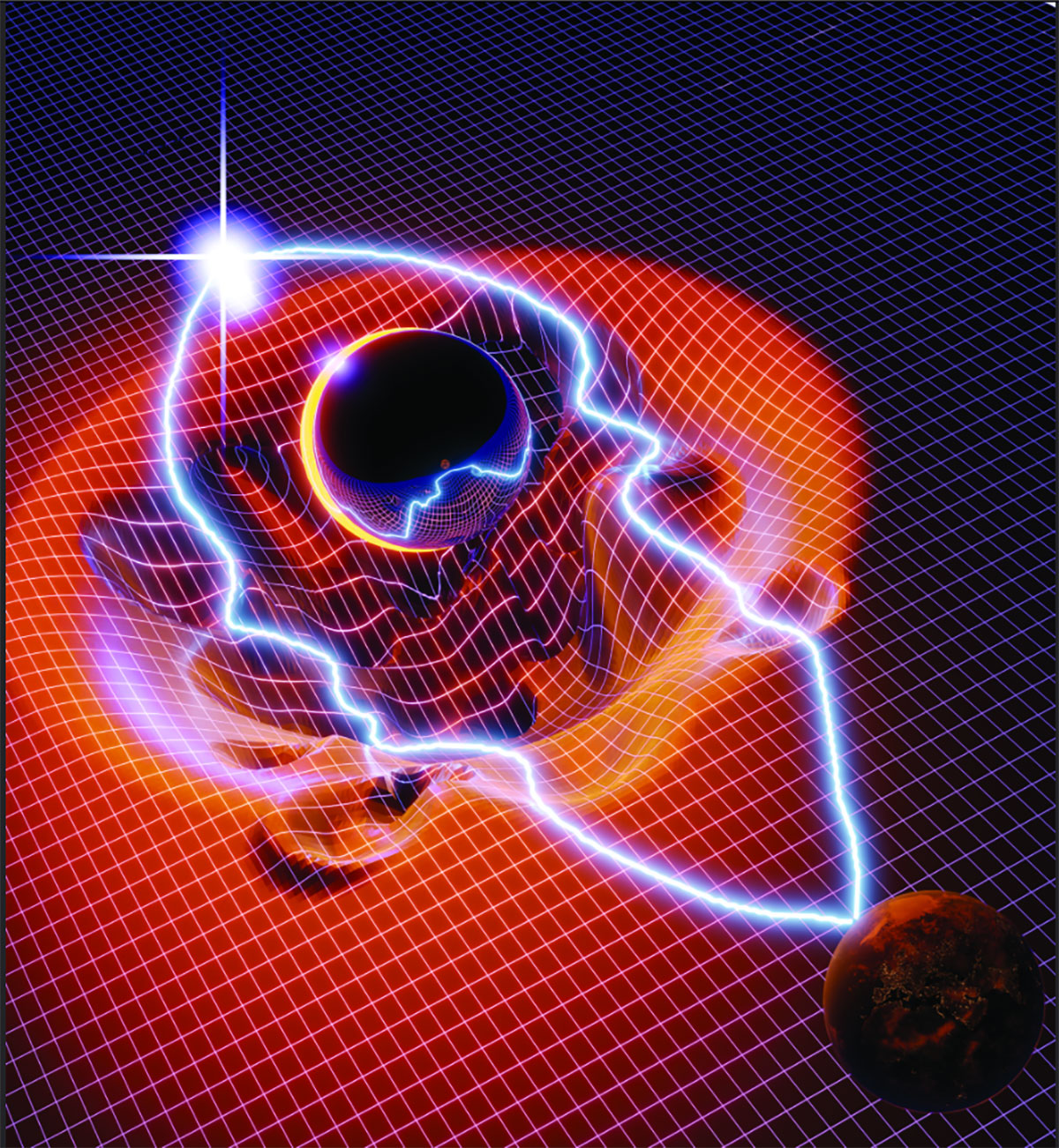
A distant quasar’s distorted images could hold clues to what dark matter is made of. Simulations of dark matter behaving like waves now offer a closer match to where those images appear.
When the gravity of a massive object bends light from a more distant source, it creates distorted, multiple images of galaxies in a phenomenon called gravitational lensing. Astronomers have long used these cosmic distortions to track dark matter, the invisible substance thought to make up 85 percent of all matter in the universe.
Dark matter does not emit, absorb, or reflect light, and it remains absent from the Standard Model of particle physics. Over the past decade, growing astronomical evidence has raised the possibility that this cosmic scaffolding actually consists of ultralight particles.
A gravitational fingerprint for fuzzy dark matter
The extremely low masses of those proposed particles would allow them to behave collectively like waves, giving this form of dark matter its nickname, “fuzzy” dark matter. Where the waves overlap, they can reinforce or cancel one another, producing interference patterns in the distribution of mass. That uneven distribution would affect how gravity bends passing light, potentially shifting the apparent positions of lensed images.
To calculate those effects, a research team led by Beijing Normal University (BNU), working with astrophysicists from the University of Hong Kong (HKU), drew gravitational-lensing predictions directly from three-dimensional wave simulations for the first time. The simulations captured the mass patterns produced by interactions between ultralight particles, providing a more physically realistic way to connect their proposed behavior with something astronomers can measure.
A closer match to quasar images
The researchers compared their predictions with the observed positions of multiple images of a well-studied quasar, whose light comes from an intensely bright galactic core. Their simulations matched those positions more closely than the commonly used comparison models tested in the study. Published in The Astrophysical Journal Letters, the findings suggest that high-resolution observations of lensed systems could help test the ultralight-particle explanation for dark matter. The closer match does not establish the identity of a substance that has puzzled physicists for nearly a century.
The work began with research visits to BNU by Professor Jeremy Lim and Dr. Amruth Alfred of HKU’s Department of Physics and the Hong Kong Institute of Astronomy and Astrophysics. There, they collaborated with Dr. Zhengxiang Li and doctoral student Jiajun Zhou, the study’s lead author, in Professor Zong-Hong Zhu’s group.
“We were very excited to see what the simulations predicted, as we did not know beforehand what observable signatures to expect. Jiajun worked very hard to rapidly get out these remarkable results, and we believe this has opened entirely new avenues for future research on the nature of Dark Matter using lensing.”
The researchers are now extending their investigation beyond image positions to other possible effects of fuzzy dark matter, including changes in the brightness of gravitationally lensed images.
Reference: “Gravitational Lensing Predictions from Wave Simulations of Fuzzy Dark Matter” by Jiajun Zhou, Zhengxiang Li, Amruth Alfred, Ran Gao, Jeremy Lim and Zong-Hong Zhu, 8 September 2026, The Astrophysical Journal Letters.
DOI: 10.3847/2041-8213/ae9a9e
Never miss a breakthrough: Join the SciTechDaily newsletter.
Follow us on Google and Google News.