

ESA’s Euclid mission explores the dark Universe by using gravitational lensing to detect distortions in galaxies caused by dark matter. This allows scientists to map the distribution of dark matter and understand dark energy’s impact on the Universe’s expansion, revealing cosmic evolution over billions of years.
The European Space Agency’s Euclid mission is scanning the sky to uncover the composition and evolution of the dark Universe. But how can Euclid observe something invisible? This video explains the light-bending phenomenon that helps scientists map dark matter across the cosmos.
Using Euclid’s advanced simulation, the video demonstrates how dark-matter filaments subtly distort the shapes of galaxies. As light from distant galaxies travels toward us, it gets bent and warped by concentrations of matter along the way. This phenomenon, known as gravitational lensing, occurs because both ‘normal’ matter and dark matter act like a cosmic magnifying glass.
Scientists classify gravitational lensing into two types: strong and weak. In strong lensing, the distortions of background galaxies or light sources are dramatic, creating features like arcs, multiple images, or Einstein rings. Weak lensing, on the other hand, causes only slight stretching or displacement of background sources, making it detectable only through statistical analysis of large numbers of galaxies.
The further we look, the more prominent the distortions from weak gravitational lensing are, because there are more dark-matter structures acting as lenses between us and the light sources.
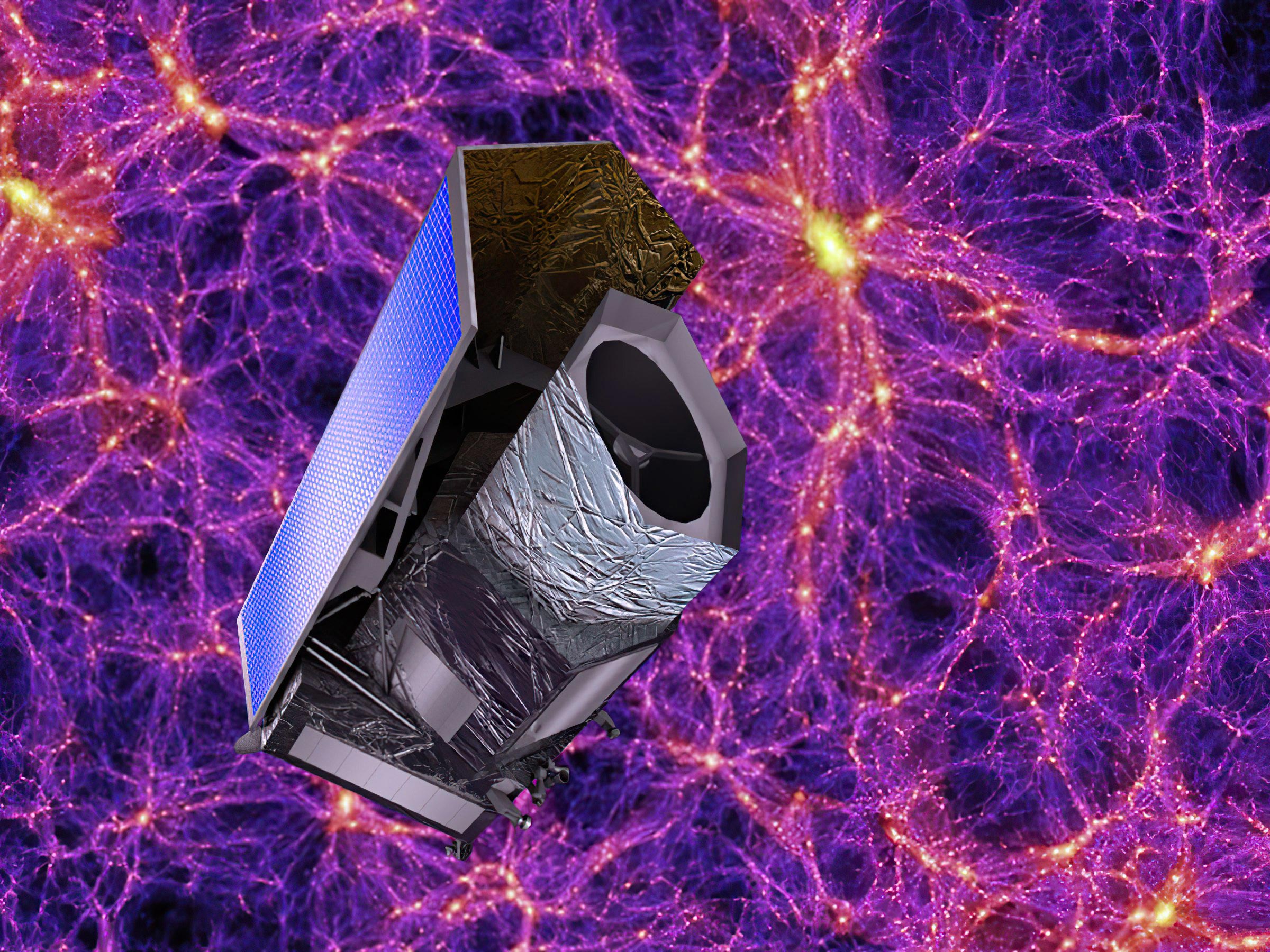
Euclid will measure the distorted shapes of billions of galaxies over 10 billion years of cosmic history, providing a 3D view of the dark matter distribution in our Universe. This will shed light on the nature of this mysterious component.
The map of the distribution of galaxies over cosmic time will also teach us about dark energy, which affects how quickly the Universe expands. By charting the Universe’s large-scale structure in unprecedented detail, Euclid will enable scientists to trace how the expansion has changed over time.
Never miss a breakthrough: Join the SciTechDaily newsletter.
Follow us on Google and Google News.
5 Comments
Dark matter is still very much an open question.
Memo 2410200630
msbase.outsid.msoss.area established the domain that dark matter exists. msbase is a general substance and is decomposed or superimposed into quantum qpeoms.tsp.mass. huh.
Source1.Edit
Scientists classify gravitational lenses into two types: strong and weak. Distortion of background galaxies or light sources in strong lenses is dramatic, resulting in features such as arcs, multiple images, or Einstein rings. On the other hand, weak lenses cause only slight stretching or displacement of background light sources and can only be detected through statistical analysis of many galaxies.
The more distant the distortion due to weak gravitational lensing becomes more pronounced, as there are more dark matter structures acting as lenses between us and the sources of light.
ESA’s Euclidean mission is a highly ambitious project undertaken by the European Space Agency (ESA) to investigate and understand the nature of dark matter and dark energy, two enigmatic components of the universe. Launched on July 1, 2023, the spacecraft will observe billions of galaxies up to 10 billion light years away, building the most accurate 3D space map ever made.
Using Euclid’s advanced simulations, this image shows how dark matter filaments subtly distort the shape of galaxies. Light from distant galaxies travels towards us, bending and bending by the concentration of matter in the process. This phenomenon, known as a gravitational lens, occurs because both ‘normal’ matter and dark matter act like a magnifying glass in the universe.
1.
If the reason why dark matter is not visible is interpreted as gravity, it could be statistically detected weak gravity, or it could be a matter that is so strong that it is smaller than an elementary particle that light bends back, a neutrino or an antiphoton without a mass such as light. Huh. But the reason it reacts to gravity is that msbase.outside=moss is also a superposition of qpeoms. Huh.
ㅡㅡㅡㅡㅡㅡㅡㅡㅡㅡㅡㅡㅡㅡ
Source 1.
https://scitechdaily.com/revealing-the-hidden-universe-how-euclid-maps-dark-matter-video/
Revealing the Hidden Universe: How Euclid Maps Dark Matter
“Dark Matter” is a “placeholder word” that somehow, dad gum it, became so biased toward a theory of gravity that nobody who is anybody wants to admit it. They’d rather opine that physics is a construct and it advances one death at a time, however holding that up is Einstein’s brain still partly frozen unexamined in a huge jar or something ambitious and hopeful like that.
Dark Matter axions are being invoked to explain gamma from pulsars. Seems kind of desperate. Euclid won’t help. Long time ago it seemed to me the best explanation was opposing electron and positron polar jet outflows eventually recombining simply enough as opposing charges under gravity.
me: “gamma from pulsars”
An occasional extremely bright scintillation is apparently at issue. Could be a result of a recombination energy “cascade” effect in a rich recombination environment, but I haven’t thought about it much.