
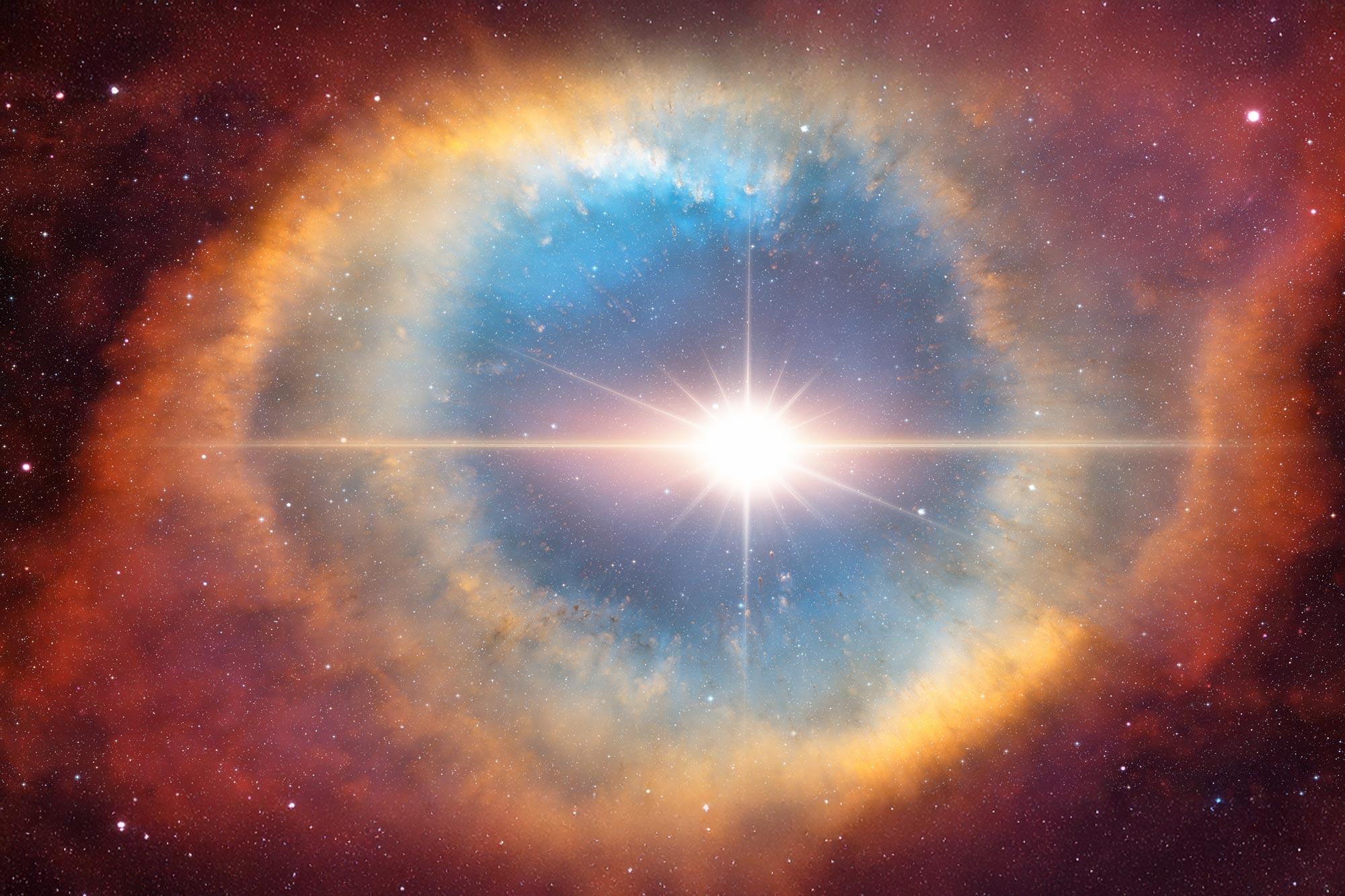
The fate of a dying massive star may depend on more than its mass and internal structure.
A massive star does not always go out in a brilliant supernova. Some instead collapse into black holes, potentially with little or no visible explosion. What determines which path a dying star takes remains one of the major unresolved problems in stellar astrophysics.
New simulations from researchers at the University of Copenhagen suggest that part of the answer may depend on neutrinos, nearly massless particles that stream through matter with very little interaction. In particular, the study indicates that changes in neutrino “flavor” can alter whether some collapsing stars explode or fail to do so.
Ghost Particles May Influence a Star’s Final Moments
Neutrinos occur in different types, or flavors, and can switch from one flavor to another through a process known as neutrino flavor conversion. Because different flavors interact differently with matter inside a collapsing star, those conversions could affect the transfer of energy during the critical moments before an explosion.
“We have long known that neutrinos can switch between different flavors. But we generally assumed that this had no effect on the outcome of the explosion itself. Our new research findings suggest that this flavor can tell us something about the star’s fate,” says Mariam Gogilashvili, a postdoctoral researcher at the Niels Bohr Institute and lead author of the study.
Supernova models have long included neutrinos because they play a central role in the physics of stellar collapse. Fully accounting for neutrino flavor conversion, however, requires calculations that are extremely demanding even for modern computers.
Testing 195 Collapsing Stars
“Simulating the death of a massive star is something that is pretty much at the frontier of what we can do computationally at the moment. That is because it is a problem involving a great deal of physics and it is extremely expensive computationally,” says Irene Tamborra, professor at the Niels Bohr Institute, head of the Particle Astrophysics group, and the second author of the study.
To make the problem manageable, Gogilashvili and Tamborra developed a simplified model that allowed them to test the influence of neutrino flavor conversion across a large set of stellar collapse simulations.
They modeled 195 stars ranging from 9 to 120 times the mass of the Sun. For each case, they compared simulations that included neutrino flavor conversion with simulations that did not. They also varied the density at which the conversion process began, then tracked whether each model produced a supernova explosion or continued collapsing toward a black hole.
Some Stars Changed Their Fate
The strongest effects appeared among stars with masses between 16 and 30 times that of the Sun. In that range, adding neutrino flavor conversion caused some simulated stars to switch outcomes, turning successful explosions into failed ones.
“It was a really exciting moment when we put all 195 simulations side by side and saw a whole range of stars flip from exploding to failing. Seeing such a clear pattern across so many stars told us that neutrino flavor conversion is something we simply cannot leave out when we try to understand how massive stars end their lives,” says postdoctoral researcher Mariam Gogilashvili.
The simulations do not establish that neutrino flavor conversion alone determines the fate of real stars. Stellar collapse depends on many interacting physical processes, and the researchers used a simplified model. The results instead suggest that neutrino flavor changes may be one of the factors that supernova calculations need to account for more carefully.
A Possible Clue to Missing Supernovae
The findings could also bear on the “supernova rate problem.” Astronomers observe fewer supernovae than theoretical models predict should occur based on the number of massive stars expected to reach the ends of their lives.
One possible explanation is that some massive stars collapse into black holes without producing the bright explosions astronomers normally use to identify supernovae. Dust can also hide explosions from view.
“Normally, we detect a supernova because the explosion shines very brightly. But if a star collapses directly into a black hole without a visible explosion, or is obscured by dust, it can effectively ‘disappear’ from our counts. Our results therefore suggest that there is a mechanism that could make such ‘failed supernovae’ more likely,” says Mariam Gogilashvili.
“This could therefore not only give us better tools to predict a dying star’s fate, but it may also help explain why observations do not always match theoretical predictions,” adds Professor Irene Tamborra.
Stellar Deaths Help Build New Worlds
Whether a massive star explodes also affects what happens to the material it produced during its lifetime. Massive stars synthesize heavier elements, and supernova explosions can eject that material into space, where it becomes part of later generations of stars, planets, and other cosmic structures.
Understanding why some stars explode while others collapse directly into black holes therefore connects the physics of neutrinos and stellar collapse with the chemical evolution of the universe.
“When we study how massive stars live and die, we are also investigating the origins of many of the elements that make up the universe and ourselves. In this way, questions about dying stars are linked to questions about our own origins,” concludes Professor Irene Tamborra.
Reference: “Neutrino flavor conversion shapes the rate of failed core-collapse supernovae” by Mariam Gogilashvili and Irene Tamborra, 22 September 2026, Physical Review D.
DOI: 10.1103/pz3y-3lv5
Never miss a breakthrough: Join the SciTechDaily newsletter.
Follow us on Google and Google News.