
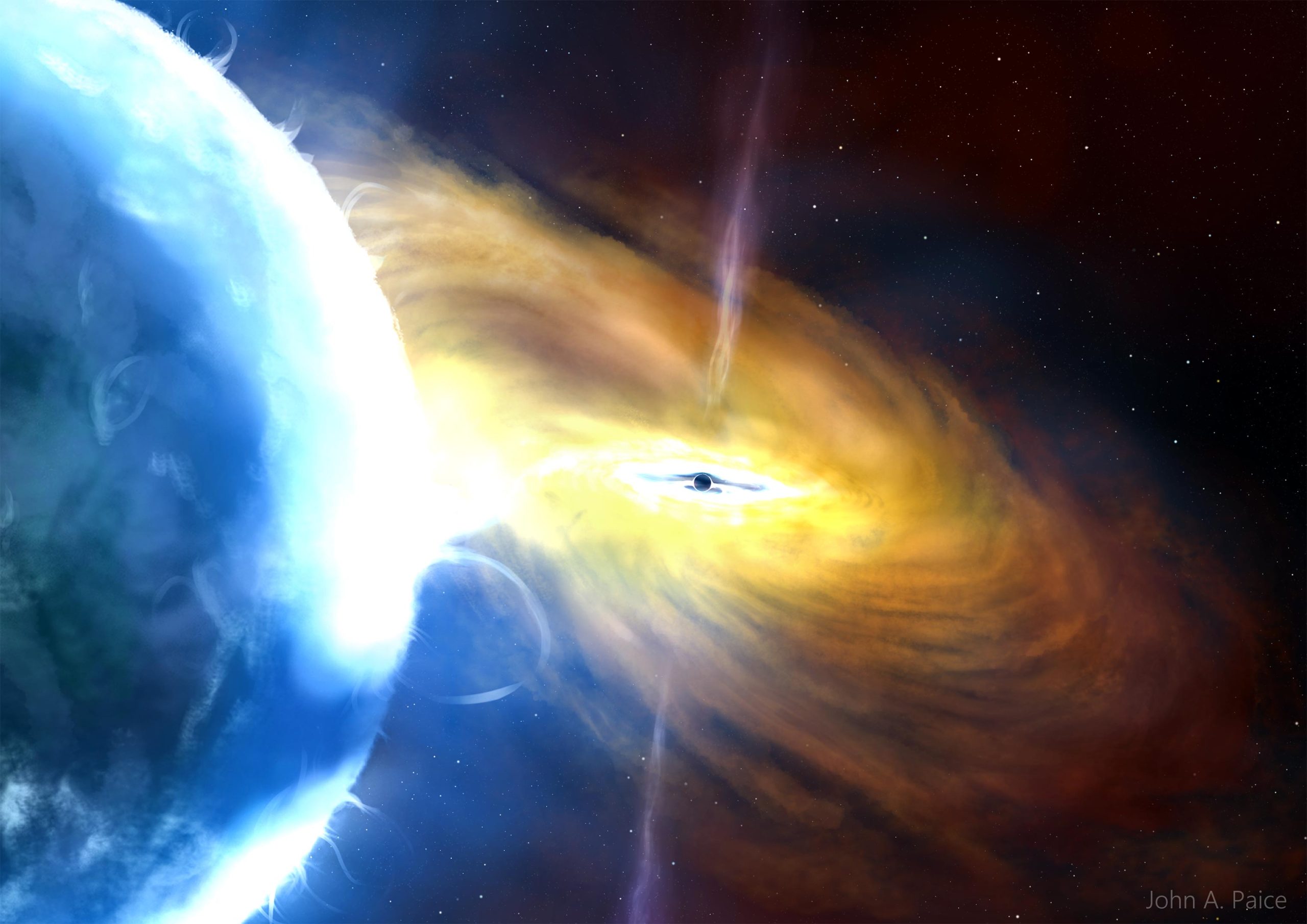
Astronomers have discovered the largest cosmic explosion ever observed, AT2021lwx, which is believed to have been caused by a supermassive black hole violently disrupting a massive gas cloud. This explosion has released far more energy than any previous event due to its extended duration.
A team of astronomers led by the University of Southampton has uncovered the largest cosmic explosion ever witnessed.
The explosion is more than ten times brighter than any known supernova (exploding star) and three times brighter than the brightest tidal disruption event, where a star falls into a supermassive black hole.
The explosion, known as AT2021lwx, has currently lasted over three years, compared to most supernovae which are only visibly bright for a few months. It took place nearly 8 billion light years away, when the universe was around 6 billion years old, and is still being detected by a network of telescopes.
The researchers believe that the explosion is a result of a vast cloud of gas, possibly thousands of times larger than our sun, that has been violently disrupted by a supermassive black hole. Fragments of the cloud would be swallowed up, sending shockwaves through its remnants, as well as into a large dusty ‘doughnut’ surrounding the black hole. Such events are very rare and nothing on this scale has been witnessed before.
Last year, astronomers witnessed the brightest explosion on record — a gamma-ray burst known as GRB 221009A. While this was brighter than AT2021lwx, it lasted for just a fraction of the time, meaning the overall energy released by the AT2021lwx explosion is far greater.
The findings of the research were published today (Friday, May 12, 2023) in Monthly Notices of the Royal Astronomical Society.
Discovery
AT2021lwx was first detected in 2020 by the Zwicky Transient Facility in California, and subsequently picked up by the Asteroid Terrestrial-impact Last Alert System (ATLAS) based in Hawaii. These facilities survey the night sky to detect transient objects that rapidly change in brightness indicating cosmic events such as supernovae, as well as finding asteroids and comets. Until now the scale of the explosion has been unknown.
“We came upon this by chance, as it was flagged by our search algorithm when we were searching for a type of supernova,” says Dr. Philip Wiseman, Research Fellow at the University of Southampton, who led the research. “Most supernovae and tidal disruption events only last for a couple of months before fading away. For something to be bright for two plus years was immediately very unusual.”
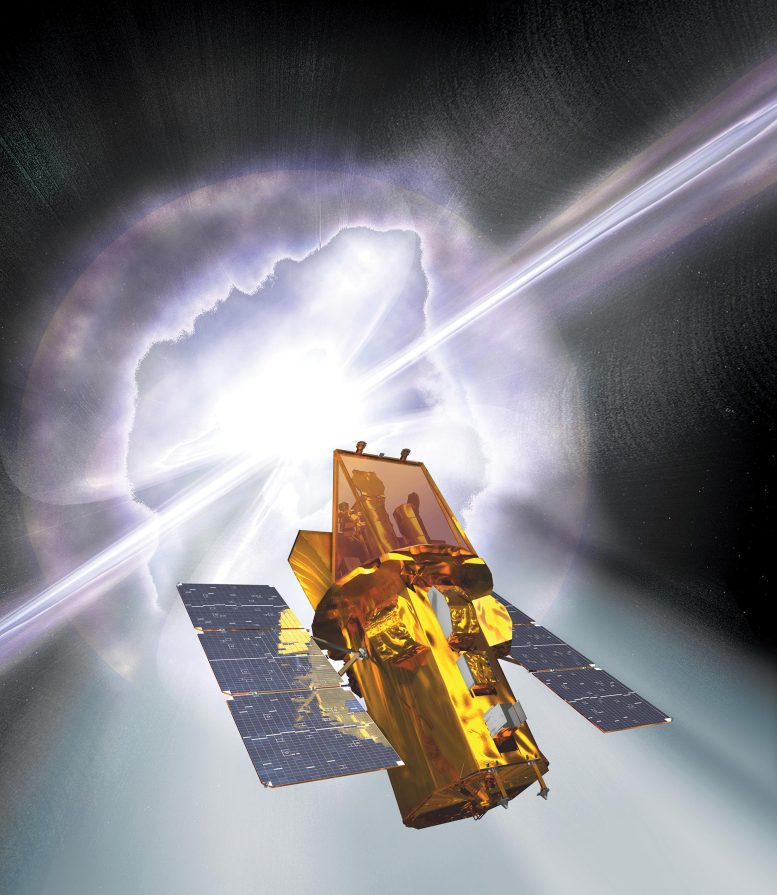
The team investigated the object further with several different telescopes: the Neil Gehrels Swift Telescope (a collaboration between NASA, the UK, and Italy), the New Technology Telescope (operated by the European Southern Observatory) in Chile, and the Gran Telescopio Canarias in La Palma, Spain.
Measuring the Explosion
By analyzing the spectrum of the light, splitting it up into different wavelengths, and measuring the different absorption and emission features of the spectrum, the team was able to measure the distance to the object.
“Once you know the distance to the object and how bright it appears to us, you can calculate the brightness of the object at its source. Once we’d performed those calculations, we realized this is extremely bright,” says Professor Sebastian Hönig from the University of Southampton, a co-author of the research.
The only things in the universe that are as bright as AT2021lwx are quasars — supermassive black holes with a constant flow of gas falling onto them at high velocity.
Professor Mark Sullivan, also of the University of Southampton and another co-author of the paper, explains: “With a quasar, we see the brightness flickering up and down over time. But looking back over a decade there was no detection of AT2021lwx, then suddenly it appears with the brightness of the brightest things in the universe, which is unprecedented.”
What Caused the Explosion?
There are different theories as to what could have caused such an explosion, but the Southampton-led team believes the most feasible explanation is an extremely large cloud of gas (mostly hydrogen) or dust that has come off course from its orbit around the black hole and been sent flying in.
The team is now setting out to collect more data on the explosion — measuring different wavelengths, including X-rays which could reveal the object’s surface and temperature, and what underlying processes are taking place. They will also carry out upgraded computational simulations to test if these match their theory of what caused the explosion.
Dr. Philip Wiseman added: “With new facilities, like the Vera Rubin Observatory’s Legacy Survey of Space and Time, coming online in the next few years, we are hoping to discover more events like this and learn more about them. It could be that these events, although extremely rare, are so energetic that they are key processes to how the centers of galaxies change over time.”
Reference: “Multiwavelength observations of the extraordinary accretion event AT2021lwx” by P Wiseman, Y Wang, S Hönig, N Castro-Segura, P Clark, C Frohmaier, M D Fulton, G Leloudas, M Middleton, T E Müller-Bravo, A Mummery, M Pursiainen, S J Smartt, K Smith, M Sullivan, J P Anderson, J A Acosta Pulido, P Charalampopoulos, M Banerji, M Dennefeld, L Galbany, M Gromadzki, C P Gutiérrez, N Ihanec, E Kankare, A Lawrence, B Mockler, T Moore, M Nicholl, F Onori, T Petrushevska, F Ragosta, S Rest, M Smith, T Wevers, R Carini, T-W Chen, K Chambers, H Gao, M Huber, C Inserra, E Magnier, L Makrygianni, M Toy, F Vincentelli and D R Young, 11 April 2023, Monthly Notices of the Royal Astronomical Society.
DOI: 10.1093/mnras/stad1000
Never miss a breakthrough: Join the SciTechDaily newsletter.
Follow us on Google and Google News.
2 Comments
Well lets be honest, they did not “witness” anything. science has become a religion.
They are able to detect these things with both instrumentation and calculation… Almost a religion but not quite. They have evidence, not faith.