
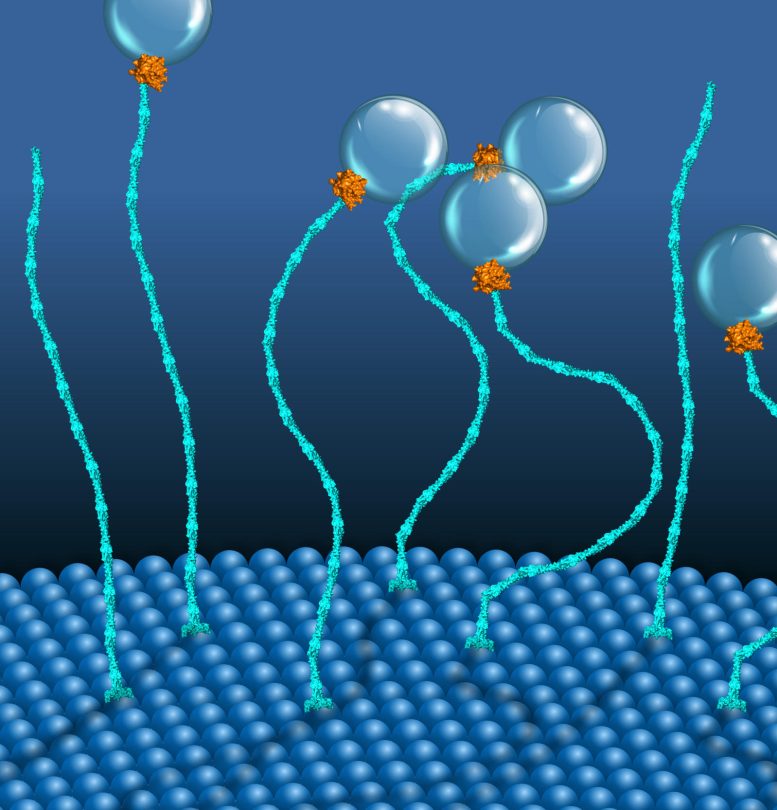
Researchers uncovered a GTP-powered molecular motor with Rab5 and EEA1, generating mechanical work through flexibility changes, offering insights into cellular mechanics and synthetic protein design.
Cells possess a remarkable ability to organize their interiors using minuscule protein machines known as molecular motors, which generate directed motion. Most molecular motors rely on a common form of chemical energy, ATP, to function. Recently, a team of researchers from the Max Planck Institute of Molecular Cell Biology and Genetics (MPI-CBG), the Cluster of Excellence Physics of Life (PoL), the Biotechnology Center (BIOTEC) of TU Dresden, and the National Centre for Biological Sciences (NCBS) in India uncovered a novel molecular system that utilizes an alternative energy source and features a new mechanism for executing mechanical tasks.
This molecular motor, which operates similarly to a traditional Stirling engine through repeated contraction and expansion, assists in distributing cargo to membrane-bound organelles. It is the first motor using two components, two differently sized proteins, Rab5 and EEA1, and is driven by GTP instead of ATP. The findings were recently published in the journal Nature Physics.
EEA1-Rab5 Molecular Motor
Motor proteins are remarkable molecular machines within a cell that converts chemical energy, stored in a molecule called ATP, into mechanical work. The most prominent example is myosin which helps our muscles to move. In contrast, GTPases which are small proteins have not been viewed as molecular force generators. One example is a molecular motor composed of two proteins, EEA1 and Rab5.
In 2016, an interdisciplinary team of cell biologists and biophysicists in the groups of MPI-CBG directors Marino Zerial and Stephan Grill and their colleagues, including PoL and BIOTEC research group leader Marcus Jahnel, discovered that the small GTPase protein Rab5 could trigger a contraction in EEA1. These string-shaped tether proteins can recognize the Rab5 protein present in a vesicle membrane and bind to it.
The binding of the much smaller Rab5 sends a message along the elongated structure of EEA1, thereby increasing its flexibility, similar to how cooking softens spaghetti. Such flexibility change produces a force that pulls the vesicle towards the target membrane, where docking and fusion occur. However, the team also hypothesized that EEA1 could switch between a flexible and a rigid state, similar to a mechanical motor motion, simply by interacting with Rab5 alone.
This is where the current research sets in, taking shape via the doctoral work of the two first authors of the study. Joan Antoni Soler from Marino Zerial’s research group at MPI-CBG and Anupam Singh from the group of Shashi Thutupalli, a biophysicist at the Simons Centre for the Study of Living Machines at the NCBS in Bangalore, set out to experimentally observe this motor in action.
With an experimental design to investigate the dynamics of the EEA1 protein in mind, Anupam Singh spent three months at the MPI-CBG in 2019. “When I met Joan, I explained to him the idea of measuring the protein dynamics of EEA1. But these experiments required specific modifications to the protein that allowed measurement of its flexibility based on its structural changes,” says Anupam.
Joan Antoni Soler’s expertise in protein biochemistry was a perfect fit for this challenging task. “I was delighted to learn that the approach to characterize the EEA1 protein could answer whether EEA1 and Rab5 form a two-component motor, as previously suspected. I realized that the difficulties in obtaining the correct molecules could be solved by modifying the EEA1 protein to allow fluorophores to attach to specific protein regions. This modification would make it easier to characterize the protein structure and the changes that can occur when it interacts with Rab5,” explains Joan Antoni.
Two-Component Motor System
Armed with the suitable protein molecules and the valuable support of co-author Janelle Lauer, a senior postdoctoral researcher in Marino Zerial’s research group, Joan and Anupam were able to characterize the dynamics of EEA1 thoroughly using the advanced laser scanning microscopes provided by the light microscopy facilities at the MPI-CBG and the NCBS. Strikingly, they discovered that the EEA1 protein could undergo multiple flexibility transition cycles, from rigid to flexible and back again, driven solely by the chemical energy released by its interaction with the GTPase Rab5. These experiments showed that EEA1 and Rab5 form a GTP-driven two-component motor.
To interpret the results, Marcus Jahnel, one of the corresponding authors and research group leader at PoL and BIOTEC, developed a new physical model to describe the coupling between chemical and mechanical steps in the motor cycle. Together with Stephan Grill and Shashi Thutupalli, the biophysicists were also able to calculate the thermodynamic efficiency of the new motor system, which is comparable to that of conventional ATP-driven motor proteins.
“Our results show that the proteins EEA1 and Rab5 work together as a two-component molecular motor system that can transfer chemical energy into mechanical work. As a result, they can play active mechanical roles in membrane trafficking. It is possible that the force-generating molecular motor mechanism may be conserved across other molecules and used by several other cellular compartments,” Marino Zerial summarizes the study.
Marcus Jahnel adds: “I am delighted that we could finally test the idea of an EEA1-Rab5 motor. It’s great to see it confirmed by these new experiments. Most molecular motors use a common type of cellular fuel called ATP. Small GTPases consume another type of fuel, GTP, and have been thought of mainly as signaling molecules. That they can also drive a molecular system to generate forces and move things around puts these abundant molecules in an interesting new light.”
Stephan Grill is equally excited: “It’s a new class of molecular motors! This one doesn’t move around like the kinesin motor that transports cargo along microtubules but performs work while staying in place. It’s a bit like the tentacles of an octopus.”
“The model we used is inspired by that of the classical Stirling engine cycle. While the traditional Stirling engine generates mechanical work by expanding and compressing gas, the two-component motor described uses proteins as the working substrate, with protein flexibility changes resulting in force generation. As a result, this type of mechanism opens up new possibilities for the development of synthetic protein engines,” adds Shashi Thutupalli.
Overall, the authors hope that this new interdisciplinary study could open new research avenues in both molecular cell biology and biophysics.
Reference: “Two-component molecular motor driven by a GTPase cycle” by Anupam Singh, Joan Antoni Soler, Janelle Lauer, Stephan W. Grill, Marcus Jahnel, Marino Zerial and Shashi Thutupalli, 4 May 2023, Nature Physics.
DOI: 10.1038/s41567-023-02009-3
Never miss a breakthrough: Join the SciTechDaily newsletter.
Follow us on Google and Google News.