
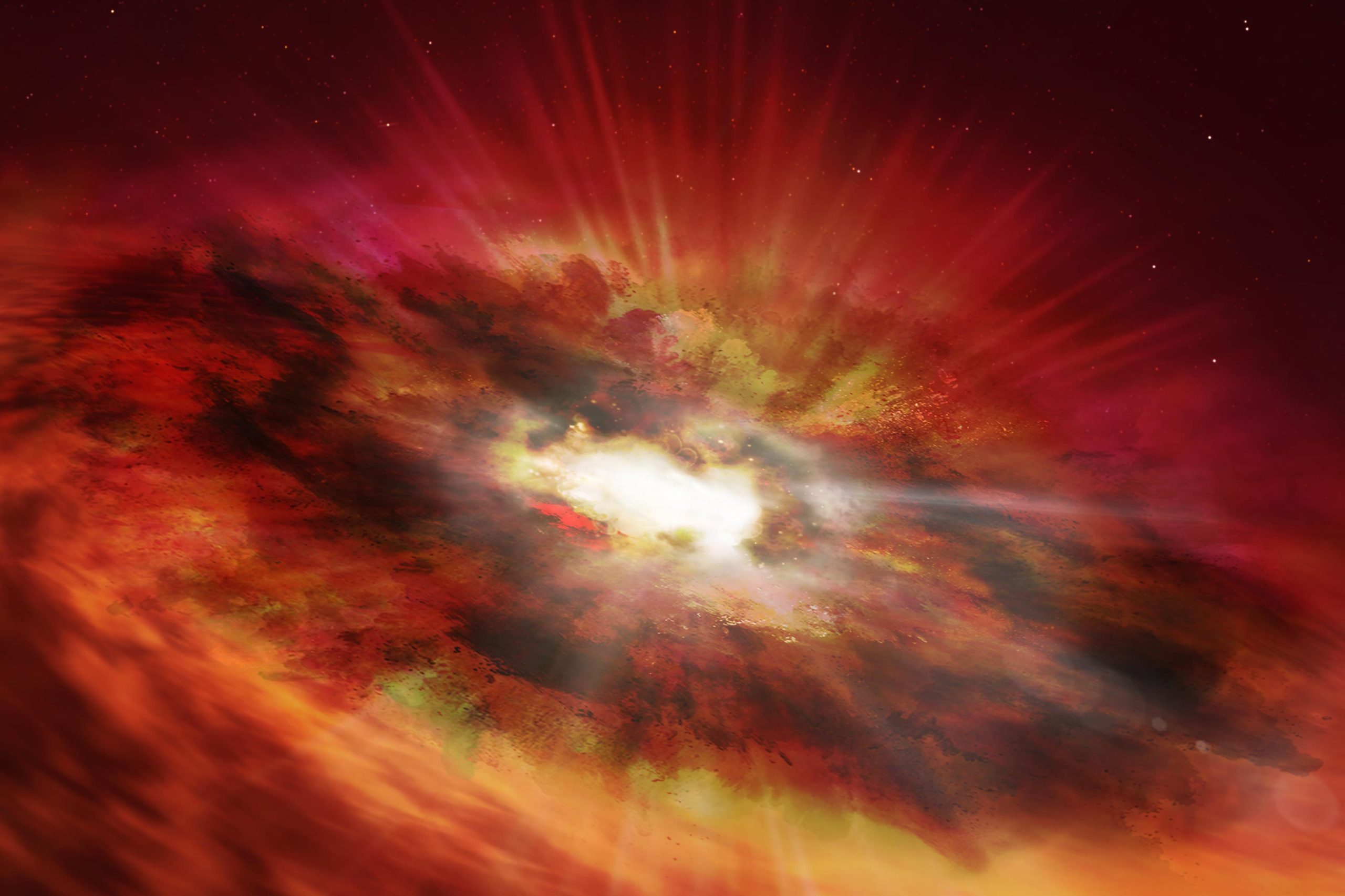
Scientists have discovered GNz7q, a distant object linking galaxies and quasars, providing new insights into early black hole formation.
An international effort led by astrophysicists at the Niels Bohr Institute, University of Copenhagen, and the Technical University of Denmark, have identified a distant object with properties that lie in-between those of a galaxy and those of a so-called quasar. The object can be seen as the ancestor of a supermassive black hole, and it was born relatively soon after the Big Bang. Simulations had indicated that such objects would exist, but this is the first actual finding.
“The discovered object connects two rare populations of celestial objects, namely dusty starbursts and luminous quasars, and thereby provides a new avenue toward understanding the rapid growth of supermassive black holes in the early universe,” says Seiji Fujimoto, a postdoctoral fellow based at the Niels Bohr Institute, University of Copenhagen.
The discovery can be attributed to the Hubble Space Telescope operated jointly by ESA and NASA. With its location in space – undisturbed by weather changes, pollution, etc. – the telescope can gaze further into the depths of the universe than would have been the case on the ground. And in astronomy, looking further equals being able to observe phenomena which took place at earlier cosmic periods – since light and other types of radiation will have traveled longer to reach us.
The newly found object – named GNz7q by the team – was born 750 million years after the Big Bang which is generally accepted as the beginning of the universe as we know it. Since the Big Bang occurred about 13.8 billion years ago, GNz7q origins in an epoch known as “Cosmic Dawn.”
The Mystery of Supermassive Black Holes
The discovery is linked to a specific type of quasars. Quasars, also known as quasi-stellar objects, are extremely luminous objects. Images from Hubble and other advanced telescopes have revealed that quasars occur in the centers of galaxies. The host galaxy for GNz7q is an intensely star-forming galaxy, forming stars at a rate 1,600 times faster than our own galaxy, the Milky Way. The stars, in turn, create and heat cosmic dust, making it glow in infrared to the extent that GNz7q’s host is more luminous in dust emission than any other known object at this period of the Cosmic Dawn.
In the most recent years it has transpired, that luminous quasars are powered by supermassive black holes, with masses ranging from millions to tens of billions of solar masses, surrounded by vast amounts of gas. As the gas falls towards the black hole, it will heat up due to friction which provides the enormous luminous effect.
“Understanding how supermassive black holes form and grow in the early universe has become a major mystery. Theorists have predicted that these black holes undergo an early phase of rapid growth: a dust-reddened compact object emerges from a heavily dust-obscured starburst galaxy, then transitions to an unobscured luminous compact object by expelling the surrounding gas and dust,” explains Associate Professor Gabriel Brammer, Niels Bohr Institute, continuing:
“Although luminous quasars had already been found even at the earliest epochs of the universe, the transition phase of rapid growth of both the black hole and its star-bursting host had not been found at similar epochs. Moreover, the observed properties are in excellent agreement with the theoretical simulations and suggest that GNz7q is the first example of the transitioning, rapid growth phase of black holes at the dusty star core, an ancestor of the later supermassive black hole.”
Both Seiji Fujimoto and Gabriel Brammer are part of the Cosmic Dawn Center (DAWN), a collaboration between Niels Bohr Institute and DTU Space.
Hiding in Plain Sight
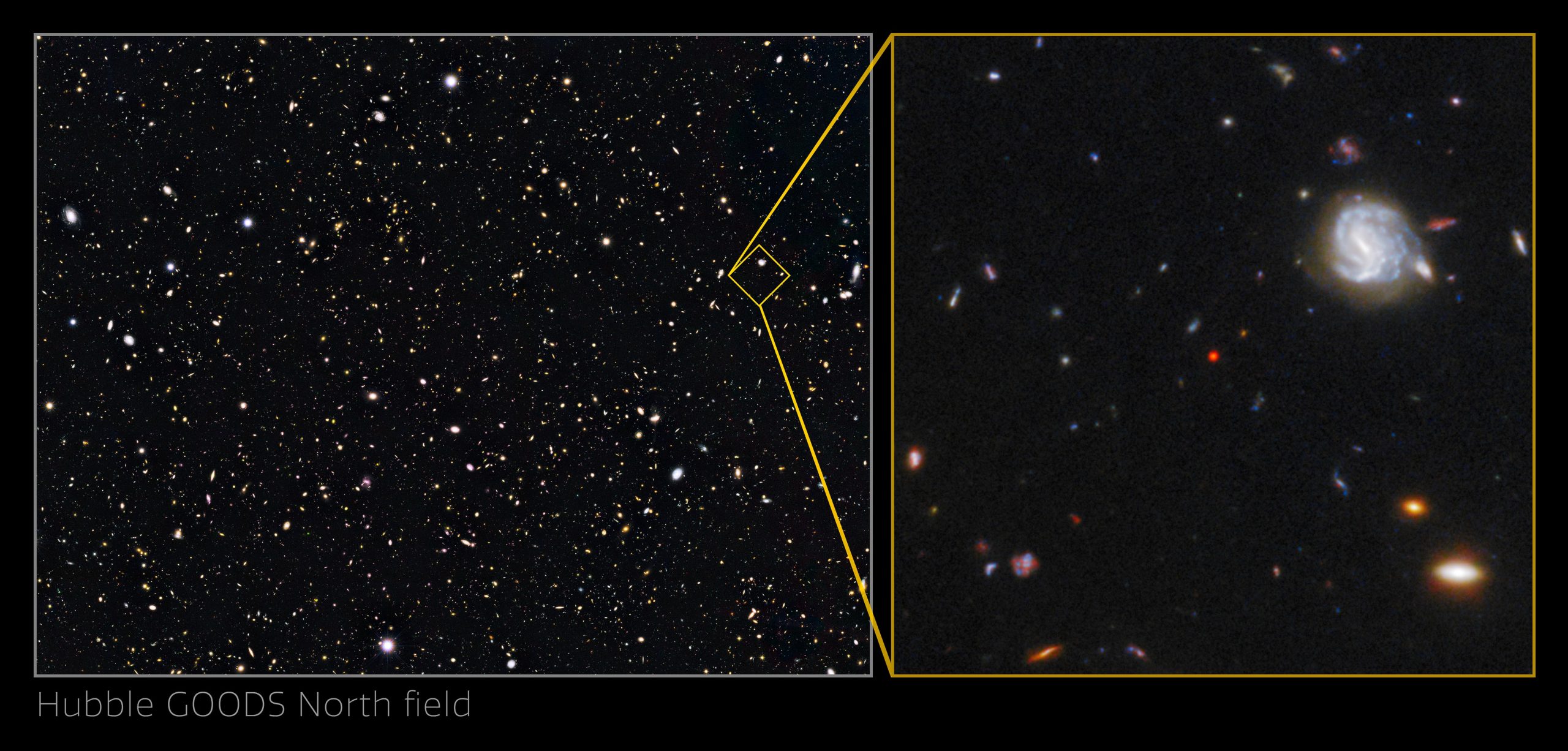
Curiously, GNz7q was found at the center of an intensely studied sky field known as the Hubble GOODS North field.
“This shows how big discoveries can often be hidden right in front of you,” Gabriel Brammer comments.
Finding GNz7q hiding in plain sight was only possible thanks to the uniquely detailed, multi-wavelength datasets available for GOODS North. Without the richness of data, the object would have been easy to overlook, as it lacks the distinguishing features for quasars in the early universe.
“It’s unlikely that discovering GNz7q within the relatively small GOODS-N survey was just “dumb luck”, but rather that the prevalence of such sources may in fact be significantly higher than previously thought,” Brammer adds.
The team now hopes to systematically search for similar objects using dedicated high-resolution surveys and to take advantage of the NASA/ESA/CSA James Webb Space Telescope.
“Fully characterizing these objects and probing their evolution and underlying physics in much greater detail will become possible with the James Webb Telescope. Once in regular operation, Webb will have the power to decisively determine how common these rapidly growing black holes truly are,” Seiji Fujimoto concludes.
For more on this discovery, see Hubble Uncovers Bizarre, Evolutionary Missing Link From the Dawn of the Universe.
Reference: “A dusty compact object bridging galaxies and quasars at cosmic dawn” by S. Fujimoto, G. B. Brammer, D. Watson, G. E. Magdis, V. Kokorev, T. R. Greve, S. Toft, F. Walter, R. Valiante, M. Ginolfi, R. Schneider, F. Valentino, L. Colina, M. Vestergaard, R. Marques-Chaves, J. P. U. Fynbo, M. Krips, C. L. Steinhardt, I. Cortzen, F. Rizzo and P. A. Oesch, 13 April 2022, Nature.
DOI: 10.1038/s41586-022-04454-1
The Cosmic Dawn Center (DAWN) is an international center of excellence for astronomy, supported by the Danish National Research Foundation.
DAWN is a collaboration between the Niels Bohr Institute at the University of Copenhagen, and at the National Space Institute at the Technical University of Denmark (DTU Space). The center is dedicated to uncovering when and how the first galaxies, stars and black holes formed and evolved in the early Universe, through observations with the prime telescopes of the next decade, as well as through theoretical work and simulations.
Never miss a breakthrough: Join the SciTechDaily newsletter.
Follow us on Google and Google News.
5 Comments
Here exists predection of Coevolution theroy,where supermassive black hole and stars have evolved simultaneously and have common growth,that star formation rate is 10 fold more for the early galaxies near to age 1 billion years after the big bang.This is an analogy with our milky way.Such galaxy also has been discovered.
But at present instance GNz7q is a yet young galaxy.Stars are not well fixed,that is,they are hidden within dust.So star formation rate,starting from zero number of star in the galaxy should be some figure fractional higher than the above situation,where this figure is 1000 stars in solar mass.As by calculation we deduce the stars evolving are
33.3×3×10 or 1000.ln milky way mass of stars are 33.3 fold of super massive black hole at the center and galaxy evolves 3 stars of solar mass per year.
The observational result of 1600 stars of solar mass is so a good approximation.
According to the prediction of coevolution theory in astrophysics of super massive black hole with stars in galaxy,star rate formation is 10 fold highier for early galaxies evolved nearly 1 billion yezrs after big bang,when make an analogy woth milky wsy.Such kind of galaxy has been discovered to confirm the theory.
Yet,discovery of GNz7q should be rrgarded due to yet younger age of 750 million years after big bang and 1.6 fold higher star formation rate than previous.Thanks to the Authors.
The coevolution theory in astrophysics is in real after hard works aiming to a zenith point of establishment,in which the super massive black hole and stars evolution simultaneously in a galaxy after big bang suffixed by a common growth rate due to dark matter.Discovery of GNz7q galaxy is one of most important milestone in this path with very exact observation and calculations.Thanks and congratulations to the authors.
The coevolution theory in astrophysics is in real after hard works aiming to a zenith point of establishment,in which the super massive black hole and stars evolution simultaneously in a galaxy after big bang suffixed by a common growth rate due to dark matter.Discovery of GNz7q galaxy is one of most important milestone in this path with very exact observation and calculations.Thanks and congratulations to the authors.
Discovery of previous galaxy more than 11 billion light years far away from milky way with 10 fold star formation rate has recorded to support coevolution theory.But,in galaxy GNz7q more potential disected view of star growth rate is presented.
The coevolution theory in astrophysics is in real after hard works aiming to a zenith point of establishment,in which the super massive black hole and stars evolution simultaneously in a galaxy after big bang suffixed by a common growth rate due to dark matter.Discovery of GNz7q galaxy is one of most important milestone in this path with very exact observation and calculations.Thanks and congratulations to the authors.
Discovery of previous galaxy more than 11 billion light years far away from milky way with 10 fold star formation rate has recorded to support coevolution theory.But,in galaxy GNz7q more potential disected view of star growth rate is presented.
To mention here in place of simply 16 fold stars rate formation with analogy to milky wzy galaxy for 750 million years aged GNz7q starting from big bang, direct calculated value of stars 1600 of solar mass formation per year is gained.