
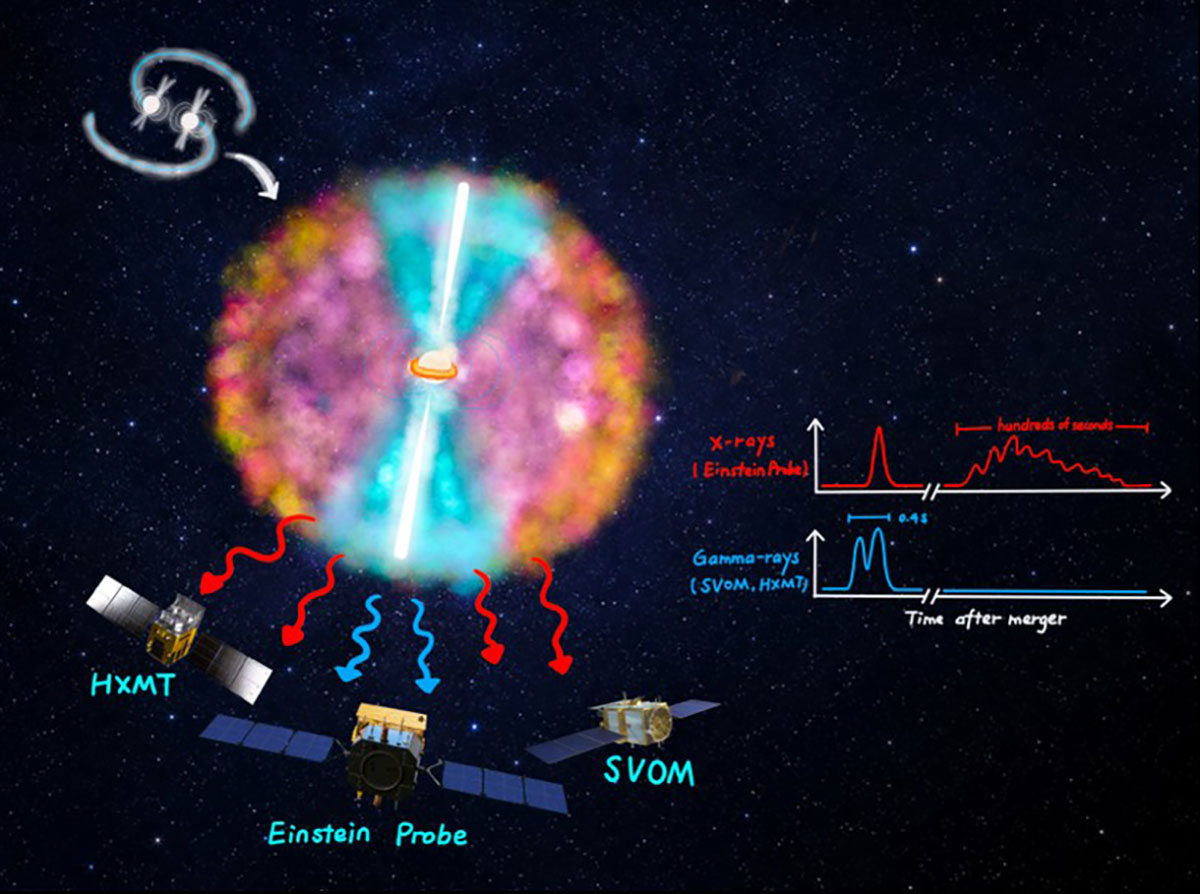
Einstein Probe uncovered a hidden soft X-ray phase that may reveal how neutron star merger remnants remain active after short gamma-ray bursts.
A burst of gamma rays can flare for less than half a second and disappear before most X-ray telescopes have even turned toward it. For decades, that delay left astronomers with only a brief glimpse of many short gamma-ray bursts, or short GRBs. The softer X-rays released during the explosion’s earliest moments remained hidden because narrow-field X-ray telescopes generally needed a gamma-ray alert to locate the burst before repointing toward it.
Short GRBs are thought to begin when two compact stars, such as neutron stars, orbit one another, collide, and merge. The crash generates gravitational waves and produces one of the most energetic explosions in the universe, but the missing soft X-ray signal has limited what astronomers can see during and immediately after the merger.
Einstein Probe catches the hidden X-rays
Einstein Probe avoids that delay by monitoring a wide area of the sky at soft X-ray energies. On July 4, 2025, the observatory caught EP250704a/GRB 250704B as it unfolded, revealing that the explosion continued long after its initial gamma-ray flash had vanished.
An Li, a PhD student at Beijing Normal University and the Transient Advocate for Einstein Probe, was on shift when the observatory issued its onboard alerts. Li responded immediately and began a preliminary analysis.
“The event initially appeared to be an ordinary short GRB, producing a bright flash lasting less than half a second that was detected simultaneously in gamma rays by SVOM-GRM and Insight-HXMT and X-rays by EP-WXT,” said Li. “However, instead of fading away, the source continued emitting episodes of soft X-rays for nearly ten minutes.”
The prolonged emission carried substantial energy, but most conventional gamma-ray instruments would not have seen it because its spectrum fell largely at softer X-ray energies.
“Although this long-lasting emission carried substantial energy, its spectrum was so soft that, for a burst at this typical cosmological distance, it would have remained below the detection threshold of conventional gamma-ray instruments, such as Swift’s Burst Alert Telescope. As a result, previous missions would have recorded only the brief gamma-ray flash, missing the prolonged activity revealed by EP,” said Bin-Bin Zhang of Nanjing University, a co-corresponding author of the paper who initiated the detailed investigation. “Our observations show that what appears to be a typical short gamma-ray burst can actually conceal a much longer and richer episode of activity at soft X-ray energies.”
Tracing X-rays to the merger remnant
Researchers then organized an international follow-up campaign extending from X-ray and optical observations to radio wavelengths. Eleonora Troja of the University of Rome “Tor Vergata,” another co-corresponding author, led a group that obtained crucial redshift information through spectroscopic analysis.
“The coordinated observations across multiwavelengths were essential,” said Troja. “They not only allowed us to identify and study the burst’s host galaxy and measure its distance, but also enabled us to rule out an accompanying supernova and provide strong evidence linking this extraordinary X-ray emission to a compact object merger.”
The timing and behavior of the signal indicated that the prolonged X-rays came directly from the remnant left behind by the merger, rather than from the expanding blast wave. Yi-Han Iris Yin, a PhD student in the Department of Physics and the Hong Kong Institute of Astronomy and Astrophysics at The University of Hong Kong, led the high-energy analysis as a co-corresponding author.
EP250704a varied rapidly, and its spectrum changed over time. Those patterns, combined with the later behavior of the X-ray and optical afterglows, pointed to sustained activity from the central engine after the initial short GRB had faded.
“One plausible explanation is that the merger produced a rapidly rotating, highly magnetized neutron star—known as a magnetar—that powered the extended X-ray emission and continued energy injection,” said Yin.
Astronomers have searched for signals that reveal what happens during and after neutron star collisions since electromagnetic radiation and gravitational waves from a merger were jointly detected for the first time in 2017. The newly observed soft X-ray phase could provide another way to connect fast electromagnetic transients with the sources of gravitational waves.
“The newly discovered soft X-ray component provides a new probe, indicating that the fast X-ray transients are also electromagnetic counterparts to gravitational-wave sources and may originate from compact object mergers,” said Troja.
Other bursts may hide prolonged X-rays
Similar soft X-ray episodes may accompany other short GRBs without being rare. Earlier missions could have missed them because they lacked the ability to capture prompt emission below gamma-ray energies, recording only the short gamma-ray flash while the source remained active in softer X-rays.
“This discovery extends our view of neutron star mergers beyond the brief gamma-ray flash,” said Yin. “By revealing this previously hidden soft X-ray phase, Einstein Probe opens a new window for studying neutron star merger remnants and may ultimately help constrain the neutron star equation-of-state.”
“The findings also demonstrate Einstein Probe’s unique capability to uncover new classes of transient phenomena and strengthen its role in the era of multi-messenger astronomy, in which gravitational waves and electromagnetic radiation are studied together to understand some of the most extreme events in the Universe,” added Zhang.
Reference: “Minutes-long soft X-ray prompt emission from a compact object merger” by An Li, Chen-Wei Wang, Niccolò Passaleva, Jie An, Bin-Bin Zhang, Eleonora Troja, Yi-Han Iris Yin, Yuan Liu, Shao-Lin Xiong, Li-Ping Xin, Yi-Xuan Shao, Jun Yang, Hui Sun, Dong Xu, Yu-Han Yang, Roberto Ricci, He Gao, Sarah Antier, Rosa L. Becerra, Jia-Xin Cao and Bing Zhang, 10 August 2026, Science Bulletin.
DOI: 10.1016/j.scib.2026.08.021
Never miss a breakthrough: Join the SciTechDaily newsletter.
Follow us on Google and Google News.